Just so you know – some links on this page are affiliate links. If you click and buy something, I may earn a small commission (think coffee money, not a luxury vacation) at no extra cost to you. I only share things I genuinely like and believe are worth it. Thanks for supporting this little corner of the internet – it really helps keep everything running.
Easter has a particular quality that sets it apart from most holidays — it arrives in spring, when the light is changing and the air smells different, and it brings with it a specific kind of permission to be a little ridiculous. Egg hunts conducted with the intensity of professional athletes. Chocolate consumed at hours that would be alarming any other time of year. Grown adults wearing bunny ears without irony. The holiday invites all of it, and that’s a large part of its charm.
Humor and Easter have always had a natural relationship. There’s something about the combination of pastels, plastic grass, and an enormous rabbit secretly depositing candy around your house that lends itself to comedy. The traditions are warm and beloved, but they’re also genuinely a little absurd — and the people who notice that absurdity and lean into it tend to have a better time than those who don’t.
A funny Easter quote does something specific: it takes the shared experience of the holiday — the chocolate, the egg hunts, the candy-fueled children, the adults who are really only there for the Cadbury eggs — and names it with enough precision to make people feel seen. When someone reads a joke that perfectly describes their relationship with Easter candy, there’s a small recognition that feels good. It’s the humor of solidarity.
Whether you’re looking for something to put in a card, caption a photo, or just send to a friend who will immediately understand, the right Easter quote is out there. This collection leans into all of it — the chocolate obsession, the competitive egg hunting, the sugar crash, the basket of candy you definitely bought for yourself. There’s no wrong way to celebrate Easter, but laughing while you do it makes it considerably better.
When Chocolate Is the Whole Point
There’s a reason chocolate is the unofficial mascot of Easter. It shows up in every form — hollow bunnies, foil-wrapped eggs, Cadbury creme, peanut butter cups dressed for the season — and most people’s primary Easter memory is some version of sitting with a basket of it and eating far more than was reasonable. The holiday essentially gives you permission to do this, and adults have been quietly taking advantage of that permission for decades.
Jokes about Easter chocolate have a particular staying power because they’re grounded in a nearly universal experience. Almost everyone has hidden chocolate from their children, eaten Easter candy before 9 AM, or found a forgotten egg in April and made a very fast decision. That common ground is where the best Easter humor lives — familiar enough to feel true, honest enough to make you laugh at yourself a little.
“If you see me running, it’s probably after the Easter Bunny for more chocolate.”
“I was going to give up chocolate for Easter, but then I remembered I’m not crazy.”
“Easter is proof that chocolate can solve almost any problem.”
“I’m egg-cited for Easter… mostly for the candy, though.”
“An Easter egg a day keeps the grumpiness away!”
Looking for Good K-Beauty?
MISSHA has a huge range of Korean skincare and makeup, including some seriously popular bestsellers.
The Easter Bunny’s Hidden Agenda
The Easter Bunny is, if you think about it, one of the stranger figures in the holiday mythology canon. A large rabbit who breaks into your house overnight, hides things, and leaves baskets of sugar — and somehow this is charming rather than alarming. Children love him unconditionally. Adults maintain the fiction long past the point of plausibility. There is something almost heroic about the collective agreement to go along with the whole arrangement.
When adults start joking about the Easter Bunny — wishing he’d hide their bills, hoping he’d bring coffee, wondering if he’s been getting into the chocolate himself — they’re doing something sweet: honoring a tradition they’ve outgrown the literal version of while still finding real pleasure in it. That combination of nostalgia and self-awareness is where a lot of the best Easter humor comes from.
More Quotes You May Enjoy
“I wish the Easter Bunny would also hide my bills.”
“Easter: The only time I willingly wake up early on a Sunday… for chocolate.”
“Let’s be real—those Easter eggs were never meant for the kids.”
“Hippity hoppity, bring me chocolate and nobody gets hurt.”
“Chocolate eggs are just proof that you can improve on perfection.”
The Candy Stash: No Apologies
There is a certain type of Easter basket that gets assembled by someone who is ostensibly buying for a child but has made a series of purchasing decisions that skew suspiciously adult. The good chocolates. The Cadbury selection. A few jelly bean flavors that no child under ten has ever requested. The basket ends up in a room that somehow always has a lock on it. This is a widespread and completely understandable phenomenon.
Easter candy culture has its own logic, and part of that logic is that the rules around what you’re allowed to eat and when are dramatically relaxed. Candy for breakfast is not only tolerated but actively encouraged by the structure of the morning. Jelly beans eaten by the fistful from a plastic grass-lined basket at 8 AM are simply a holiday tradition. Easter grants these permissions freely, and the jokes that play with that freedom tend to land because everyone recognizes themselves in them.
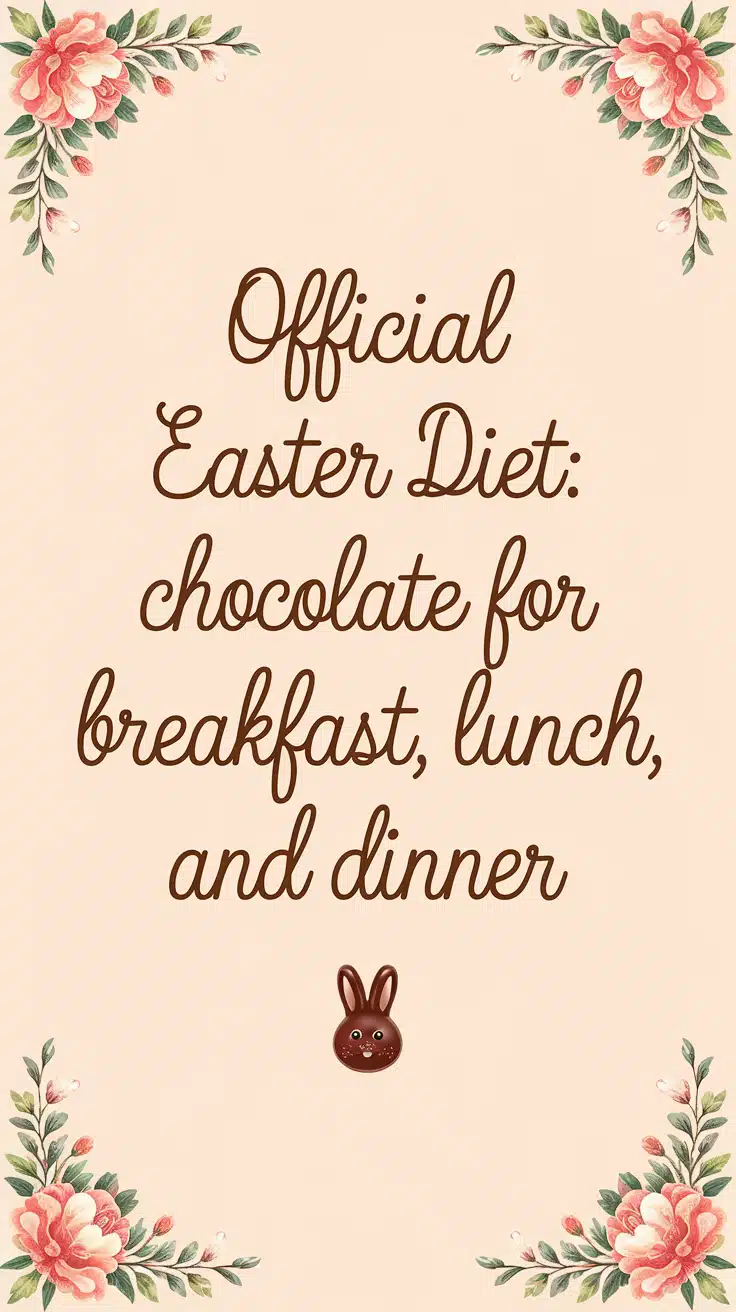
“I’m on a strict Easter diet: chocolate in both hands at all times.”
“If only the Easter Bunny delivered coffee too!”
“Who needs an Easter bonnet when you can have a chocolate coma instead?”
“Easter: The best excuse to eat candy straight out of plastic grass.”
“I’m just here for the jelly beans and bad bunny puns.”
Cavities Blamed on the Holiday
Peeps are one of those Easter traditions that defies rational explanation. They are marshmallow, primarily, shaped into chicks or bunnies and coated in colored sugar, and they inspire a level of devotion in some people and bafflement in others that seems disproportionate to what they actually are. And yet every Easter they reappear, proudly displayed, consumed in quantities that would alarm a nutritionist, and defended fiercely by their fans. That’s a holiday tradition doing exactly what it’s supposed to do.
The adult relationship with Easter candy has a particular flavor of guilty self-awareness to it. You know you’re eating too much. You know the kids were theoretically the intended recipients. You know this basket is technically not yours. And yet. The humor that plays with this mild self-incrimination — the jokes about stolen eggs and competitive candy acquisition — works because the guilt is never real enough to actually stop anyone. Easter candy is its own absolution.
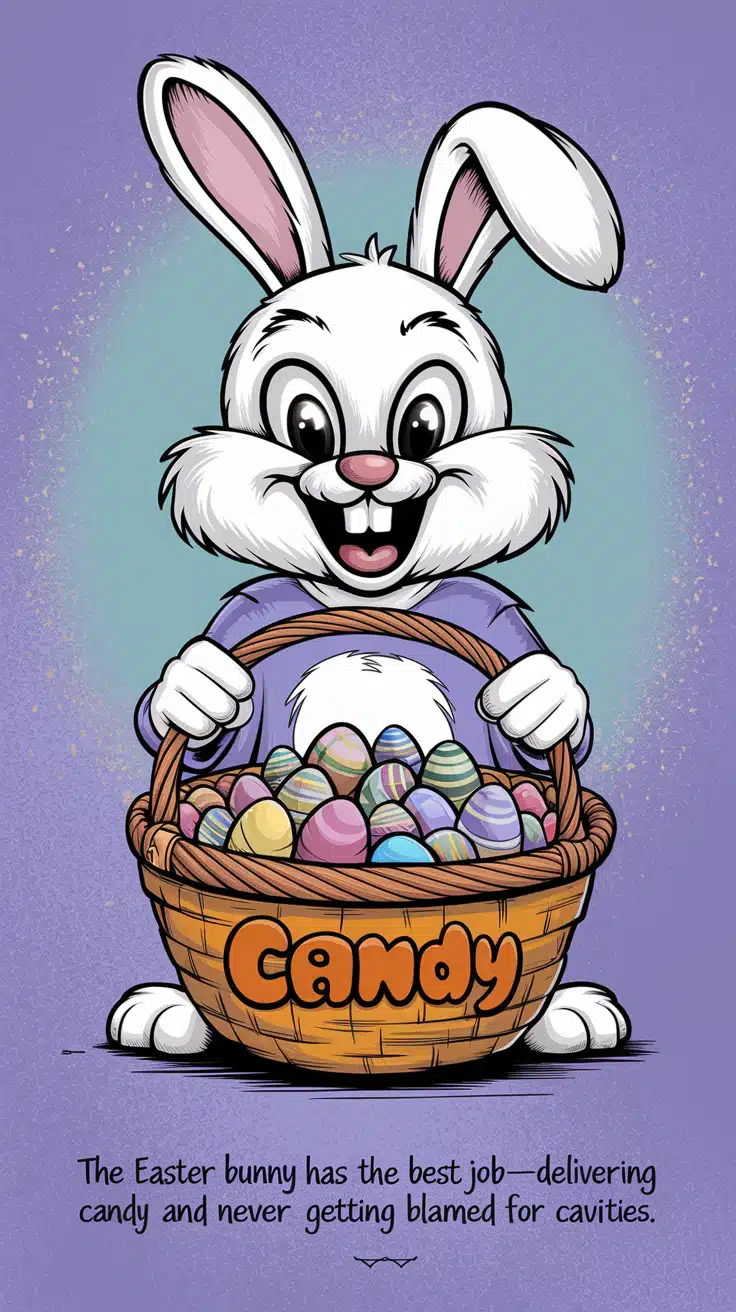
“Easter: That magical time when peeps suddenly become a food group.”
“Egg hunts: The one time it’s okay to steal from little kids.”
“Why do we hide eggs on Easter? Because good luck hiding chocolate from me!”
“I think I’m part bunny… I just keep multiplying the chocolate in my basket!”
“You know you’re an adult when you have to buy your own Easter candy.”
In Defense of the Chocolate Bunny
The chocolate bunny occupies a specific and beloved place in Easter tradition. It arrives in the basket looking dignified, sometimes wearing a ribbon, holding its shape with a certain quiet confidence — and within minutes of being discovered, someone has eaten the ears. This is apparently always how it goes. Nobody starts with the feet. Nobody nibbles gently from the side. The ears go first, every time, and the bunny is diminished in stages throughout the day until only a chocolate torso remains somewhere near a TV remote.
There is a genuine hierarchy of Easter candy opinions, and people hold them with conviction. The Cadbury egg faction is large and vocal. The Reese’s peanut butter egg contingent is equally committed. Jelly bean preferences break down by flavor in ways that can genuinely divide households. Peeps have both devoted fans and baffled detractors. This level of candy tribalism, applied to a spring holiday involving a fictional rabbit, is part of what makes Easter so reliably funny.
“Bunnies are cute and all, but let’s talk about the real MVP—Cadbury eggs.”
“I don’t need an Easter basket, just hand me a giant bag of chocolate.”
“Hopelessly devoted… to chocolate.”
“I’m on an Easter egg diet—if I see one, I eat it.”
“Would it be weird to send the Easter Bunny a thank-you note?”
Chocolate Involved, Dignity Optional
Easter has a way of reducing otherwise composed adults to their most instinctive candy-seeking state. The egg hunt, in particular, brings out a competitive edge that most people didn’t know they had until they found themselves hip-checking a seven-year-old for a plastic egg with a Reese’s cup in it. There is no shame in this. The holiday creates the conditions, and the conditions are what they are.
Easter also has a particular talent for producing memorable moments that are undignified in the best possible way. The sugar crash that hits around 2 PM. The chocolate stain that appears on someone’s good clothes before noon. The basket that started with a tasteful arrangement and ended up as a pile of wrappers. These are not failures of planning. They are simply Easter doing exactly what Easter does, and they make for excellent material.
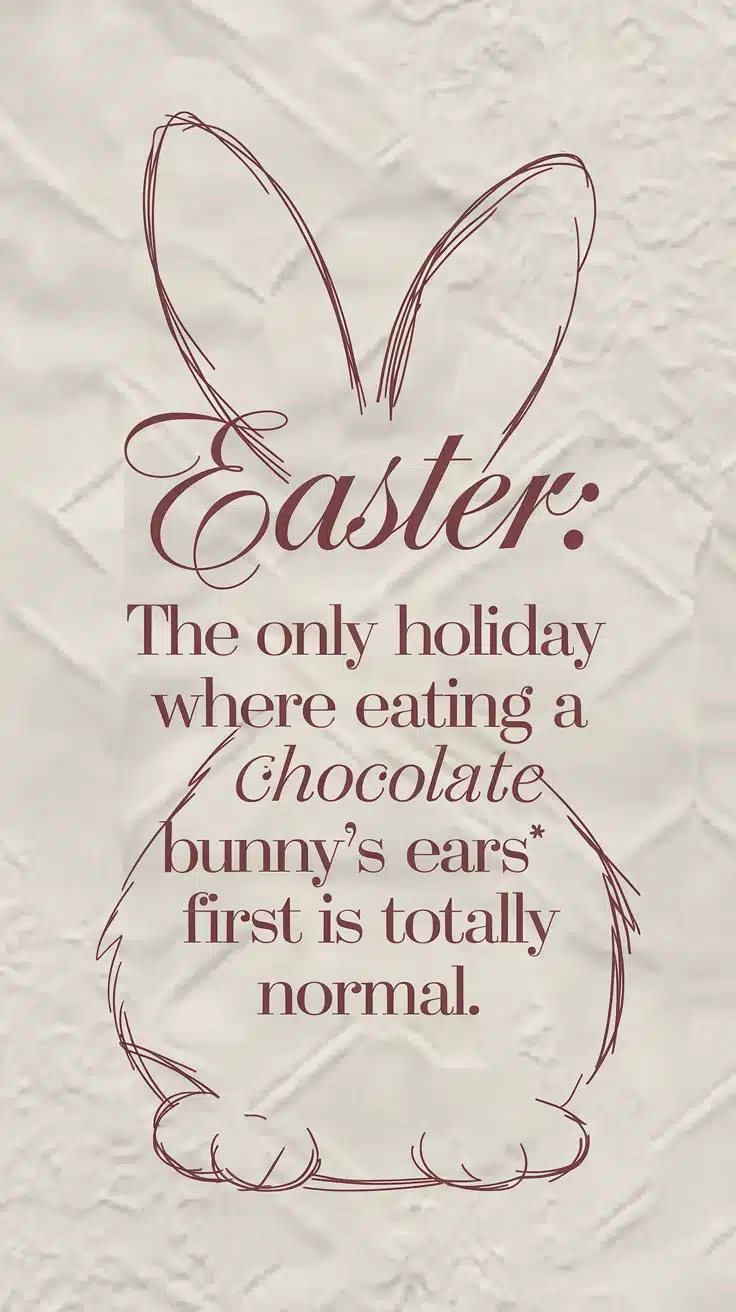
“Easter is the only time it’s acceptable to eat someone’s ears first.”
“Egg-cellent news: I found all the candy before the kids!”
“Nothing says Easter like a sugar rush and a chocolate-stained face.”
“Remember: You’re never too old for an Easter egg hunt or too young for a sugar crash.”
“Some people run marathons, I run towards Easter candy sales.”
Easter Calories Don’t Count (Allegedly)
There is a widely held, entirely unscientific belief that holiday calories operate under a different set of rules than regular calories. Easter is a particularly strong case for this theory. It is a Sunday. It is a holiday. The chocolate was provided by a supernatural rabbit. Under these conditions, the normal accounting simply doesn’t apply — or at least that’s the reasoning that allows people to eat a Cadbury egg before they’ve had breakfast and feel absolutely fine about it.
The humor around Easter and healthy eating has a particular warmth to it because everyone is in on the joke. Nobody actually believes they’re going to eat well on Easter. The basket is right there. The chocolate is real. Any wellness intentions that survived Holy Week quietly dissolve sometime around 8 AM on Sunday, and the rest of the day is conducted in a spirit of cheerful surrender. There’s something genuinely freeing about that, and the jokes that play with it capture the mood perfectly.
“I was going to be healthy today, but then the Easter Bunny showed up.”
“I have a strong suspicion that my Easter basket is just my grocery list in disguise.”
“Easter: The official start of my chocolate hoarding season.”
“That moment when you realize the Easter Bunny is just your parents with a sweet tooth.”
“Easter egg hunts prepare kids for Black Friday shopping.”
The Egg Hunt: A Competitive Sport
The Easter egg hunt is one of those traditions that sounds gentle and pastoral — children skipping through a garden, discovering colorful eggs, filling their baskets with innocent delight — and then the starting whistle goes and it becomes something else entirely. Adults who swore they’d let the kids win find themselves calculating angles. Children who seemed distracted reveal hidden strategic reserves. Someone always cries. It’s a wonderful chaos every time.
The thing about an egg hunt is that it activates something primal. The scarcity, the competition, the ticking clock — it turns a backyard into a very low-stakes but surprisingly intense arena. People who are otherwise mild and reasonable become extremely focused. The jokes about taking egg hunts too seriously resonate because almost everyone, at some point, has caught themselves being slightly too invested in finding a plastic egg filled with candy. There is no judgment here. Only solidarity.
“I put the ‘hop’ in ‘hopelessly addicted to chocolate’.”
“Easter: The holiday where eating candy for breakfast is not only accepted but encouraged.”
“My Easter resolution? Eat more chocolate.”
“Warning: My Easter basket may contain more candy than legally recommended.”
“I think I found my true calling: professional Easter egg hunter.”
Eating Before Noon: A Holiday Tradition
One of Easter morning’s defining features is that the candy arrives before the day has properly started. The basket is there when you wake up. The eggs are hidden throughout the house. The chocolate bunny is already making eye contact from the kitchen table. Under these conditions, a reasonable person cannot be expected to make responsible food choices. The holiday has structurally ensured that sugar is the first thing consumed, and there is a certain freedom in accepting that.
Easter jokes about food timing tend to work because they acknowledge a universal truth: the regular rules around when and how much to eat simply do not apply on this particular Sunday. The holiday suspends normal judgment, and the humor that plays with that suspension — the jokes about candy marathons, the mock confessions about what was consumed before coffee — gives people permission to laugh at themselves without actually feeling bad about any of it.
“Roses are red, violets are blue, Easter means candy, and I want it all too!”
“I asked for a fitness challenge, the Easter Bunny gave me a candy marathon.”
“My Easter motto: ‘One more chocolate egg won’t hurt’.”
“Life’s too short to say no to Easter candy.”
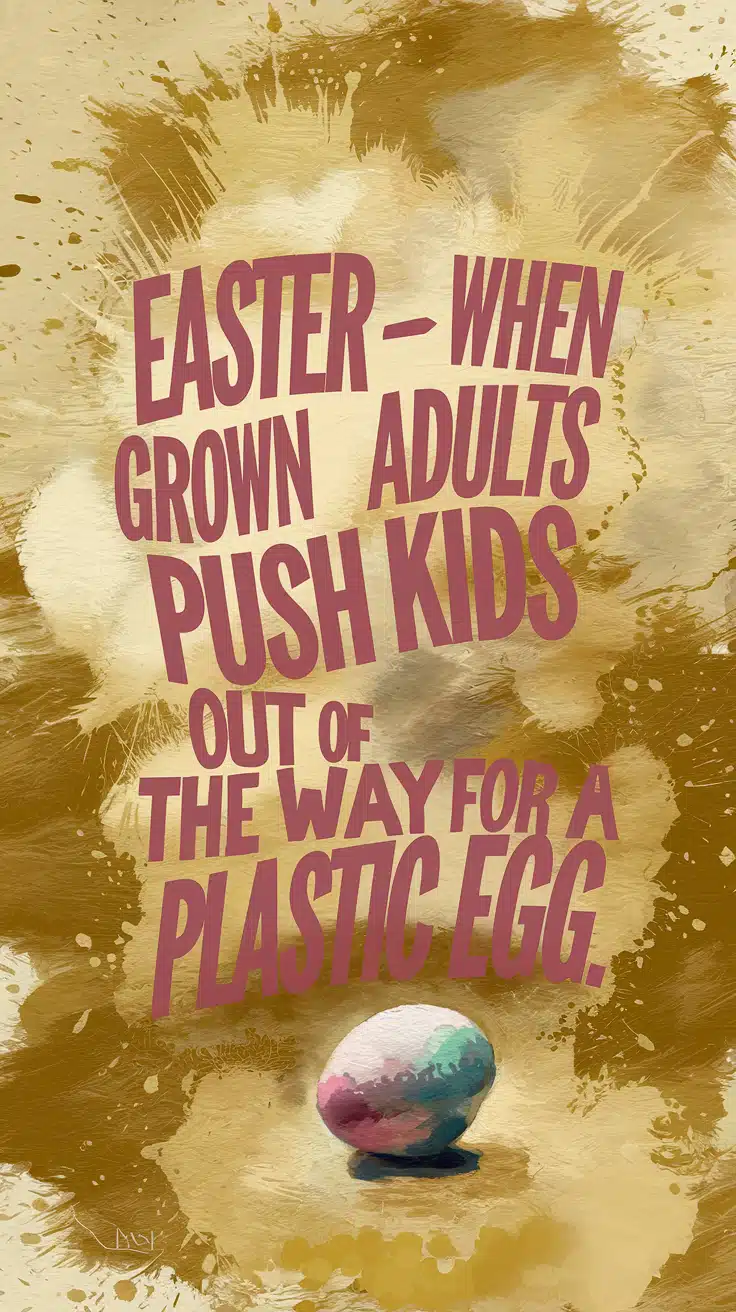
“You know you’re competitive when you push kids aside for Easter eggs.”
Egg-stra Everything This Easter
Easter puns occupy a specific and cherished niche in the holiday humor canon. The egg vocabulary alone — egg-cited, egg-cellent, egg-stra, egg-sactly — provides nearly unlimited material for jokes that are simultaneously groan-worthy and genuinely enjoyable. A good egg pun doesn’t try too hard. It arrives, does its job, and moves on, leaving a small smile behind. That’s a respectable contribution to a holiday gathering.
There is a specific pleasure in a pun that commits to itself without apology. The best Easter wordplay knows exactly what it is — cheerful, a little corny, made for people who are already in a good mood and just want something to laugh at. Shared with the right person at the right moment, a well-timed Easter pun can be the best joke of the day. Especially if that day also involves significant quantities of chocolate.
“Chocolate doesn’t ask silly questions, chocolate understands—especially on Easter!”
“Why do I suddenly have more plastic eggs than socks?”
“Easter is just an excuse to test how many chocolate bunnies you can eat in a day.”
“Why is it called an Easter ‘egg’ hunt? It should be an Easter ‘chocolate’ hunt!”
“It’s not Easter until you’ve eaten your body weight in candy.”
What’s in the Basket (All of It)
The Easter basket is a cultural institution. It arrives filled with plastic grass that will be found in the carpet for the next three months, an assortment of candy that reflects someone’s very specific preferences, and occasionally a small toy or book that everyone ignores in favor of the candy. It is an object that somehow manages to feel abundant regardless of what’s actually in it, and people have strong feelings about what constitutes a proper one.
Adults assembling Easter baskets for themselves — which is a growing and entirely justified practice — tend to make extremely honest purchasing decisions. The basket contains what they actually want, in the quantities they actually prefer, without any compromise to small people with different candy opinions. This is one of the underrated advantages of adulthood, and Easter is a fine occasion to embrace it without apology.
“Someone hide my scale. It’s Easter season.”
“I don’t chase dreams, I chase chocolate bunnies.”
“If you need me, I’ll be recovering from my Easter sugar crash.”
“Easter is like Halloween but in pastel colors.”
“If I had a dollar for every chocolate egg I ate, I’d buy more chocolate eggs.”
Chocolate Is a Girl’s Best Friend
Post-Easter is a real phenomenon — the particular state of a person who has eaten more candy than was strictly advisable and now exists in a gentle haze somewhere between satisfied and horizontal. It has its own texture: the slightly sticky fingers, the wrappers that need to be quietly relocated, the unspoken agreement among family members not to mention what just happened. Easter naps are not accidental. They are the natural conclusion of the Easter experience.
The humor that plays with the aftermath of Easter candy consumption works because it’s so recognizable. The sugar crash. The moment of reckoning with the basket. The optimistic thought that you’ll be more restrained next year, filed alongside similar resolutions that have never once been kept. Easter makes the same promises it always does, and people accept them every time, and everyone ends up in the same affectionate pile of wrappers. That’s tradition.
“They should have a post-Easter nap holiday. I’m exhausted from all the eating.”
“When life gives you lemons, trade them for chocolate eggs.”
“I’m too egg-stra for my own good this Easter.”
“The only Easter workout I’m doing is lifting chocolate eggs to my mouth.”
“Chocolate eggs: because regular eggs just don’t cut it.”
The Easter Bunny Knows Your Handwriting
There is a moment in every child’s Easter experience when they notice something. The handwriting on the card from the Easter Bunny looks familiar. The basket was assembled with suspiciously specific knowledge of their preferences. The hiding spots correspond exactly to places their parents know well. The fiction begins to develop cracks, but the candy is still real, and the morning is still magical, and most kids make a quiet decision to table the investigation for now.
Adults on the other side of this transaction — the ones doing the hiding, the basket-assembling, the late-night plastic egg filling — have their own perspective on the whole operation. It involves staying up past a reasonable hour, miscounting the eggs, forgetting where at least two of them are, and hoping that the pajamas are good enough for the photo that will inevitably be taken. The magic is real, but the logistics are decidedly unglamorous. That gap is excellent comedy.
“My Easter outfit? Pajamas covered in melted chocolate.”
“At my age, I should be hiding my chocolate eggs from myself.”
“The best Easter surprise? Finding chocolate you forgot about.”
“Chocolate before breakfast? Easter says it’s okay!”
“Who needs a golden egg when you have golden chocolate wrappers?”
No Quitter When It Comes to Candy
There is a particular kind of Easter commitment that gets activated once the basket is in hand. It’s the commitment that says: this candy will not be rationed. This chocolate will not be saved for later. One does not strategically manage an Easter haul — one engages with it fully and immediately, with both hands, and deals with the consequences somewhere around mid-afternoon. This is not a character flaw. It is a reasonable response to the circumstances the holiday creates.
The Easter spirit, at its most honest, is one of joyful excess. Not recklessness, but a genuine willingness to set aside the usual measurements and just enjoy what’s in front of you. Candy eaten from a basket on Easter morning, surrounded by people you like, in the particular light of an April Sunday, is one of the small, uncomplicated pleasures that life reliably provides. The jokes that celebrate this excess are really celebrating that pleasure — and there’s nothing wrong with that at all.
“Easter baskets: Because adulting is overrated.”
“I follow a strict Easter routine: eat, nap, repeat.”
“Chocolate bunnies never judge you—be more like a chocolate bunny.”
“Bunny ears and candy bars—that’s my kind of Easter.”
“I just realized my Easter basket is mostly made up of my own purchases.”
One Egg Is Never Enough
Easter candy operates under a logic that defies normal restraint. One chocolate egg leads to another with a speed and inevitability that seems almost physics-based. The basket, which looked substantial when you started, always looks smaller by mid-morning. The wrappers accumulate. The plastic grass develops an archaeological record of what was there and is no longer there. This is not a failure of willpower. It’s just Easter doing what Easter does.
The jokes about Easter candy quantities work because they’re rooted in shared experience rather than individual excess. Almost nobody who has ever had unsupervised access to an Easter basket has come out the other side feeling like they showed great restraint. The holiday is designed to be indulgent, the candy is designed to be compelling, and the combination is reliably effective every single year. The humor is just the honest acknowledgment of that.
“If I keep eating Easter candy at this rate, I’ll need a bigger basket… and pants.”
“An egg hunt is just cardio in disguise.”
“I work out just so I can eat unlimited Easter candy guilt-free.”
“Today’s forecast: 100% chance of chocolate.”
“Easter candy is the answer. Who cares what the question is?”
What’s Inside the Plastic Egg
The plastic egg is Easter’s most democratic object. It can hold anything — a coin, a jelly bean, a folded dollar bill, a small note, a single M&M that rolls out and disappears into the grass — and regardless of what’s inside, the act of finding and opening it produces genuine satisfaction. This is partly the egg hunt doing its work, and partly something more fundamental: people like small surprises. They like the moment just before the reveal. Easter has industrialized that pleasure and filled it with candy, and that is an achievement worth appreciating.
The competitive dimension of the egg hunt is well-documented in family lore across generations. There is always someone who takes it seriously. There is always a hiding spot that turns out to be too good and produces an egg that isn’t found until June. There is always a post-hunt negotiation about fairness that reveals more about family dynamics than anyone particularly wanted to know. It’s a wonderful tradition, and the humor that surrounds it is almost all affectionate.
“Egg hunting: The sport I was born to dominate.”
“I can’t adult today, I’m too busy being an Easter bunny in disguise.”
“Easter makes me question my priorities: fitness or candy? Candy wins.”
“Bunnies and chocolate—what else do we need in life?”
“Easter baskets: Because carrying chocolate in your pockets is frowned upon.”
Rotten Luck if You Find the Last Egg in July
Hiding Easter eggs with genuine enthusiasm and then immediately forgetting where you put several of them is a rite of passage for Easter hosts everywhere. The hunt ends, the children disperse, the adults congratulate themselves on the execution — and then someone opens a cabinet in August and finds a slightly mysterious plastic egg behind the soup cans. These discoveries are always treated as minor victories, a small bonus round from a holiday that already gave so much.
Easter as an extreme sport is a comedic framing that captures something true about how the holiday actually feels in a family with young children. The logistics are considerable. The timeline is compressed. Someone is always up earlier than expected. The basket assembly happens at an hour that should not exist. And yet somehow it comes together every year, the magic lands, and the chaos is retrospectively worth it. That gap between the messy reality and the cherished outcome is the whole joke.
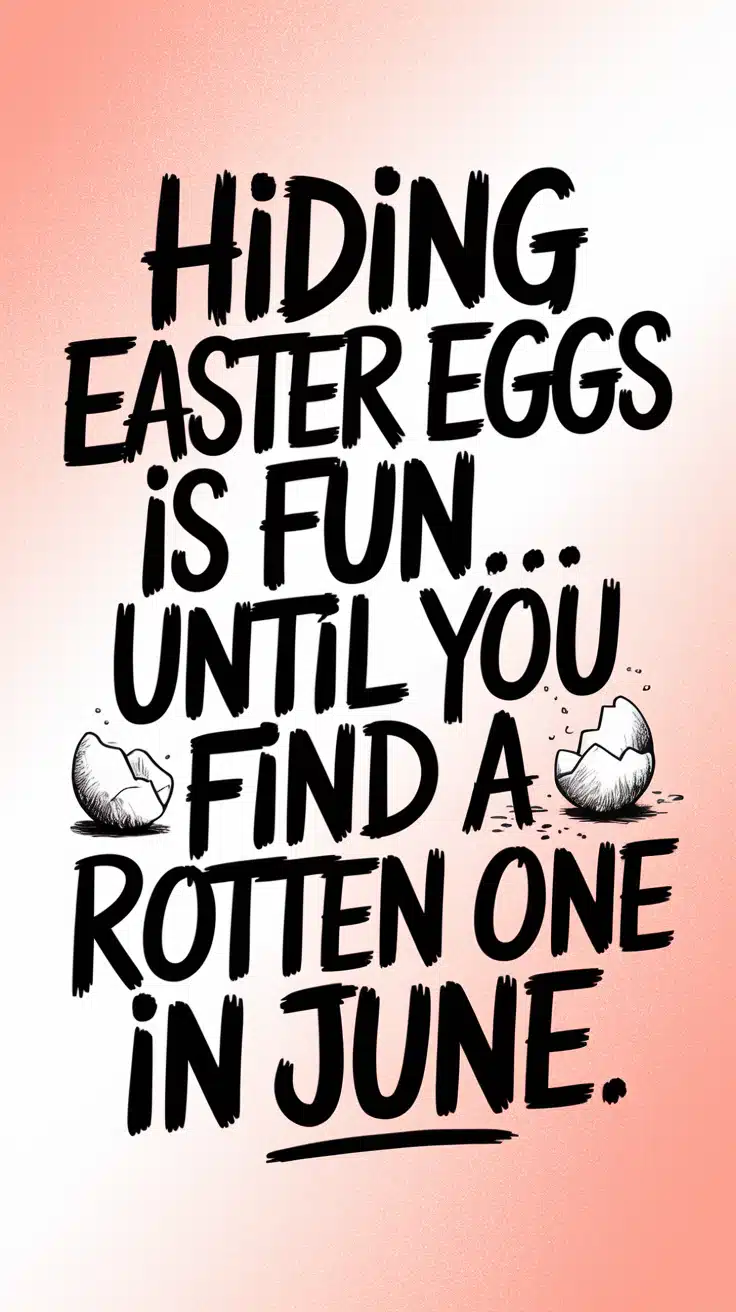
“Hiding Easter eggs is fun—until I forget where I put them.”
“Step aside, kids—I take my egg hunts seriously!”
“Bunny ears on, responsibilities off. Let’s do this, Easter!”
“Warning: Excessive Easter candy may result in extreme happiness.”
“Bunnies are fast, but I’m faster when it comes to candy.”
Share the Chocolate (Or Don’t)
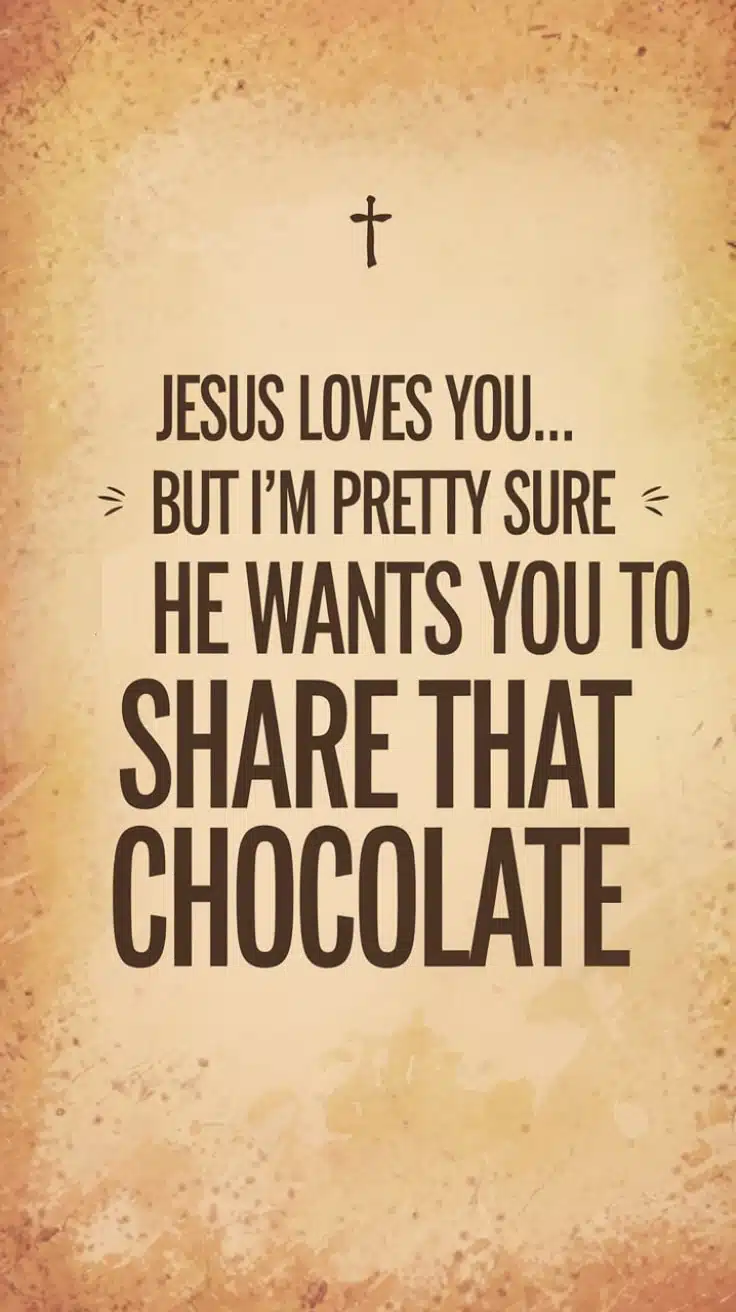
Easter candy sharing exists on a spectrum. At one end: the generous person who sets out a communal bowl and waves everyone in. At the other: the person who has identified a specific hiding spot in their home and is not discussing it. Both approaches are valid. Easter candy is personal, and the decisions people make about it reveal something about their relationship to abundance, scarcity, and the question of whether chocolate counts as a love language. It does.
The jokes about Easter candy and therapy are perennial because they tap into something real: certain foods carry a comfort that’s hard to explain but easy to feel. Easter candy specifically — the seasonal versions, the ones that only appear for a few weeks a year — carries an extra charge. Its limited availability makes each piece feel more significant. The jokes that acknowledge this are really acknowledging something true about why people love the holiday so much. It shows up, it’s abundant, it’s sweet, and then it’s gone. Until next year.
“Easter: The only holiday where it’s acceptable to eat a chocolate bunny’s face off.”
“Egg hunting: The original extreme sport.”
“Easter candy is cheaper than therapy!”
“One does not simply eat just one chocolate egg.”
“I trained my whole life for this Easter candy haul.”
The Six-Pack That Wasn’t
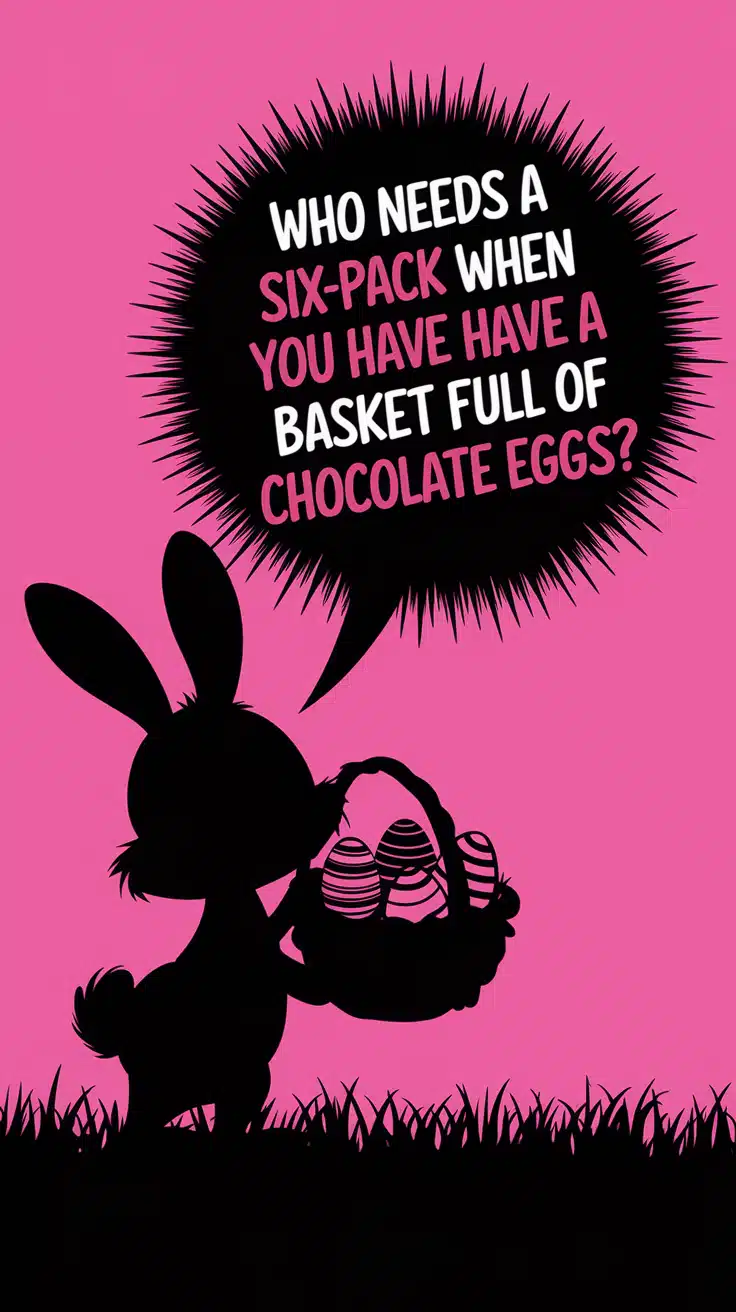
Easter and fitness have a long, complicated relationship. January’s resolutions are still technically in play by April, but they’re being renegotiated in real time as the candy selection comes into focus. The gym exists. The basket also exists. These are not compatible goals in the short term, and Easter has a way of clarifying which one is going to win for the day. Most people make their peace with this fairly quickly, and the jokes that play with that surrender have a warmth and self-awareness that makes them land well.
The Easter love language jokes work because they’re true in a way that doesn’t require qualification. Chocolate on Easter morning, given or received, does communicate something. It says: I thought of you. I know what you like. I wanted you to have something good today. That’s a real message, delivered in an edible format, and there’s nothing wrong with taking it seriously. The holiday has been making this argument for decades, and it’s a compelling one.
“Chocolate is my love language, especially on Easter.”
“I run on chocolate and Easter spirit.”
“May your Easter be egg-ceptionally sweet!”
“Do I have an Easter candy addiction? Egg-sactly!”
“I need an Easter basket upgrade—this one’s too small for my candy stash!”
Stealing From Kids: An Easter Tradition
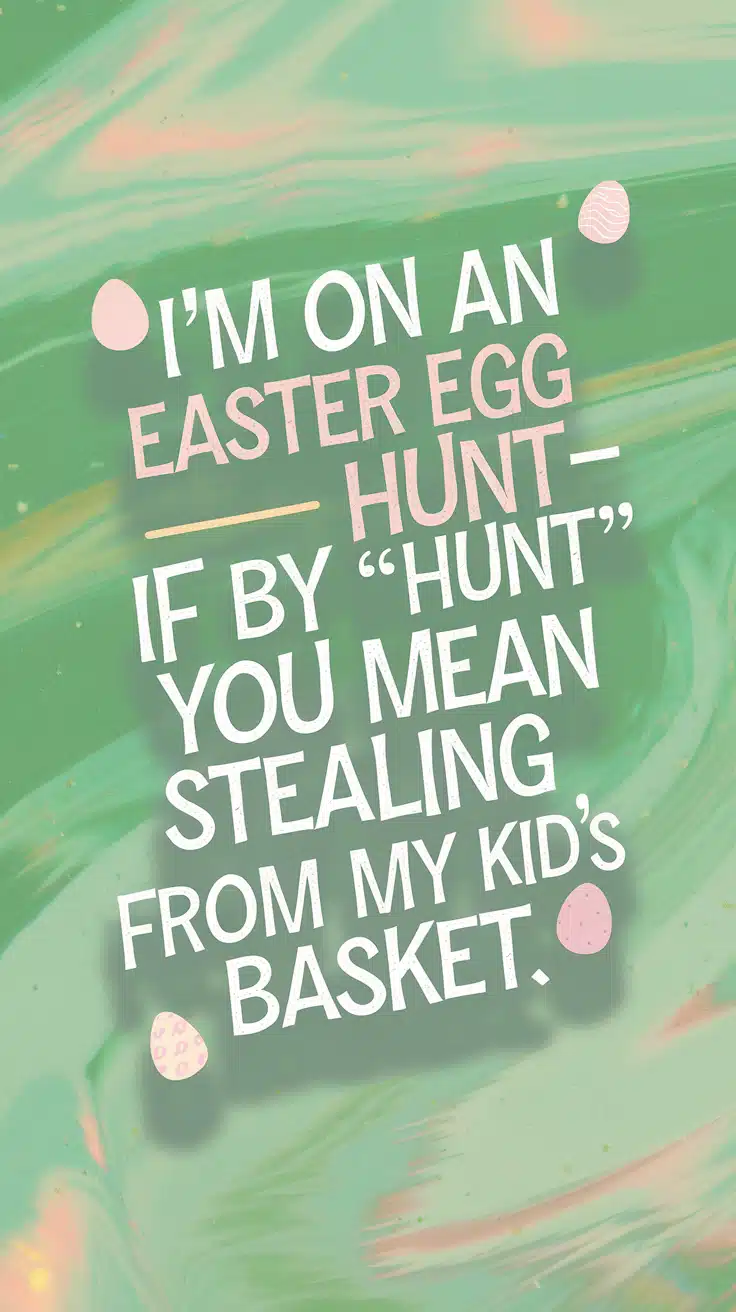
The dynamic between adults and Easter candy belonging to children is one of the holiday’s most reliable comic territories. The candy is technically for the kids. The adults bought the candy. The adults also hid the candy. The adults are also standing in the kitchen eating from a bag of Easter M&Ms that may or may not have been designated for a basket. These are the compromises of the season, and they are widely made and widely understood.
What makes Easter humor so reliably good is that it never takes itself too seriously. The jokes are warm, the targets are usually oneself, and the overall tone is one of affectionate self-incrimination rather than genuine critique. Nobody actually feels bad about the Easter candy situation. The laughter is the sound of people enjoying a holiday that’s cheerful by design, filled with things that taste good, and surrounded by people they like. That’s a holiday doing its job well.
“The Easter Bunny’s real talent? Getting me to eat way too much sugar.”
“Easter magic = chocolate in unlimited supply.”
“Why limit Easter candy to one day? I say we make it a season!”
“I’m not saying I stole Easter eggs from my niece, but… I definitely won.”
“The Easter Bunny knows me too well—he left me nothing but chocolate!”
The Whole Basket, Every Year
Easter humor works because it’s grounded in affection — for the holiday, for the traditions, for the slightly absurd rituals that people repeat every year knowing exactly how they’ll end. Nobody is surprised by the sugar crash. Nobody is shocked that the chocolate bunny is gone by noon. Nobody genuinely thought they’d leave the egg hunt with any restraint intact. The jokes about all of this are the sound of people enjoying themselves enough to laugh at their own predictability.
There is something quietly lovely about a holiday that produces the same jokes year after year and people still laugh. The Easter candy jokes are not new. The egg hunt competition material has been around for generations. The “I was going to be healthy but then the basket happened” observation has been made by roughly every adult who has ever celebrated Easter. And yet the jokes still land, still get shared, still make people smile — because they’re true every single time.
What Easter humor actually celebrates, underneath the egg puns and chocolate jokes, is the pleasure of doing the same things with the same people in the same spirit year after year. Traditions are funny because they’re so reliably themselves. You already know the egg hunt will get competitive. You already know the chocolate will be gone faster than seemed possible. You already know someone will be wearing bunny ears longer than is strictly necessary. The knowing is part of the joy.
A good Easter quote, funny or otherwise, does the same thing a good tradition does: it creates a small moment of shared recognition. Someone reads it and thinks yes, that’s it exactly. That’s the thing I couldn’t quite say about this holiday that I love. The best jokes aren’t just funny — they’re accurate. They describe something real about a specific human experience, and in doing so, they make the people who recognize themselves in it feel a little less alone in their candy consumption habits.
So whether you’re sending these to someone who will immediately understand, posting one as a caption for the photo of the basket, or just reading through them on a quiet Sunday morning with a chocolate egg in hand — the hope is that something in here felt true. Easter is one of the warmer holidays, and laughter is one of the warmer ways to spend it. The two go together well, and they always have.