
Just so you know – some links on this page are affiliate links. If you click and buy something, I may earn a small commission (think coffee money, not a luxury vacation) at no extra cost to you. I only share things I genuinely like and believe are worth it. Thanks for supporting this little corner of the internet – it really helps keep everything running.
Sports compress time in a way that ordinary life rarely does. In the space of a single game, a single race, a single moment of competition, years of preparation meet the unpredictability of the present — and what happens in that collision tends to reveal something true about the person experiencing it. That is part of why the words that come out of sport carry a particular weight. They are not spoken in comfort. They are earned.
Athletes and coaches spend their careers navigating a world governed by effort and outcome, by the gap between what a person wants and what they can actually produce under pressure. That experience — repeated across thousands of practices and competitions — tends to produce a certain kind of clarity. The people who spend a lifetime in sport often end up saying things that go well beyond the game they are describing.
What makes these words endure is that they speak to something universal. Most of us will never play at the highest level of any sport, but we all know what it is to face a challenge that feels too large, to fail at something that mattered, to wonder whether the effort is worth continuing. The competitive arena simply makes these experiences visible in a way that everyday life often does not.
The voices gathered here come from different sports, different eras, different parts of the world. A boxer and a basketball coach and an Olympic swimmer do not have obvious reasons to sound alike, and yet something runs through what all of them have said — a shared reckoning with difficulty, a shared insistence that character matters more than circumstance. That convergence is worth paying attention to.
Sport also has a particular relationship with failure that sets it apart from most other human endeavors. Losing is built into the structure of competition — even the greatest athletes lose regularly, often publicly. The ones who last are not the ones who avoid failure but the ones who have learned to carry it differently, to let it inform rather than define them. That lesson shows up again and again in the words they leave behind.
The ten themes explored here — from perseverance to legacy, from mental toughness to sportsmanship — represent the full breadth of what sport has to teach. Taken together, they amount to something close to a philosophy of effort: what it requires, what it costs, what it gives back, and why, for so many people across so many generations, it has been worth pursuing anyway.
Perseverance & Determination
Perseverance is not a dramatic quality. It does not announce itself the way talent does. It shows up quietly, in the decision to continue when stopping would be easier, in the willingness to return to something that has already hurt you more than once. In sport, that quality gets tested repeatedly and in public — which is perhaps why athletes have more to say about it than almost anyone else.
What separates those who endure from those who do not is rarely a matter of raw ability. It is more often a question of what a person is willing to do when the effort stops feeling rewarding, when the progress is invisible, when the outcome is genuinely uncertain. The capacity to keep going under those conditions — not with certainty but despite its absence — is the thing that competitive sport demands above almost all else.
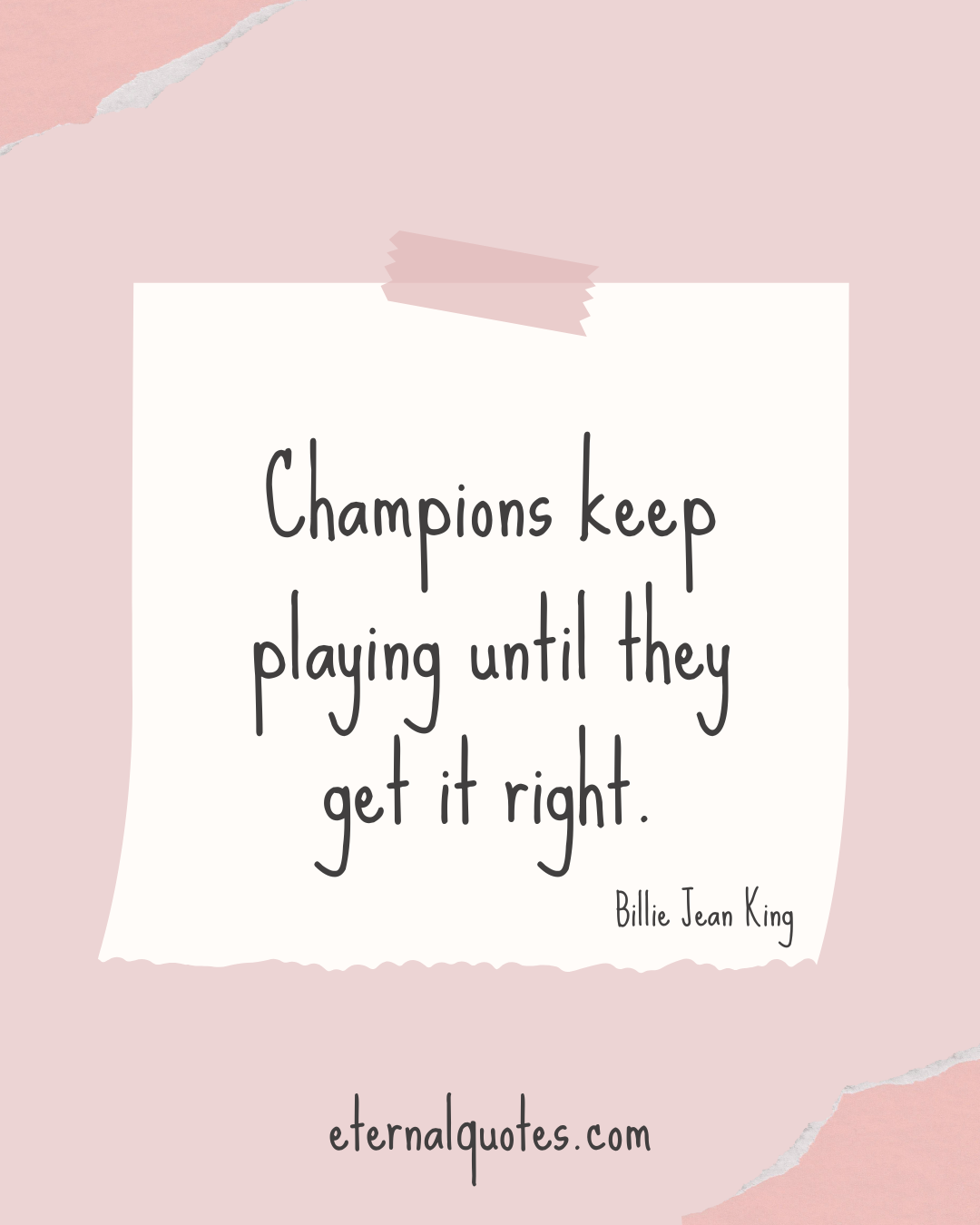
“It’s not whether you get knocked down; it’s whether you get up.” – Vince Lombardi
“The difference between the impossible and the possible lies in a person’s determination.” – Tommy Lasorda
“If you can believe it, the mind can achieve it.” – Ronnie Lott
“When you fall, get right back up. Just keep going, keep pushing it.” – Lindsey Vonn
“The road to athletic greatness is not marked by perfection but by the ability to overcome adversity.” – Diana Golden
“The more difficult the victory, the greater the happiness in winning.” – Pelé
“There may be people that have more talent than you, but there’s no excuse for anyone to work harder than you do.” – Derek Jeter
“Don’t give up. Don’t ever give up.” – Jim Valvano
“Mental toughness is finding fuel when the tank is empty.” – Kyle Chandler
“Persistence can change failure into extraordinary achievement.” – Matt Biondi
Looking for Good K-Beauty?
MISSHA has a huge range of Korean skincare and makeup, including some seriously popular bestsellers.
Leadership & Teamwork
Leadership in sport is a strange and often misunderstood thing. It does not always belong to the loudest person or the best player on the field. More often it belongs to the person who understands what those around them need — when to push and when to ease off, when to speak and when to let the work do the talking. That kind of awareness takes time to develop, and it rarely arrives without first learning what it feels like to follow.
Teams that win consistently tend to share something that goes beyond athletic ability. They have found a way to make individual effort serve a collective purpose — to get each player to care about outcomes that extend beyond their own statistics and their own reputation. Building that kind of culture is the real work of leadership in sport, and the coaches and athletes who have done it well tend to describe it in remarkably similar terms: trust, sacrifice, and a willingness to let go of personal credit.
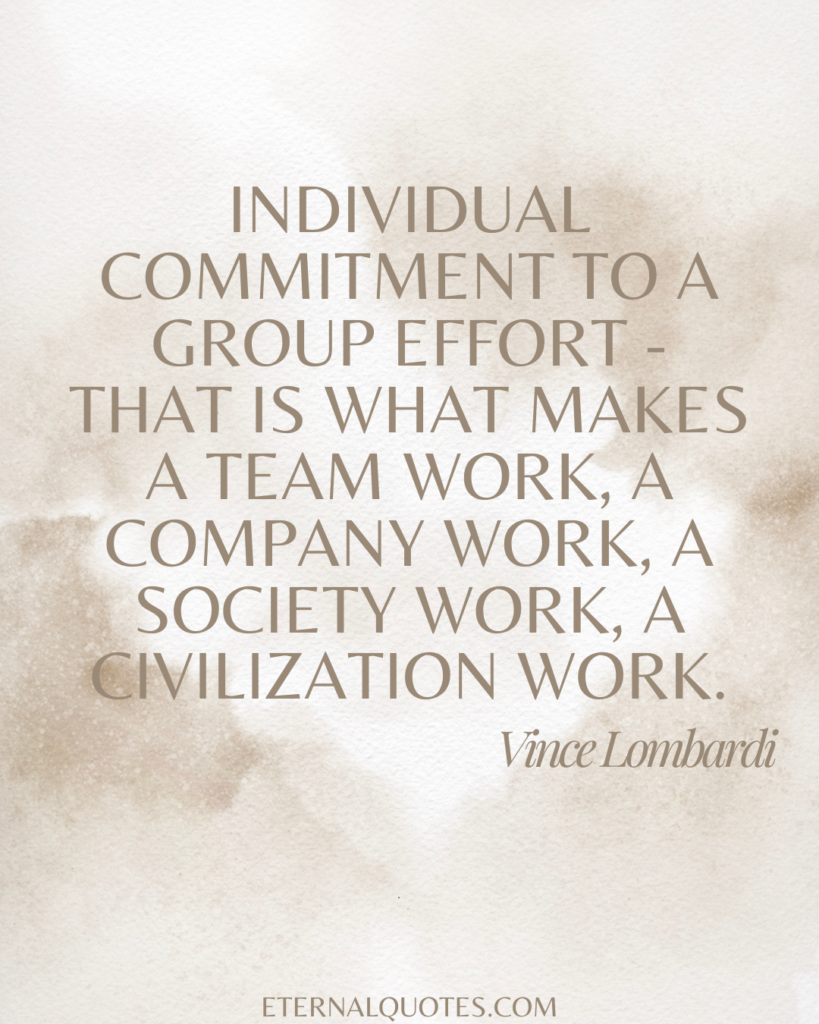
“Talent wins games, but teamwork and intelligence win championships.” – Michael Jordan
“A champion team will defeat a team of champions.” – John McGrath
“The strength of the team is each individual member. The strength of each member is the team.” – Phil Jackson
“If you want to go fast, go alone. If you want to go far, go together.” – African Proverb
“Unity is strength… when there is teamwork and collaboration, wonderful things can be achieved.” – Mattie Stepanek
“It is amazing how much can be accomplished when nobody cares who gets the credit.” – John Wooden
“The way a team plays as a whole determines its success.” – Babe Ruth
“A good leader inspires others with confidence in them; a great leader inspires them with confidence in themselves.” – Eleanor Roosevelt
“Great moments are born from great opportunities.” – Herb Brooks
“The real leader has no need to lead – he is content to point the way.” – Henry Miller
Mental Strength & Focus
The mental side of sport is the part that most people outside of competition underestimate. It is easy to appreciate physical ability — speed, strength, skill are visible and measurable. But the internal landscape of a competitor under pressure, the ability to stay composed when everything is on the line, to narrow attention to what is happening right now rather than what might happen next — that is harder to see and harder to develop.
Elite athletes spend considerable time and effort training their minds alongside their bodies, and for good reason. A physical capacity without the mental architecture to deploy it under pressure is an incomplete thing. The moments that define careers are rarely the ones where everything felt easy. They are the ones where the conditions were difficult and the person found a way to focus anyway — to set aside fear, fatigue, and doubt long enough to do what they had prepared to do.
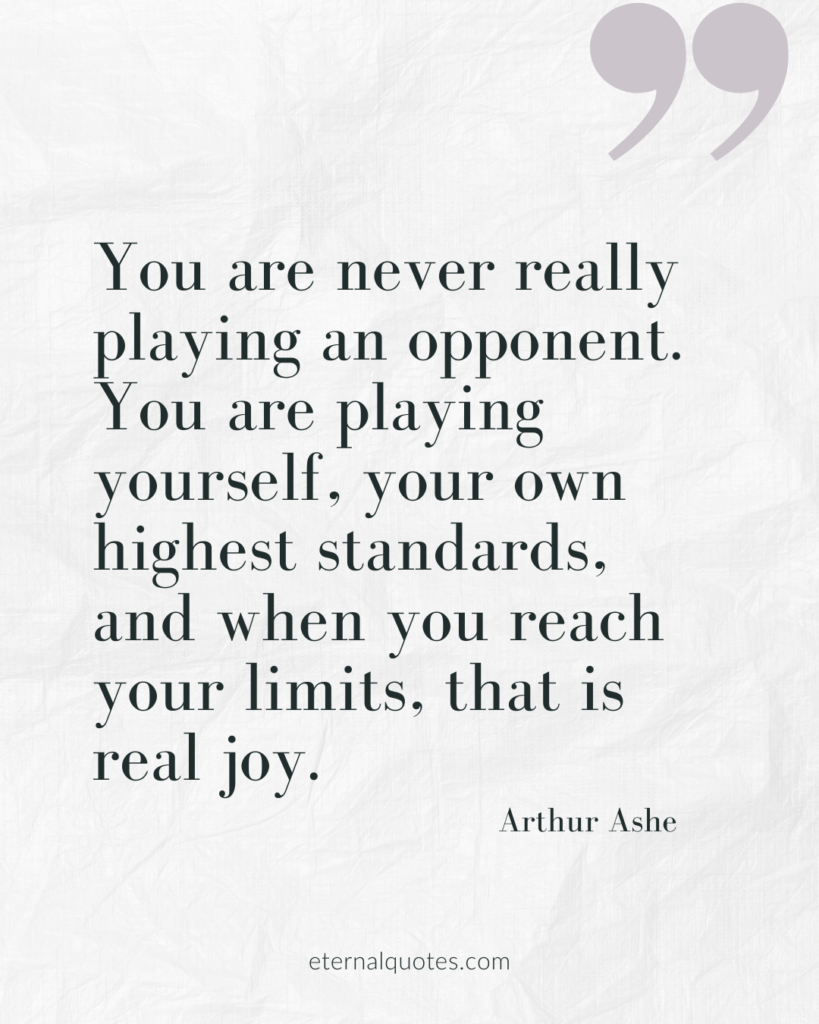
“What separates the good from the great is the mental game.” – Ken Griffey Jr.
“Concentration and mental toughness are the margins of victory.” – Bill Russell
“The mind is the limit. As long as the mind can envision you doing something, you can do it.” – Arnold Schwarzenegger
“Sports do not build character. They reveal it.” – Heywood Broun
“Adversity causes some to break; others to break records.” – William Arthur Ward
“The greatest weapon against stress is our ability to choose one thought over another.” – William James
“Competitive sports are played mainly on a five-and-a-half inch court, the space between your ears.” – Bobby Jones
“Winning isn’t everything, but wanting to win is.” – Vince Lombardi
“Focus on the journey, not the destination. Joy is found not in finishing an activity but in doing it.” – Greg Anderson
“Champions aren’t made in gyms. Champions are made from something they have deep inside them—a desire, a dream, a vision.” – Muhammad Ali
Preparation & Training
Most of what makes an athlete great happens before anyone is watching. The training sessions, the film study, the long mornings when motivation is low and the only thing moving a person forward is discipline — this is where performance is actually built. Competition is the test, but preparation is the education, and the two cannot be separated without consequence.
The best athletes tend to have a complicated relationship with the training process. It is rarely pleasant in the way that competing can be pleasant. It is repetitive, demanding, and often unrewarding in the short term. What keeps people at it — what makes the difference between someone who trains adequately and someone who trains in a way that compounds over years — is a genuine commitment to the process itself, independent of what it immediately produces.
“I hated every minute of training, but I said, ‘Don’t quit. Suffer now and live the rest of your life as a champion.'” – Muhammad Ali
“Excellence is not a singular act but a habit. You are what you do repeatedly.” – Shaquille O’Neal
“Practice does not make perfect. Only perfect practice makes perfect.” – Vince Lombardi
“To uncover your true potential you must first find your own limits and then you have to have the courage to blow past them.” – Picabo Street
“I’ve missed more than 9000 shots in my career. I’ve lost almost 300 games. 26 times, I’ve been trusted to take the game winning shot and missed. I’ve failed over and over and over again in my life. And that is why I succeed.” – Michael Jordan
“The only place where success comes before work is in the dictionary.” – Vidal Sassoon
“An athlete cannot run with money in his pockets. He must run with hope in his heart and dreams in his head.” – Emil Zatopek
“The principle is competing against yourself. It’s about self-improvement, about being better than you were the day before.” – Steve Young
“You can’t put a limit on anything. The more you dream, the farther you get.” – Michael Phelps
“Spectacular achievements are always preceded by unspectacular preparation.” – Roger Staubach
Victory & Success
Winning in sport is a complicated thing to talk about honestly. It is clearly worth pursuing — the drive to win is part of what makes competition meaningful — but those who have won at the highest levels tend to be the first to say that the outcome tells only part of the story. What a victory actually represents depends almost entirely on what went into it, on the quality of the preparation and the difficulty of the challenge overcome to get there.
The most enduring understanding of success in sport tends to be the one that broadens out from a single result. A scoreboard can tell you who won on a given day. It cannot tell you who competed with full commitment, who grew through the process, who will carry something useful from the experience into what comes next. Those things matter beyond any trophy, and the athletes who understand that early tend to have longer and more meaningful careers as a result.
“The glory is not in never falling, but in rising every time you fall.” – Confucius
“Never let the fear of striking out get in your way.” – Babe Ruth
“Gold medals aren’t really made of gold. They’re made of sweat, determination, and a hard-to-find alloy called guts.” – Dan Gable
“Success is no accident. It is hard work, perseverance, learning, studying, sacrifice and most of all, love of what you are doing.” – Pelé
“Victory belongs to the most persevering.” – Napoleon Bonaparte
“Never underestimate the heart of a champion.” – Rudy Tomjanovich
“Some people say I have attitude—maybe I do…but I think you have to. You have to believe in yourself when no one else does—that makes you a winner right there.” – Venus Williams
“Winning isn’t getting ahead of others. It’s getting ahead of yourself.” – Roger Staubach
“It’s not the will to win that matters—everyone has that. It’s the will to prepare to win that matters.” – Paul “Bear” Bryant
“The price of success is hard work, dedication to the job at hand, and the determination that whether we win or lose, we have applied the best of ourselves to the task at hand.” – Vince Lombardi
Overcoming Failure
Failure is not incidental to sport — it is built into its structure. Even the most decorated athletes in history lost more than they won, missed more shots than they made, fell short of the mark in ways that were public and sometimes humiliating. The question that competition keeps asking, over and over, is not whether a person will fail. It is what they will do when they do.
The athletes who have the most useful things to say about failure are usually the ones who experienced it in significant quantities before finding their footing. Failure at that scale is an education — it teaches a person what they are actually made of, where their real limits are, and whether their commitment to something is conditional on things going well. Those who come through that process intact tend to carry a composure that is very difficult to rattle.
“You can’t let praise or criticism get to you. It’s a weakness to get caught up in either one.” – John Wooden
“You win some, you lose some, and some get rained out, but you gotta suit up for them all.” – J. Askenberg
“Obstacles don’t have to stop you. If you run into a wall, don’t turn around and give up. Figure out how to climb it, go through it, or work around it.” – Michael Jordan
“The greatest glory in living lies not in never falling, but in rising every time we fall.” – Nelson Mandela
“When you lose a game you shouldn’t lose, examine your reasons and learn from your mistakes.” – Kareem Abdul-Jabbar
“If you’re trying to achieve, there will be roadblocks. I’ve had them; everybody has had them. But obstacles don’t have to stop you. If you run into a wall, don’t turn around and give up.” – Michael Jordan
“The hardest skill to acquire in this sport is the one where you compete all out, give it all you have, and you are still getting beat no matter what you do. When you have the killer instinct to fight through that, it is very special.” – Eddie Reese
“Show me someone who has done something worthwhile, and I’ll show you someone who has overcome adversity.” – Lou Holtz
“The greatest test of courage on earth is to bear defeat without losing heart.” – Robert Green Ingersoll
“Defeat is not the worst of failures. Not to have tried is the true failure.” – George Edward Woodberry
Inspiration & Motivation
Motivation is not a stable thing. It arrives and recedes, intensifies before a major event and fades during the long weeks of ordinary preparation. The athletes who perform consistently over many years tend to be the ones who have made peace with this — who have built routines and commitments that do not depend on feeling inspired, who show up when the motivation is absent as reliably as when it is present. That is a harder discipline than it sounds.
Inspiration, at its best, does something more than make a person feel energized in the moment. It shifts their sense of what is possible — it makes them reconsider where they have drawn their limits and why. The words of athletes and coaches who have genuinely pushed those limits themselves carry a particular credibility. They are not theorizing about what might be achievable. They are reporting back from somewhere they have actually been.
“Do not let what you cannot do interfere with what you can do.” – John Wooden
“Set your goals high, and don’t stop till you get there.” – Bo Jackson
“Never say never because limits, like fears, are often just an illusion.” – Michael Jordan
“Don’t be afraid of failure. This is the way to succeed.” – LeBron James
“Today I will do what others won’t, so tomorrow I can accomplish what others can’t.” – Jerry Rice
“The only one who can tell you ‘you can’t win’ is you, and you don’t have to listen.” – Jessica Ennis-Hill
“If you can’t outplay them, outwork them.” – Ben Hogan
“When you’ve got something to prove, there’s nothing greater than a challenge.” – Terry Bradshaw
“The expert in anything was once a beginner.” – Helen Hayes
“Age is no barrier. It’s a limitation you put on your mind.” – Jackie Joyner-Kersee
Character & Sportsmanship
How a person competes says something about who they are that a résumé or a conversation cannot always reveal. Sport has a way of bypassing the managed version of a person and getting to the underlying one — the one that shows up under pressure, that responds to unfairness, that either honors or abandons the agreed-upon terms of the contest when the stakes get high enough. That is why character and competition have always been linked in the way that they are.
Sportsmanship, at its core, is a commitment to competing in a way that respects both the opponent and the game itself. It is a recognition that the contest only has meaning if both sides are genuinely trying, that winning at any cost is not really winning at all. The athletes who embody it most fully tend to be those who understand that what they do on the field is a reflection of something larger than the outcome of any single competition.
“I’ve learned that something constructive comes from every defeat.” – Tom Landry
“You were born to be a player. You were meant to be here. This moment is yours.” – Herb Brooks
“One man practicing sportsmanship is far better than a hundred teaching it.” – Knute Rockne
“Sportsmanship for me is when a guy walks off the court and you really can’t tell whether he won or lost, when he carries himself with pride either way.” – Jim Courier
“In the end, it’s extra effort that separates a winner from second place. But winning takes a lot more than that, too. It starts with complete command of the fundamentals.” – Jesse Owens
“True champions aren’t always the ones that win, but those with the most guts.” – Mia Hamm
“Always make a total effort, even when the odds are against you.” – Arnold Palmer
“What makes something special is not just what you have to gain, but what you feel there is to lose.” – Andre Agassi
“I never left the field saying I could have done more to get ready and that gives me peace of mind.” – Peyton Manning
“Good, better, best. Never let it rest. Until your good is better and your better is best.” – Tim Duncan
Legacy & Impact
Legacy is a word that gets used often in sports, but it points to something genuinely worth thinking about. What an athlete leaves behind is not just their statistics or their trophy count — it is the impression they made on the people who watched them, the standards they set for those who came after, the way their example changed what others believed was possible. That kind of impact does not arrive all at once. It accumulates slowly, sometimes long after a career has ended.
The athletes whose legacies endure tend to be the ones who competed in a way that connected with something beyond the game. Their influence lives on not because they were the fastest or the strongest — those records get broken — but because they stood for something that resonated. Watching them, people felt that they understood a little better what human effort and commitment actually looked like when taken to their fullest expression.
“I’ve failed over and over and over again in my life. And that is why I succeed.” – Michael Jordan
“A lifetime of training for just ten seconds.” – Jesse Owens
“Make sure your worst enemy doesn’t live between your own two ears.” – Laird Hamilton
“Most talented players don’t always succeed. Some don’t even make the team. It’s more what’s inside.” – Brett Favre
“If you don’t have confidence, you’ll always find a way not to win.” – Carl Lewis
“You were designed for accomplishment, engineered for success, and endowed with the seeds of greatness.” – Zig Ziglar
“It’s not just about the winning or losing aspect of sports, it’s about what sports teaches you.” – Lisa Leslie
“The rewards of the journey far outweigh the risk of leaving the harbor.” – Jimmy Johnson
“The harder you work, the harder it is to surrender.” – Vince Lombardi
“Your legacy is being written by yourself. Make the right decisions because they do matter.” – Gary Vaynerchuk
Wisdom & Life Lessons
Sport has always been a place where life lessons arrive in compressed and clarified form. The same qualities that allow a person to compete well — patience, discipline, the ability to manage setbacks, the willingness to keep working when results are not yet visible — turn out to be exactly the qualities that serve people well outside the arena too. Athletes who spend years developing those qualities often emerge with a practical wisdom that is difficult to acquire any other way.
What is striking about the wisdom that comes from sport is how consistent it is across different games, different eras, different cultures. The specific sport matters far less than the underlying experience — the prolonged commitment to something difficult, the encounter with real limits, the discovery of what a person is actually capable of when pushed. The lessons that emerge from that process tend to sound remarkably similar regardless of which field or court they were learned on.
“The five S’s of sports training are: stamina, speed, strength, skill, and spirit; but the greatest of these is spirit.” – Ken Doherty
“A trophy carries dust. Memories last forever.” – Mary Lou Retton
“Sometimes you learn more from losing than winning. Losing forces you to reexamine.” – Pat Summitt
“It’s not about breaking the rules. It’s about making the rules.” – Picabo Street
“Life is about making an impact, not making an income.” – Kevin Kruse
“Always turn a negative situation into a positive situation.” – Michael Jordan
“Pain is temporary. It may last a minute, or an hour, or a day, or a year, but eventually it will subside and something else will take its place. If I quit, however, it lasts forever.” – Lance Armstrong
“The difference between the ordinary and the extraordinary is that little extra.” – Jimmy Johnson
“Sports teaches you character, it teaches you to play by the rules, it teaches you to know what it feels like to win and lose—it teaches you about life.” – Billie Jean King
“In baseball and in business, there are three types of people. Those who make it happen, those who watch it happen, and those who wonder what happened.” – Tommy Lasorda
What Competition Leaves You With
The voices gathered in this collection come from different decades, different disciplines, different corners of the athletic world. And yet, reading through them, a coherent picture emerges — not of sport as entertainment or spectacle, but of sport as a sustained encounter with something real. These are people who tested themselves against difficulty, in public, repeatedly, and who found in that process a clarity about human effort that is genuinely hard to come by any other way.
What competition leaves a person with, if they engage it honestly, is a more accurate sense of what they are made of. Not the version of themselves they present in ordinary circumstances, but the one that shows up when the pressure is real and the outcome uncertain. That kind of self-knowledge is rare and genuinely useful — it tends to travel well beyond the playing field and into everything else a person does.
The themes that run through these words — perseverance, teamwork, the management of failure, the development of character — are not sports themes. They are human ones. Sport simply provides an unusually concentrated setting in which to experience them, where the consequences are immediate and the feedback is clear and the process of growth is compressed into seasons and careers that can be observed from beginning to end.
It is also worth noting what these quotes do not promise. They do not promise that hard work always produces the result a person is working toward. They do not claim that determination guarantees victory or that good character is always rewarded in competition. What they offer instead is something more honest: that the effort itself is worthwhile, that the person who comes out the other side of genuine struggle has gained something that a person who avoided the struggle never will.
Generations of athletes have found, sometimes to their surprise, that the most important things sport gave them had nothing to do with what showed up in the final standings. The discipline, the perspective, the capacity for honest self-assessment, the understanding of what it actually takes to do something difficult — these are the things that last. The trophies gather dust, as Mary Lou Retton observed, while the rest of it stays with a person.
Whatever you are facing — in competition or outside of it — the wisdom here points in a consistent direction. Show up. Do the work. Handle failure without letting it define you. Hold yourself to a standard that does not shift based on whether anyone is watching. These are not complicated ideas, but they are difficult ones. The athletes who have lived them most fully spent entire careers finding that out, and their words are the record of what they learned along the way.