
Just so you know – some links on this page are affiliate links. If you click and buy something, I may earn a small commission (think coffee money, not a luxury vacation) at no extra cost to you. I only share things I genuinely like and believe are worth it. Thanks for supporting this little corner of the internet – it really helps keep everything running.
Books have a way of holding things we didn’t know we needed until we found them. A sentence read at the right moment can settle something inside you that had been restless for years. Literature at its best doesn’t just tell stories — it maps the interior life, gives shape to feelings that otherwise drift unnamed. That intimacy between reader and page is unlike almost anything else.
Writers across centuries and cultures have wrestled with the same essential questions: how to love well, how to bear loss, what makes a life feel meaningful. What’s remarkable is how often they arrive at similar truths, even when separated by time and language. The words of a Victorian novelist and a twentieth-century poet can ring with the same recognition, the same quiet accuracy. That continuity is one of literature’s quiet gifts.
Reading changes you slowly, in ways that are hard to trace. A phrase lodges in memory without any deliberate effort. Later it surfaces — on a difficult morning, in the middle of a conversation, at the edge of a decision — and suddenly it means something different than it did before. The best literary lines seem to grow with you rather than stay fixed.
Quotes endure because they compress. A great sentence does the work of a paragraph, sometimes of an entire chapter, by finding exactly the right words in exactly the right order. It’s a kind of precision that takes immense care to achieve. When a writer manages it, the result is something readers return to again and again across a lifetime.
What draws people to collect and share these lines is something more than admiration. It’s recognition — the feeling of being seen in another person’s words, of discovering that someone else has already named what you were only half aware of feeling. That sense of connection across time and distance is part of what makes literature feel necessary rather than merely enjoyable.
The quotes gathered here span many themes and many voices. Some are gentle, some are stark, and some carry a weight that’s hard to explain until you’ve read them at the right moment. Take them slowly. The best ones tend to reveal more on a second reading than a first.
Love & Romance in Literature
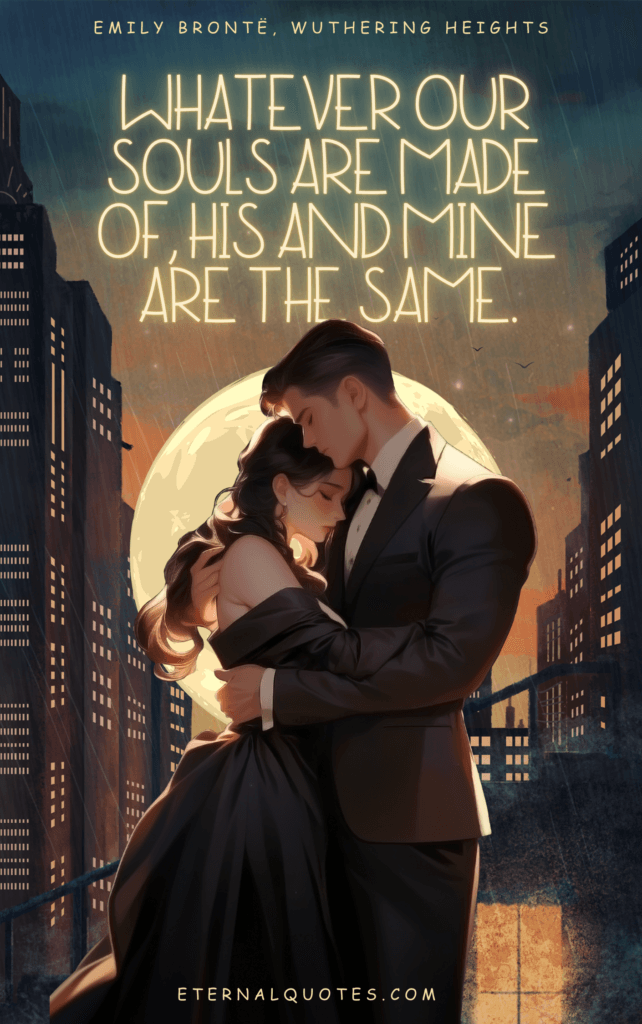
Love has occupied writers for as long as there has been writing. Not because it is simple, but because it resists simplicity — it keeps slipping past language just when you think you’ve pinned it down. The writers who have come closest tend to be those who stopped trying to define it and started describing it in its smallest, most specific moments. A glance. A hesitation. The weight of what goes unsaid.
What literature does with love that life sometimes can’t is give it the space to breathe fully. On the page, the feeling can be held still long enough to be examined — its tenderness, its terror, the way it makes ordinary things feel unbearable or radiant depending on the day. The most enduring literary love isn’t perfect. It is honest, complicated, and deeply human.
“You should be kissed and often, and by someone who knows how.” — Margaret Mitchell, Gone with the Wind
“I wish you to know that you have been the last dream of my soul.” — Charles Dickens, A Tale of Two Cities
“He stepped down, trying not to look long at her, as if she were the sun.” — Leo Tolstoy, Anna Karenina
“We loved with a love that was more than love.” — Edgar Allan Poe, Annabel Lee
“I want to know you moved and breathed in the same world with me.” — F. Scott Fitzgerald, The Beautiful and Damned
“When you fall in love, it is a temporary madness.” — Louis de Bernières, Captain Corelli’s Mandolin
“There is no charm equal to tenderness of heart.” — Jane Austen, Emma
“If I loved you less, I might be able to talk about it more.” — Jane Austen, Emma
“The heart was made to be broken.” — Oscar Wilde, De Profundis
“You are my heart, my life, my one and only thought.” — Arthur Conan Doyle, The White Company
Looking for Good K-Beauty?
MISSHA has a huge range of Korean skincare and makeup, including some seriously popular bestsellers.
Wisdom from the Classics
The writers we call classical earned that designation not through age alone but through staying power — the ability to say something true enough that it holds across centuries and contexts. They were often writing about deeply specific circumstances, particular societies, particular griefs, and yet what they uncovered in the process had a universal weight that still lands today. That is what separates wisdom from mere observation.
Reading the classics can feel demanding at first, but what they reward is patience. They ask you to slow down, to sit with an idea rather than move past it. The payoff is a kind of steadiness — the sense that whatever you’re navigating, someone has been here before, has thought it through carefully, and has left a map in the form of a sentence.
“Not all those who wander are lost.” — J.R.R. Tolkien, The Lord of the Rings
“The only way out of the labyrinth of suffering is to forgive.” — John Green, Looking for Alaska
“There is some good in this world, and it’s worth fighting for.” — J.R.R. Tolkien, The Two Towers
“Happiness can be found even in the darkest of times, if one only remembers to turn on the light.” — J.K. Rowling, Harry Potter and the Prisoner of Azkaban
“To be yourself in a world that is constantly trying to make you something else is the greatest accomplishment.” — Ralph Waldo Emerson
“There is nothing either good or bad, but thinking makes it so.” — William Shakespeare, Hamlet
“All we have to decide is what to do with the time that is given us.” — J.R.R. Tolkien, The Fellowship of the Ring
“Even the darkest night will end and the sun will rise.” — Victor Hugo, Les Misérables
“Until I feared I would lose it, I never loved to read. One does not love breathing.” — Harper Lee, To Kill a Mockingbird
“It is only with the heart that one can see rightly; what is essential is invisible to the eye.” — Antoine de Saint-Exupéry, The Little Prince
Courage & Strength
Courage in literature rarely looks like the heroic version we’re taught to expect. It tends to be quieter — a choice made in private, a person continuing when every instinct says to stop. Writers understand this because they spend their working lives examining what it actually costs to act, to speak, to stay when leaving would be easier. The result is a body of work that describes courage in its most honest form.
What makes literary depictions of strength so enduring is that they don’t pretend it comes without cost. The characters who move us most are the ones who are afraid, who feel the full weight of what they’re facing, and act anyway. That version of bravery is far more useful than any idealized portrait — it’s one we can actually recognize in ourselves.
“Fear doesn’t shut you down; it wakes you up.” — Veronica Roth, Divergent
“Hardships often prepare ordinary people for an extraordinary destiny.” — C.S. Lewis
“Bran thought about it. ‘Can a man still be brave if he’s afraid?’ ‘That is the only time a man can be brave,’ his father told him.” — George R.R. Martin, A Game of Thrones
“Courage is found in unlikely places.” — J.R.R. Tolkien, The Hobbit
“Do not go gentle into that good night.” — Dylan Thomas
“A thing isn’t beautiful because it lasts.” — Joss Whedon, Avengers: Age of Ultron
“Scared is what you’re feeling. Brave is what you’re doing.” — Emma Donoghue, Room
“It’s the possibility of having a dream come true that makes life interesting.” — Paulo Coelho, The Alchemist
“Fairy tales are more than true: not because they tell us that dragons exist, but because they tell us that dragons can be beaten.” — Neil Gaiman, Coraline
“There is no greater agony than bearing an untold story inside you.” — Maya Angelou, I Know Why the Caged Bird Sings
Life & Its Meaning
The question of what makes a life meaningful has no clean answer, and literature has never pretended otherwise. What the best writers offer instead is something more useful — an honest account of how particular people, in particular circumstances, made sense of their time here. The meaning isn’t handed to them. It’s arrived at slowly, through living and loss and attention.
Part of what makes reading so valuable is that it gives you access to many different answers at once. You can hold a stoic’s view of duty alongside a romantic poet’s view of beauty, a philosopher’s account of suffering alongside a novelist’s account of ordinary joy. None of them cancel each other out. Together they make the picture more complete.
“The purpose of life is a life of purpose.” — Robert Byrne
“We are all fools in love.” — Jane Austen, Pride and Prejudice
“People generally see what they look for, and hear what they listen for.” — Harper Lee, To Kill a Mockingbird
“We accept the love we think we deserve.” — Stephen Chbosky, The Perks of Being a Wallflower
“It is our choices, Harry, that show what we truly are, far more than our abilities.” — J.K. Rowling, Harry Potter and the Chamber of Secrets
“A reader lives a thousand lives before he dies.” — George R.R. Martin, A Dance with Dragons
“Memories warm you up from the inside. But they also tear you apart.” — Haruki Murakami, Kafka on the Shore
“Man is not what he thinks he is, he is what he hides.” — André Malraux
“I took a deep breath and listened to the old brag of my heart: I am, I am, I am.” — Sylvia Plath, The Bell Jar
“We do not remember days, we remember moments.” — Cesare Pavese
Friendship & Loyalty
Friendship is one of those things that’s easy to underestimate until you’re in the middle of needing it. It doesn’t announce itself the way love does. It builds quietly, through small consistencies — showing up, remembering, not requiring you to be more than you are. Writers who’ve captured this well tend to focus on exactly those small moments rather than grand gestures.
Loyalty, the companion to friendship, is tested rather than declared. Literature is full of characters who find out who they are in the moments when standing by someone costs something. Those are the relationships that endure on the page and in life — not because they are easy, but because both people chose them when it mattered.
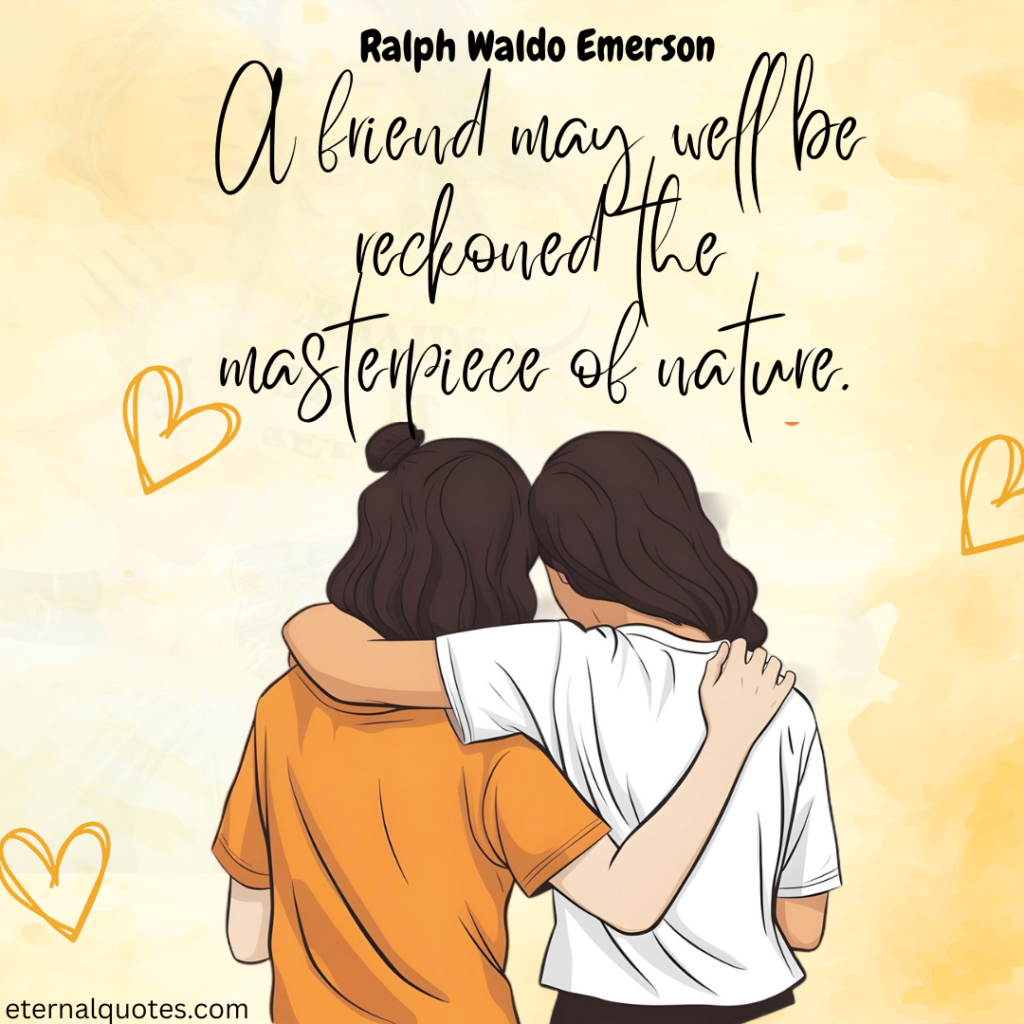
“I would rather walk with a friend in the dark, than alone in the light.” — Helen Keller
“Friendship is born at that moment when one person says to another: ‘What! You too? I thought I was the only one.'” — C.S. Lewis
“Some people arrive and make such a beautiful impact on your life, you can barely remember what life was like without them.” — Anna Taylor
“No man is a failure who has friends.” — Frank Capra, It’s a Wonderful Life
“You can’t stay in your corner of the forest waiting for others to come to you. You have to go to them sometimes.” — A.A. Milne, Winnie the Pooh
“A day without a friend is like a pot without a single drop of honey left inside.” — A.A. Milne, Winnie the Pooh
“True friends stab you in the front.” — Oscar Wilde
“What is a friend? A single soul dwelling in two bodies.” — Aristotle
“There is nothing on this earth more to be prized than true friendship.” — Thomas Aquinas
“Friendship is the only cement that will ever hold the world together.” — Woodrow Wilson
Hope & Resilience
Hope is one of those quiet forces that can completely change how a person carries their life. It does not always show up loudly or dramatically. A lot of the time it looks small, almost fragile, but it keeps you moving in ways fear and logic alone never could. Writers have always known this — which is why hope appears not as triumph in literature but as something closer to stubborn persistence.
Resilience is different from strength, though they’re often confused. Strength suggests an absence of damage. Resilience acknowledges the damage and asks what happens next. The writers who have written most honestly about survival tend to focus on that space — not the moment of breaking, but the slow, uneven process of finding a way to continue.
“Rock bottom became the solid foundation on which I rebuilt my life.” — J.K. Rowling
“Even in the mud and scum of things, something always, always sings.” — Ralph Waldo Emerson
“We must accept finite disappointment, but never lose infinite hope.” — Martin Luther King Jr.
“Hope is being able to see that there is light despite all of the darkness.” — Desmond Tutu
“The world breaks everyone, and afterward, some are strong at the broken places.” — Ernest Hemingway, A Farewell to Arms
“When you come to the end of your rope, tie a knot and hang on.” — Franklin D. Roosevelt
“Dwell on the beauty of life. Watch the stars, and see yourself running with them.” — Marcus Aurelius, Meditations
“Nothing can dim the light that shines from within.” — Maya Angelou
“Everything will be okay in the end. If it’s not okay, it’s not the end.” — John Lennon
“To live is to suffer, to survive is to find some meaning in the suffering.” — Friedrich Nietzsche
Adventure & Exploration
The impulse to move — to go somewhere unfamiliar and find out what happens — runs through literature from its earliest forms. Odysseys and pilgrimages, sea voyages and road trips: the shape changes but the underlying drive remains the same. Writers return to it because exploration is one of the few activities that changes a person in ways they can’t fully predict or control going in.
Adventure in literature isn’t always geographical. Sometimes it’s the decision to try something that might fail, to leave a situation that feels safe but deadening, to follow a question without knowing where it leads. The writers who’ve written best about exploration tend to understand that the external journey and the internal one are almost always the same journey.
“A man’s got to take a lot of punishment to write a really funny book.” — Ernest Hemingway
“I am not afraid of storms, for I am learning how to sail my ship.” — Louisa May Alcott, Little Women
“The world is a book and those who do not travel read only one page.” — Augustine of Hippo
“Adventure is worthwhile in itself.” — Amelia Earhart
“A ship in harbor is safe, but that is not what ships are built for.” — John A. Shedd
“You must go on adventures to find out where you belong.” — Sue Fitzmaurice
“You have brains in your head. You have feet in your shoes. You can steer yourself any direction you choose.” — Dr. Seuss
“It is not down in any map; true places never are.” — Herman Melville, Moby-Dick
“Not all those who wander are lost.” — J.R.R. Tolkien
The Power of Words
Language is the strangest and most ordinary tool human beings have. We use it constantly without thinking, to negotiate and complain and make plans. But writers who take it seriously understand that words are also something else entirely — a way of making felt experience communicable, of closing the distance between one person’s inner world and another’s. That’s a remarkable thing for marks on a page to accomplish.
The relationship between reading and thinking is closer than it might appear. Encountering a sentence that’s been put together with real care tends to make you more careful with your own thinking in response. Good writing is contagious in that way. It raises the standard for what you’ll settle for — not just on the page, but in how you pay attention to your own life.
“A word after a word after a word is power.” — Margaret Atwood
“If you only read the books that everyone else is reading, you can only think what everyone else is thinking.” — Haruki Murakami
“You can make anything by writing.” — C.S. Lewis
“Writing is easy. All you have to do is cross out the wrong words.” — Mark Twain
“Books are a uniquely portable magic.” — Stephen King
“The pen is mightier than the sword.” — Edward Bulwer-Lytton
“Books are mirrors: you only see in them what you already have inside you.” — Carlos Ruiz Zafón
“A room without books is like a body without a soul.” — Marcus Tullius Cicero
“That’s the thing about books. They let you travel without moving your feet.” — Jhumpa Lahiri
“The library is inhabited by spirits that come out of the pages at night.” — Isabel Allende
Fate & Destiny
Fate is a concept literature has never quite been able to leave alone. Writers return to it because it touches something genuinely unresolved in human experience — the tension between the sense that our choices matter and the suspicion that certain things were always going to happen. That uncertainty isn’t comfortable, but it’s honest, and the best literary treatments of fate sit with that discomfort rather than resolving it too neatly.
What’s interesting is how often characters in literature push back against fate — and how often the pushing back turns out to be part of the path itself. Destiny in literature is rarely a fixed destination. It tends to be something that only reveals its shape in retrospect, through the accumulation of small choices that didn’t seem significant at the time.
“There are no wrong turnings. Only paths we had not known we were meant to walk.” — Guy Gavriel Kay
“You cannot swim for new horizons until you have courage to lose sight of the shore.” — William Faulkner
“The best way to predict your future is to create it.” — Abraham Lincoln
“Sometimes fate is like a small sandstorm that keeps changing directions.” — Haruki Murakami, Kafka on the Shore
“When it is time for souls to meet, there’s nothing on earth that can prevent them from meeting.” — Paulo Coelho
“A man can be destroyed but not defeated.” — Ernest Hemingway, The Old Man and the Sea
“Our lives are defined by opportunities, even the ones we miss.” — F. Scott Fitzgerald
“What we do now echoes in eternity.” — Marcus Aurelius
“We are all in the gutter, but some of us are looking at the stars.” — Oscar Wilde
“Fate leads the willing and drags along the reluctant.” — Seneca
The Beauty of Life
Beauty in life is rarely where we expect to find it. Writers have always known this — which is why so much of the best literature slows down around the small and the easily missed: a particular quality of afternoon light, the way a room feels after someone has just left it, the unexpected kindness of a stranger. Paying that kind of attention is itself a practice, one that literature quietly teaches.
The beauty of life as a theme in literature isn’t about optimism or pretending difficulty doesn’t exist. It’s about the capacity to notice what’s still here, even when things are hard. That dual awareness — holding the difficulty and the grace at the same time — is something many writers have worked toward, and managed, in ways that stay with readers long after the book is closed.
“Sometimes the smallest things take up the most room in your heart.” — A.A. Milne, Winnie the Pooh
“Live, travel, adventure, bless, and don’t be sorry.” — Jack Kerouac
“Happiness depends upon ourselves.” — Aristotle
“It is not length of life, but depth of life.” — Ralph Waldo Emerson
“Happiness is not something ready made. It comes from your own actions.” — Dalai Lama
“A thing of beauty is a joy forever.” — John Keats
“The flower that blooms in adversity is the rarest and most beautiful of all.” — Mulan
“It does not do to dwell on dreams and forget to live.” — J.K. Rowling, Harry Potter and the Sorcerer’s Stone
“One sees clearly only with the heart. Anything essential is invisible to the eyes.” — Antoine de Saint-Exupéry, The Little Prince
“Because when you stop and look around, this life is pretty amazing.” — Dr. Seuss
Words That Outlast the Page
The strange thing about a truly good line is that it doesn’t stay inside the book. It travels with you. You carry it into conversations without meaning to, find it waiting for you in quiet moments, discover that it means something slightly different now than it did when you first encountered it. That kind of staying power isn’t designed — it emerges from a writer having been honest enough about something real.
Literature works slowly, which is one reason it’s easy to underestimate. Unlike other forms of media, it doesn’t overwhelm you with sensation or pace. It asks for sustained attention and rewards it with something that accumulates quietly inside you over years. Many readers can point to a book or a single sentence that shifted something in how they understood themselves or the world around them.
The quotes gathered here come from very different traditions, periods, and sensibilities. Some are spare; others are lyrical. Some arrive from fiction, others from poetry, philosophy, or the margins of a writer’s working life. What connects them is that each one was earned — wrested from experience or observation or grief and shaped into something that holds its meaning across time.
Reading widely builds a kind of internal archive — a store of perspectives and voices you can draw on when your own thinking runs thin. This isn’t about accumulating knowledge in any formal sense. It’s about having company. The writers behind these lines were working through the same fundamental conditions of being alive that you are, and they left something behind that can still speak to it.
If a particular line stopped you here, it’s worth paying attention to that. The lines that catch us tend to catch us for a reason. They often name something we were already carrying without quite having words for it. Following that thread — back to the book it came from, or into whatever it stirs in your own thinking — is usually worth the time.
Books will keep offering this. New writers will find new ways to say true things, and old writers will keep meaning new things to new readers. The conversation between literature and the people who read it doesn’t close. It just keeps going, one sentence at a time, in whatever direction it needs to go next.