Just so you know – some links on this page are affiliate links. If you click and buy something, I may earn a small commission (think coffee money, not a luxury vacation) at no extra cost to you. I only share things I genuinely like and believe are worth it. Thanks for supporting this little corner of the internet – it really helps keep everything running.
Sunflowers have a way of making a landscape feel warmer, even before the weather changes. Their color is vivid, but it is not only the color that stays with people. It is the posture, the openness, the sense that they belong fully to the season they are in. They feel familiar in a way that is hard to explain, as if they carry something both cheerful and steady at once.
Part of their appeal lies in the contrast they hold so naturally. They are bright without seeming delicate, bold without seeming harsh, and striking without needing anything ornate around them. A sunflower does not ask for attention in a dramatic way, yet it draws the eye almost immediately. It stands there with a kind of quiet certainty that feels grounding.
People often connect sunflowers with summer, but they also speak to patience, timing, and endurance. Before there is any bloom at all, there is a long stretch of waiting beneath the surface. What eventually looks effortless came through heat, weather, soil, and time. That makes their beauty feel earned rather than decorative.
They also carry a sense of movement, even when standing still. A field of sunflowers never looks lifeless, because everything about them suggests responsiveness. They seem aware of their surroundings in a way that makes them feel almost companionable. Looking at them can feel less like observing a plant and more like sharing a mood.
There is something comforting about a flower that can be so large, so visible, and still feel unpretentious. Sunflowers do not have the fragility people often associate with beauty. They are sturdy, useful, imperfect, and radiant all at once. That combination makes them easy to admire and even easier to remember.
Maybe that is why they keep returning in gardens, paintings, photographs, and ordinary conversation. They seem to express something people are always trying to hold onto – warmth, clarity, resilience, or simply a little brightness that does not feel forced. Even a single sunflower can change the tone of a room or a piece of land. It brings a presence that feels simple on the surface and richer the longer you sit with it.
Sunflowers and Positivity
Some things brighten a space without trying too hard, and sunflowers are one of them. Their presence feels open and generous, as if they bring a little steadiness along with their color. They do not come across as fragile or precious. Instead, they feel warm in a grounded, uncomplicated way.
Positivity often gets mistaken for noise or constant enthusiasm, but it can be much quieter than that. Sometimes it looks more like keeping a soft heart in a difficult season or choosing not to let heaviness define the whole day. Sunflowers carry that kind of feeling. They suggest brightness that still has roots in real soil.
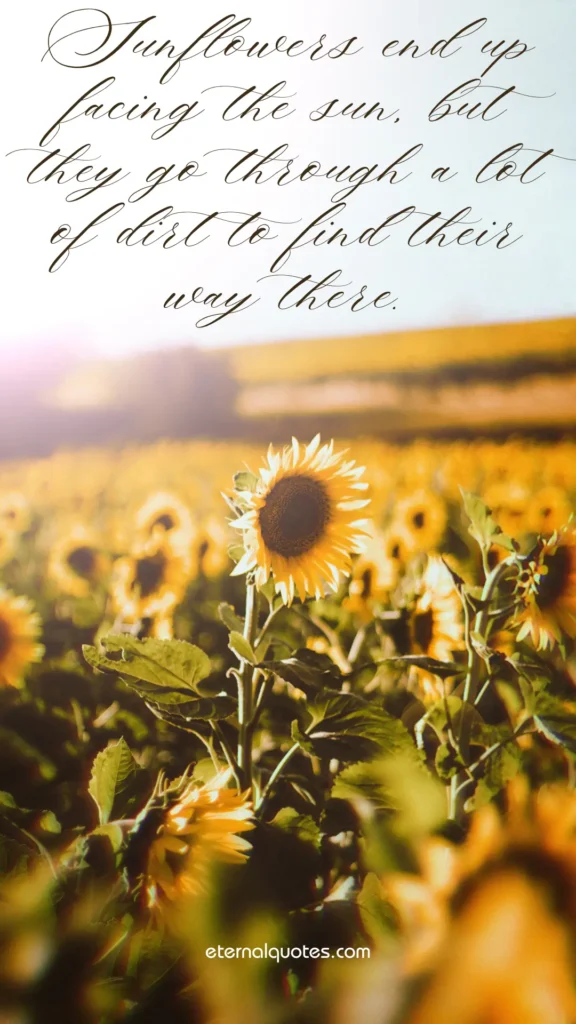
Keep your face to the sunshine and you cannot see the shadows. It’s what the sunflowers do.
A sunflower teaches us that even on the darkest days, we need to keep our face toward the light.
Be like a sunflower – brighten someone’s day just by being yourself.
Sunflowers don’t judge other flowers; they’re too busy radiating their own light.
Plant sunflowers in your mind and watch positivity grow.
In a world full of roses and daisies, be a sunflower.
Sunflowers aren’t just flowers – they’re little pockets of sunshine on Earth.
Choose to shine like a sunflower in a garden of uncertainty.
Sunflowers teach us that you can grow through dirt and still remain spotless.
When everything feels heavy, let your spirit be light and bright like a sunflower.
Looking for Good K-Beauty?
MISSHA has a huge range of Korean skincare and makeup, including some seriously popular bestsellers.
Following the Light
One of the reasons sunflowers stay in the imagination is that they seem guided by something beyond themselves. They bring to mind the human habit of searching for warmth, direction, or meaning, especially when life feels uncertain. That instinct is not always grand or dramatic. A lot of the time it is simply the small decision to keep turning toward what nourishes you.
Light, in that sense, is not only about happiness. It can also mean clarity, honesty, peace, or the steady presence that helps a person keep going. Sunflowers make that search feel natural rather than desperate. They remind us that orientation matters. Where we keep turning, little by little, shapes the life we grow into.
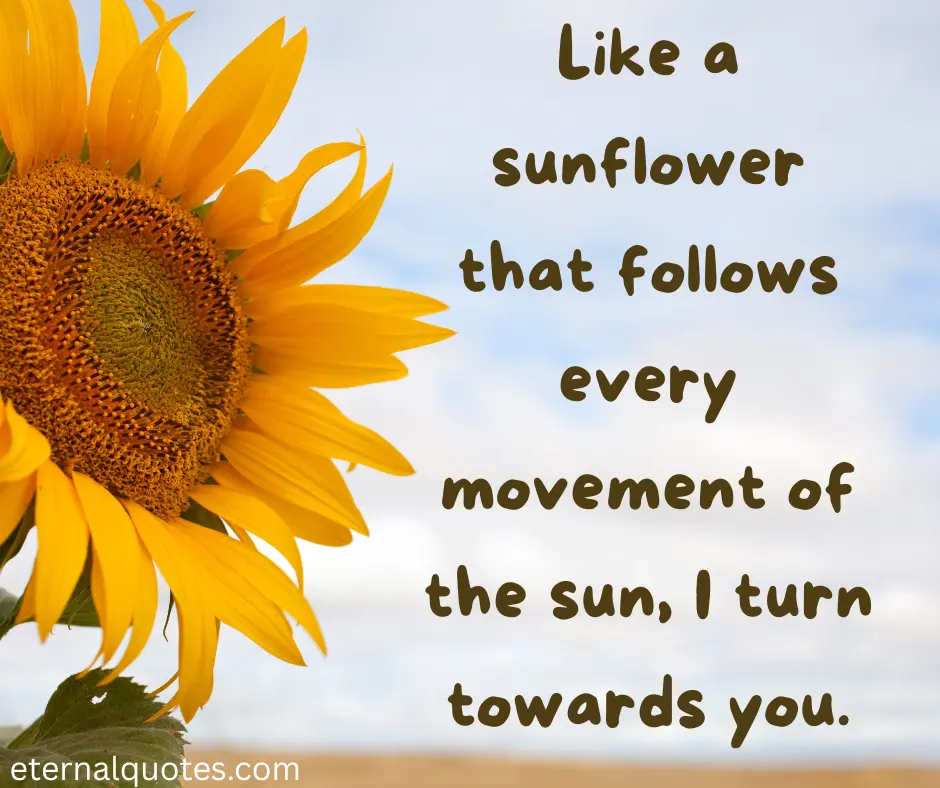
The sunflower is a favorite emblem of constancy, because it turns its face toward the sun all day.
I want to be like a sunflower; so that even on the darkest days I will stand tall and find the light.
Sunflowers know the secret – always follow what illuminates your path.
Every sunflower tells the same story: find your light and turn toward it relentlessly.
Even when the skies are gray, sunflowers remember where the light last was.
True north isn’t always straight ahead – sometimes it’s straight up, as sunflowers know well.
Sunflowers don’t ask permission to follow the sun; they simply do what they were born to do.
We’re all just sunflowers searching for our own source of light.
The most faithful flower in the garden is the sunflower, never straying from its devotion to the sun.
Turn your face to the sun and the shadows fall behind you – the eternal lesson of the sunflower.
Growth and Resilience
Growth rarely looks impressive while it is happening. Most of it is repetitive, slow, and easy to overlook from the outside. A sunflower begins in darkness and works its way upward through conditions that are not always gentle. By the time people admire the bloom, a long unseen process has already done its work.
That is part of what makes resilience feel present in them. They do not deny strain, weather, or waiting. They simply keep responding to what is needed, drawing strength where they can and continuing upward when they are able. There is nothing flashy about that kind of endurance. It is steady, practical, and deeply admirable.
Sunflowers don’t grow overnight. Patience reveals magnificence.
Be patient with your growth – sunflowers take time to reach for the sky.
Sunflowers teach us that even the tallest among us started as a small seed in the dark.
A single sunflower can rise from the driest soil and still create beauty.
The taller the sunflower grows, the stronger its roots must become.
Sunflowers are proof that there’s no such thing as growing too tall too fast if your roots are strong.
The growth of a sunflower isn’t an accident – it’s persistence day after day.
Even bent by the weight of rain, a sunflower rises again when morning comes.
Like sunflowers, we have unlimited capacity to begin again.
Sunflowers remind us that the will to grow can overcome the harshest conditions.
Golden Beauty
Sunflowers have a kind of beauty that feels immediate and unmistakable. They are vivid, but not in a delicate way. Their color has weight to it, almost like something you could hold in your hands. It feels closer to warmth than decoration.
What makes them especially memorable is that their beauty is never separate from their structure. The thick stems, broad faces, and dark centers all contribute to the effect. Nothing about them is timid. They seem to show that boldness can still feel natural when it belongs fully to what something is.
There’s a kind of gold that doesn’t need to be mined – it grows in fields and turns its face to the sky.
Van Gogh understood – there’s something eternally captivating about the golden face of a sunflower.
The rich amber petals of a sunflower are nature’s way of showing off.
Like liquid sunshine poured into petal form – the beauty of a sunflower defies simple description.
The golden crown of a sunflower is a masterpiece that requires no museum.
Each sunflower carries a piece of summer’s gold, even as autumn approaches.
Sunflowers wear their hearts on the outside – golden, open, and unashamed.
The sunflower’s beauty isn’t in perfection but in its bold, unapologetic golden presence.
Even as they fade, sunflowers maintain their golden dignity.
There’s a shade of yellow that only sunflowers have perfected – somewhere between honey and hope.
Sunflowers in Art and Culture
Some flowers remain botanical, while others become part of a larger shared language. Sunflowers have moved well beyond the garden into painting, story, symbol, memory, and ritual. They are recognizable almost everywhere, yet people keep finding new ways to interpret them. That balance between familiarity and richness is part of their power.
Art tends to return to whatever still holds emotional charge, and sunflowers clearly do. They can suggest abundance, devotion, warmth, labor, summer, or a kind of plainspoken beauty that does not need refinement. Different cultures have attached different meanings to them, but the response is often similar. People see something life-giving in them and want to keep that image close.
Van Gogh didn’t just paint sunflowers; he translated their souls onto canvas.
Across cultures, the sunflower speaks a universal language of optimism.
Sunflowers have inspired more poets than perhaps any flower save the rose.
The ancient Incas used sunflowers as an image of their sun god, bringing gold to Earth.
Sunflowers remind us that sometimes the most profound art is growing in a field.
Artists return to sunflowers again and again, drawn by their perfect combination of simplicity and complexity.
A sunflower field is like a sky with a thousand suns – no wonder photographers can’t resist them.
In Native American cultures, sunflowers represented harvest, bounty, and provision.
The sunflower doesn’t need a signature to be recognized as a masterpiece.
Throughout history, the image of the sunflower has been a symbol of hope and resilience in art.
Life Lessons from Sunflowers
People often look to nature for lessons not because nature speaks in slogans, but because it shows patterns clearly. A sunflower makes visible what many people spend years trying to understand. It grows upward without losing contact with the ground. It opens fully without ceasing to be strong.
That is part of why it feels instructive without being sentimental. It suggests that steadiness and openness are not opposites. You can be rooted and responsive at the same time. You can take in light without pretending the weather is always easy.
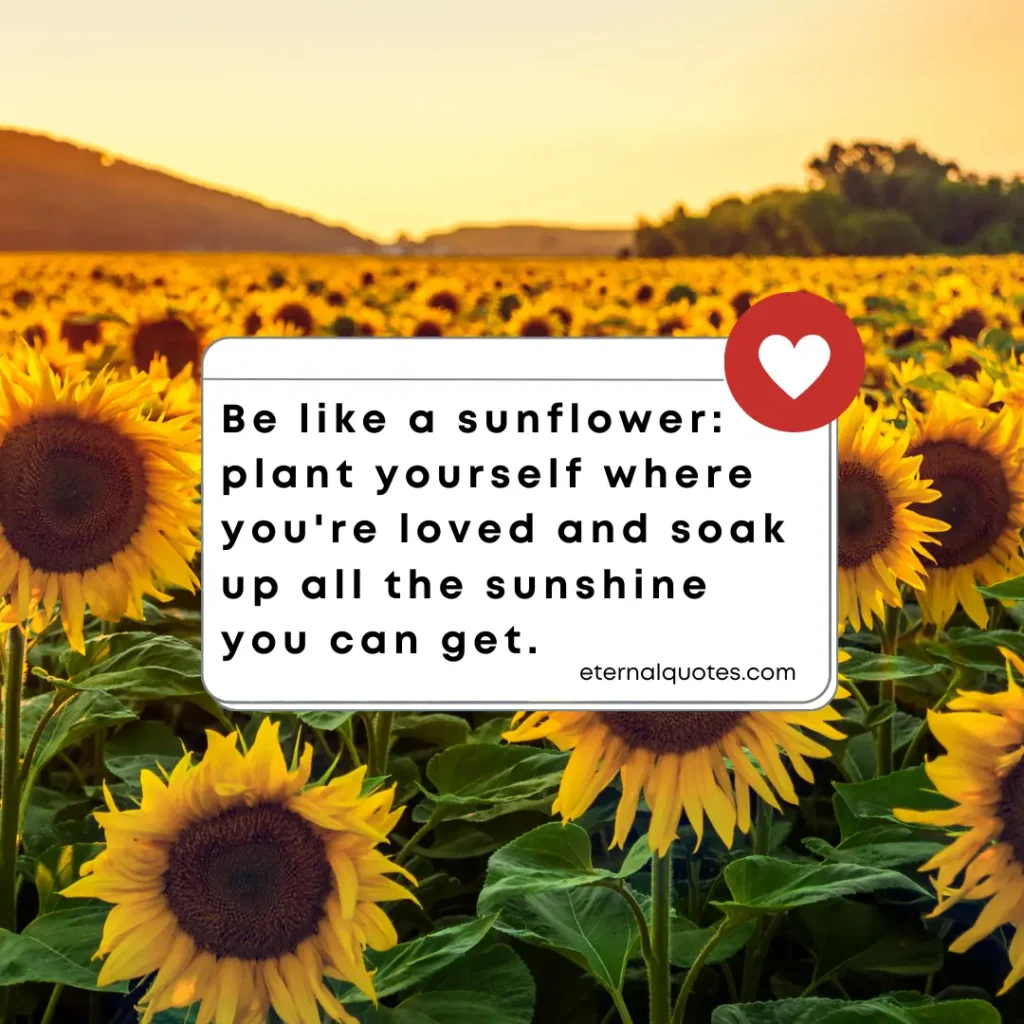
Sunflowers don’t waste energy hiding their beauty – there’s a lesson in that authenticity.
From sunflowers we learn: it’s not the size of the seed but the depth of the roots that determines growth.
Sunflowers teach us that sometimes you have to grow tall before you bloom.
A sunflower never questions its purpose – it simply grows and gives beauty freely.
Observe a sunflower and learn that sometimes the heaviest heads are held with the most grace.
Sunflowers remind us that our potential often lies dormant like a seed until the right conditions arrive.
The wisdom of the sunflower: keep your roots down and your petals up.
Sunflowers teach us that it’s possible to be both firmly grounded and completely open to the sky.
A sunflower’s lesson: sometimes the most beautiful things require the most patience.
Watch how a sunflower moves with the sun and learn adaptability without compromising stability.
Standing Tall
Height can look dramatic in a sunflower, but what makes it compelling is not just size. It is the way that height seems carried rather than performed. The flower rises visibly above much of what surrounds it, yet it does not feel arrogant. It simply becomes what it was made to become.
There is something reassuring in that kind of presence. Standing tall does not have to mean becoming hard or forceful. It can also mean holding your shape, taking up your space, and remaining upright through weather that would have once undone you. Sunflowers make that posture feel both strong and calm.

Like sunflowers, we were born to stand tall and capture the warmth that helps us grow.
Even with its heavy head, a sunflower stands tall – strength isn’t always about muscle.
There’s something noble about how sunflowers reach impossible heights yet remain humble.
When life weighs you down, remember the sunflower – tall despite carrying so much weight at its crown.
Sunflowers don’t apologize for taking up space or standing taller than the rest.
The tallest sunflowers face the strongest winds but rarely break.
Stand proud, stand visible, stand in your full height – this is what sunflowers know.
A sunflower doesn’t worry about outgrowing its neighbors; it simply reaches for its own potential.
The quiet confidence of a sunflower comes from knowing exactly how tall it’s meant to be.
In a garden where everything grows at different paces, the sunflower reminds us that there’s glory in standing out.
The Sunflower Field
A single sunflower can hold attention, but a field of them creates an entirely different feeling. The scale changes the experience from admiration to immersion. What seems charming in one bloom becomes almost overwhelming in many. It turns brightness into atmosphere.
There is also something moving about seeing so many strong individual forms gathered in one place. A field does not erase the distinctness of each flower, yet together they create rhythm, pattern, and calm. The repetition feels generous rather than monotonous. It is a reminder that abundance can be beautiful without becoming excessive.
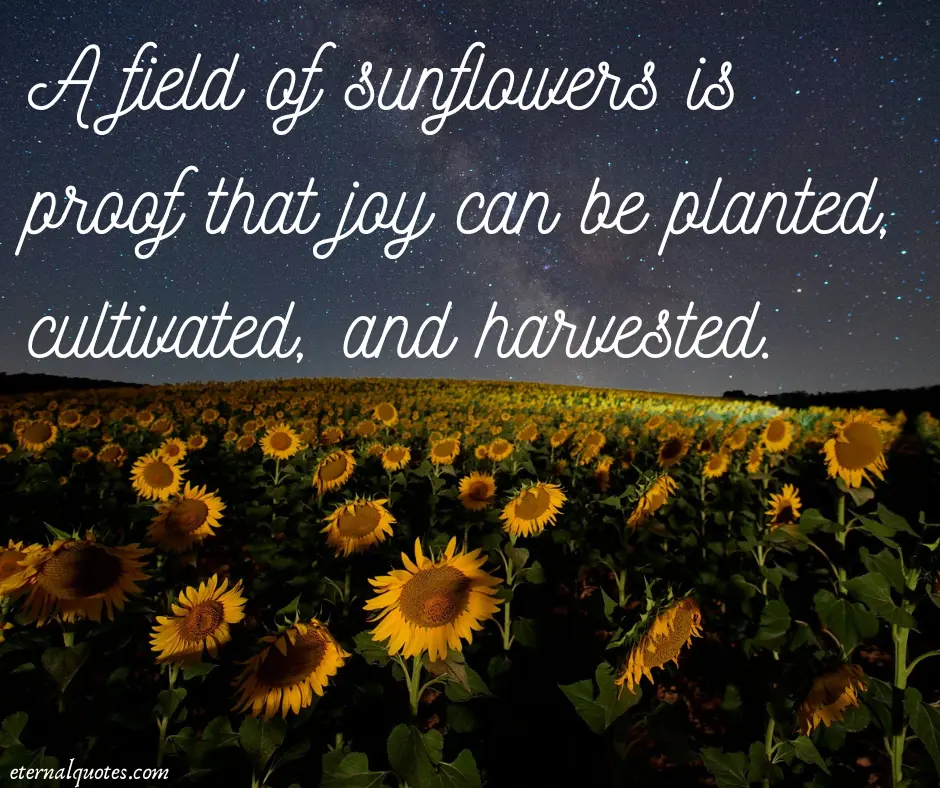
There is nothing more optimistic than a field of sunflowers turning their faces in perfect unison.
Walk into a sunflower field and understand what it means to be surrounded by living optimism.
Sunflower fields are where summer shows off its best work.
A thousand suns grow from the earth in a field of sunflowers.
The most beautiful kind of crowd is a field of sunflowers moving as one with the breeze.
Sunflower fields remind us that sometimes the most spectacular views aren’t on mountain tops but on flat ground.
There’s a special kind of magic when sunlight meets a field of its namesake flowers.
A sunflower field is nature’s way of showing that repetition can create magnificence.
The harmony of a sunflower field shows us what’s possible when individuals align with the same purpose.
The edge of a sunflower field is where the cultivated meets the wild, and both are equally beautiful.
Seeds of Potential
Potential is one of those words that sounds abstract until you hold something small enough to fit in your palm. A seed makes the idea tangible. It does not look like much from the outside, yet it carries form, direction, and the possibility of transformation. That gap between appearance and capacity is part of what makes it so compelling.
Sunflower seeds make this especially vivid because the result is so large, so bright, and so visible. It is hard not to be struck by the contrast. What begins as something dry, dark, and modest can become something towering and full of color. That movement from hidden potential to full expression feels deeply human as well.
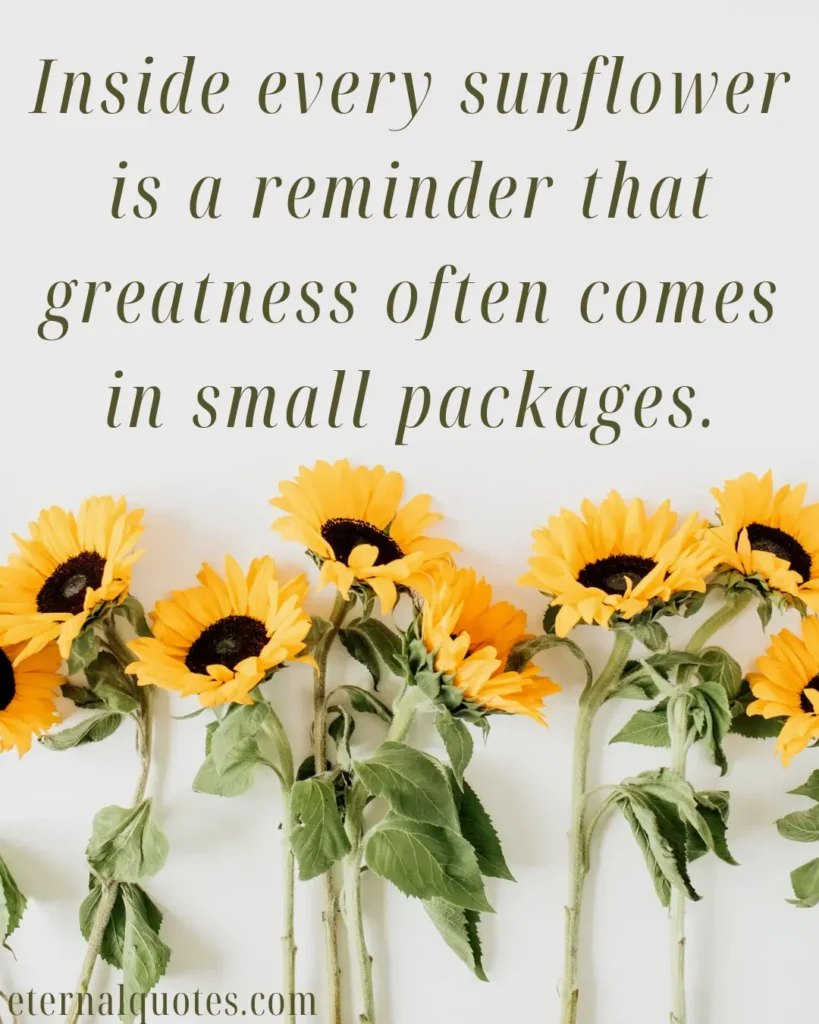
Sunflower seeds teach us that even when we’re small, we contain everything needed to become magnificent.
A handful of sunflower seeds is a handful of future sunflowers, waiting for their moment.
In the pattern of a sunflower’s seeds lies the golden ratio – even in chaos, there is perfect order.
The mathematics of a sunflower’s seed pattern reminds us that even nature appreciates good design.
From tiny black seeds to towering yellow blooms – sunflowers are living proof of potential realized.
Sunflower seeds don’t question whether they’re capable of becoming sunflowers – they simply become.
The spiral arrangement of sunflower seeds is nature’s perfect packaging system.
A sunflower’s seeds hold not just future flowers but food, oil, and a future that expands beyond the original.
The most impressive part of a sunflower might be what we can’t see – the intricate pattern of possibility in its center.
Every sunflower was once just a possibility stored in a tiny seed.
Sunflowers and Happiness
Happiness is often easier to recognize in simple forms than in complicated ones. A sunflower does not represent a perfect life or permanent ease. What it offers is a brief but unmistakable feeling of warmth, openness, and vitality. Sometimes that is enough to shift the tone of a moment.
That may be why people respond to them so quickly. They make joy feel less like an achievement and more like a natural response to light, season, and presence. Not every kind of happiness needs analysis. Some of it is immediate, physical, and quietly restorative, the way a bright field or a vase on a kitchen table can be.
You can’t look at a sunflower without smiling – it’s scientifically impossible.
Sunflowers are the extroverts of the flower world, sharing their happiness generously.
Plant sunflowers when you need to remember what happiness looks like in bloom.
If happiness could photosynthesize, it would grow up to be a sunflower.
The cheerful disposition of sunflowers is contagious to all who encounter them.
You don’t pick sunflowers – they pick you with their irresistible joy.
Sunflowers don’t need anyone’s permission to shine with unbridled happiness.
There’s something about sunflowers that turns ordinary moments into celebrations.
The happiest gardens always make room for at least one sunflower.
Walk with the same confidence as a sunflower that knows it brings happiness wherever it grows.
Where Warmth Takes Root
Sunflowers stay with people because they seem to hold several truths at once. They are bright, but not shallow. They are sturdy, but never severe. They show how something can be joyful without losing its depth, and that combination is rarer than it first appears.
They also remind us that beauty is often most convincing when it is connected to process. A sunflower does not appear out of nowhere. It comes through time, weather, rootedness, and quiet persistence. That makes its radiance feel less like ornament and more like the natural result of staying alive to what nourishes it.
There is comfort in how physical they are. Thick stems, rough centers, heavy heads, broad leaves – nothing about them feels overly delicate or distant. Their beauty belongs to the earth as much as to the eye. They seem to say that warmth does not have to float above real life in order to matter.
A lot of what they represent is easy to overlook because it arrives in such a cheerful form. Yet beneath that brightness is patience, adaptation, endurance, and an unusual kind of openness. Sunflowers do not hide what they are. They turn outward fully, and in doing so they make confidence look less like performance and more like alignment.
That may be why they continue to feel meaningful across so many different settings. In a garden, in a field, in a vase, in a painting, or even in memory, they carry the same unmistakable tone. They bring light, but not the kind that denies shadow. It is a steadier kind of light, one that coexists with labor, weather, and change.
To spend time with sunflowers is to be reminded that warmth can have structure, and joy can have roots. Not everything bright is fleeting, and not everything strong needs to harden. Some things simply grow toward what sustains them and, in doing so, become impossible not to notice. Sunflowers have a way of making that feel both beautiful and true.