
Just so you know – some links on this page are affiliate links. If you click and buy something, I may earn a small commission (think coffee money, not a luxury vacation) at no extra cost to you. I only share things I genuinely like and believe are worth it. Thanks for supporting this little corner of the internet – it really helps keep everything running.
Some minds do not move in a straight line. They circle, return, inspect, and question, not because they want to create trouble, but because they are trying to make sense of everything they carry. A small moment can stay alive for hours, then drift back again days later with a new angle attached to it. What looks quiet from the outside can feel very crowded on the inside.
Overthinking often begins as a form of care. It can come from wanting to get things right, wanting to protect yourself, or wanting to understand people more deeply than the surface usually allows. The problem is that care does not always know when to stop. It keeps turning the same thought over long after it has stopped being useful, hoping one more pass will finally bring peace.
There is also a strange loneliness in living this way. You can be sitting in an ordinary room, having an ordinary day, while your mind is moving through old memories, imagined futures, and conversations that never quite ended. It becomes hard to explain that exhaustion to other people because nothing dramatic has happened. The tiredness comes from the sheer amount of inner movement that never really settles.
At the same time, an overactive mind is not empty or shallow. It notices details, patterns, shifts in tone, and small emotional currents that others might miss completely. It can be deeply perceptive and deeply tender, even when it becomes difficult to live with. A restless mind is often trying to protect a sensitive heart, even if it goes about it in a clumsy way.
Many people know the feeling of wanting relief while also being reluctant to let go of the habit. Thinking feels like effort, and effort can feel like control. Slowing down can seem risky when the mind has convinced itself that constant scanning is the only thing keeping life from falling apart. So the cycle continues, not because it feels good, but because it feels familiar.
Still, there is something deeply human in this struggle. It speaks to how much people want clarity, safety, and connection in a world that rarely offers complete certainty. A mind that overthinks is often a mind that feels a lot, notices a lot, and carries more than it lets on. That inner intensity can be heavy, but it also says something honest about how fully a person is trying to live.
The Endless Loop of Thoughts
Some thoughts do not arrive once and leave. They circle back with slightly different wording, a slightly different fear, or a new detail the mind suddenly decides is important. What should have been a passing moment turns into a private orbit that keeps pulling attention back in. The repetition can feel absurd, but it also feels impossible to interrupt once it starts.
That mental looping is exhausting in a very particular way because nothing is visibly happening, yet so much energy is being spent. A person can look still while internally moving at full speed, revisiting old scenes and testing possibilities that may never matter. The day goes on, but part of the mind remains caught in a place it cannot seem to leave. It is not just thinking hard – it is being unable to put a thought down.

I don’t just cross bridges when I come to them – I build them in my mind before I even see water.
Sometimes I replay conversations from 2015 just to make sure I didn’t miss anything.
I’ve solved problems that haven’t even happened yet.
Three hours of sleep and five hours of wondering why I can’t sleep.
Overthinking – the art of creating problems that weren’t even there.
My brain doesn’t have a pause button, only fast-forward.
I’ve mentally lived through 37 different scenarios before breakfast.
Sometimes I wish I could unplug my brain like I do my devices at night.
The most exhausting part of my day is the journey between my ears.
I’ve rehearsed tomorrow’s meeting seventeen times – and it might get canceled.
Looking for Good K-Beauty?
MISSHA has a huge range of Korean skincare and makeup, including some seriously popular bestsellers.
The Weight of What-Ifs
Uncertainty rarely stays empty for long. The mind has a way of rushing in to fill the silence with possibilities, and once that begins, the possibilities multiply faster than they can be answered. One question easily becomes ten, and each one seems to demand attention right now. What could happen starts to feel almost as real as what is happening.
The burden is not only fear of the future, but the endless responsibility of trying to pre-live it. The imagination becomes busy drawing paths, exits, disasters, recoveries, and side effects for events that have not even arrived. Even hopeful outcomes can feel tense when the mind insists on examining every angle before life has had a chance to unfold. It is a heavy way to carry time.
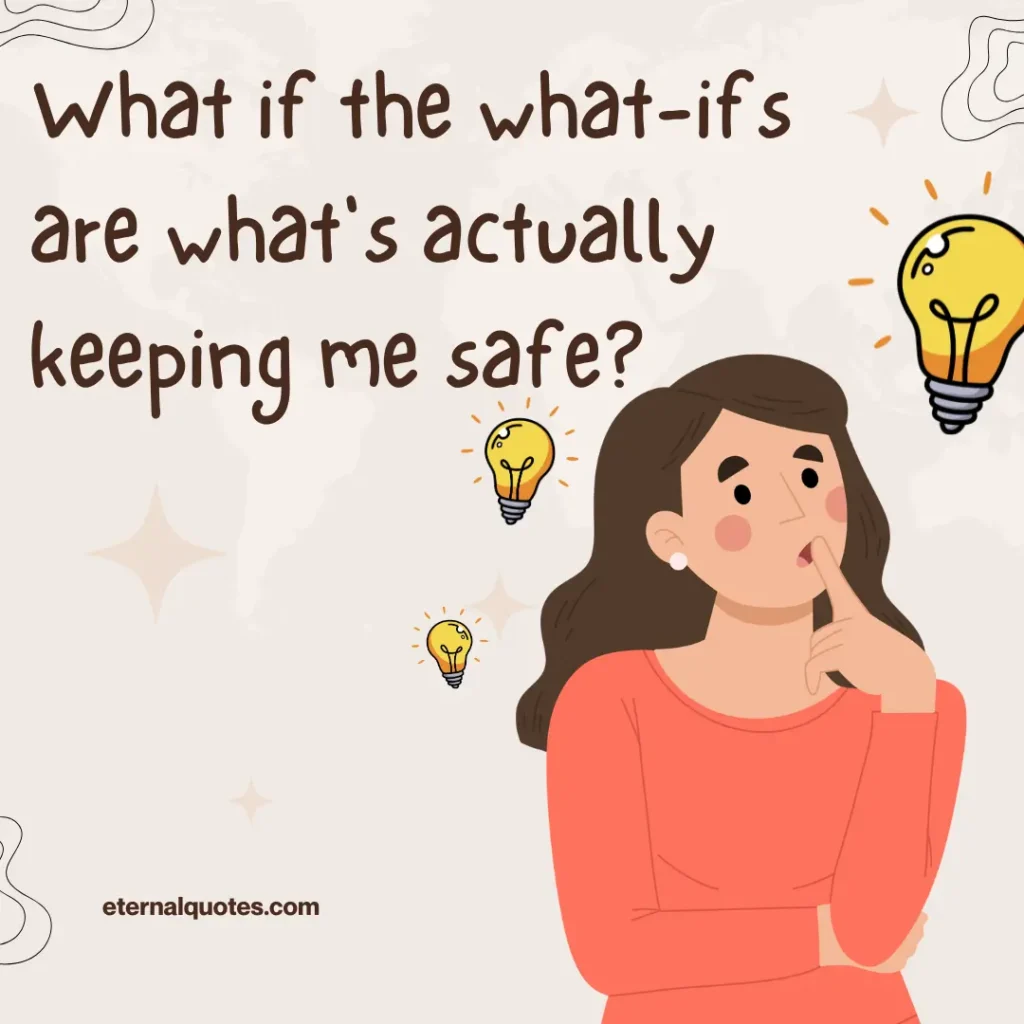
I excel at imagining the worst before the best has a chance.
For every decision I make, there are twenty alternate universes I’ve already explored in my mind.
What if my overthinking is actually problem-solving in disguise?
My favorite exercise is jumping to conclusions.
I don’t fear the unknown – I fear all the scenarios I’ve created about it.
What if everything works out and I worried for nothing? That’s what worries me most.
Every path not taken haunts me with infinite possibilities.
I’ve lived a thousand lives in my mind while standing frozen at a crossroads.
My what-ifs have what-ifs of their own.
The heaviest weight I carry is the collection of scenarios that never happened.
The Midnight Mind
Night has a way of stripping life down to the bare essentials. The noise is gone, the distractions are fewer, and the mind finally has room to bring forward everything it managed to postpone during the day. Thoughts that seemed manageable in daylight can become larger, sharper, and more convincing in the dark. Silence does not always feel restful when the inside of the mind is this awake.
Insomnia is often more than a sleep problem. It can feel like being trapped in a private room with every unfinished thought, every old memory, and every unanswered question asking for one last look. Hours pass in stillness, yet the mind keeps moving as if it has mistaken bedtime for a work shift. Morning arrives, but the inner conversation never really ended.
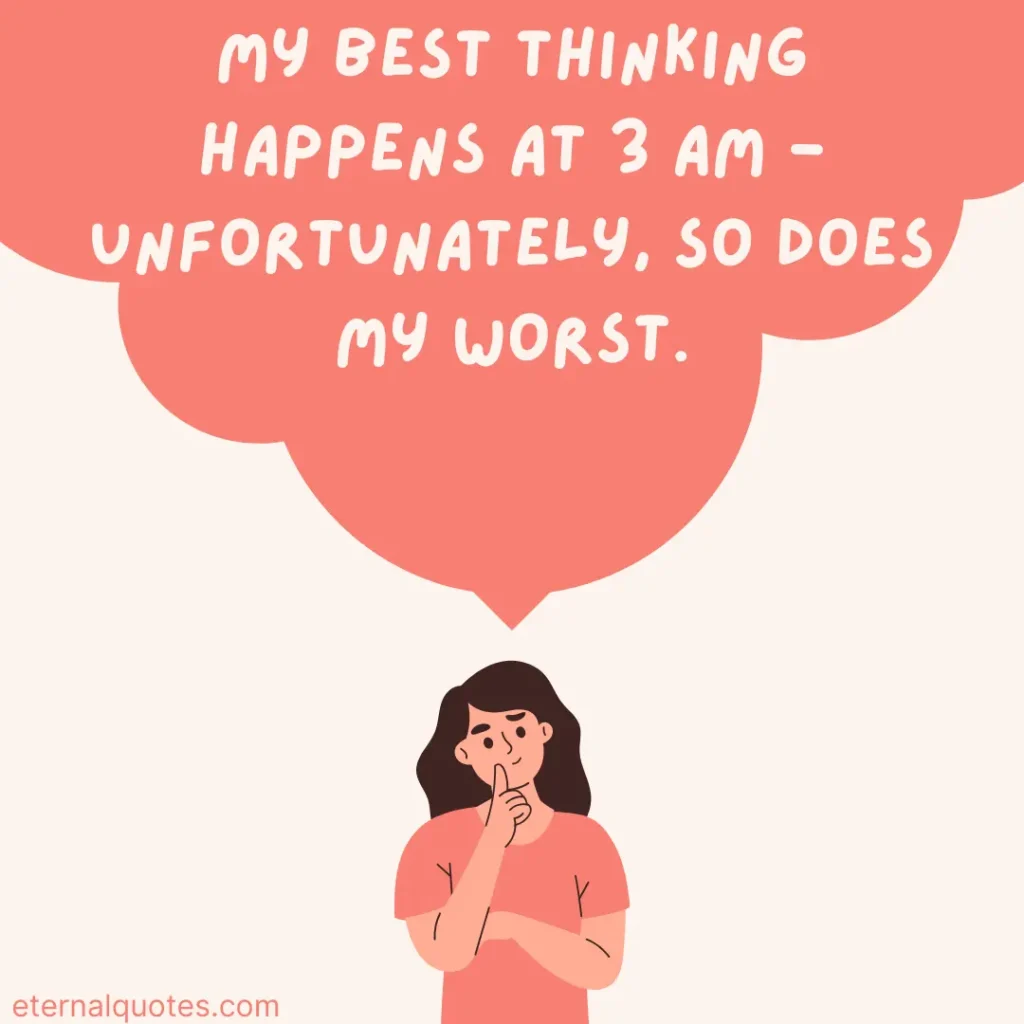
Sleep is just a concept my overthinking has heard about.
Night – when my brain decides it’s finally time to solve all of life’s mysteries.
I’ve had entire debates with people while they were sleeping peacefully next to me.
My brain at midnight: Let’s analyze that comment from 2012 again.
Counting sheep turned into planning a sustainable wool business.
My pillowcase holds more thoughts than dreams.
The dark amplifies the volume of my thoughts.
I’ve decorated entire houses in my mind while trying to fall asleep.
My midnight thoughts have depth that daylight can’t comprehend.
I’ve solved world problems at 2 AM then forgotten them by breakfast.
The Analyst’s Curse
Some people hear a sentence and let it pass. Others keep turning it over, studying the wording, the tone, the pause before it, and the expression that came with it. Meaning begins to spread beyond the words themselves. A small exchange becomes a puzzle with too many possible answers.
This kind of analysis can feel intelligent right up until it becomes its own trap. The mind starts searching for hidden layers even when none were intended, and ordinary interactions begin to feel crowded with signals that need decoding. It becomes difficult to accept simplicity when your instincts keep insisting there must be more underneath. Sometimes the search for meaning ends up creating confusion rather than clarity.

I can find seventeen meanings in a one-word text message.
I’ve analyzed the tone of your email for longer than it took you to write it.
My hobby is dissecting casual remarks until they lose all meaning.
I see subtext where there’s barely text.
I’m fluent in over-interpretation.
I can turn a simple hello into a psychological case study.
The tone of your voice has been cataloged and cross-referenced with previous conversations.
I could teach a master class on finding hidden meanings in ordinary exchanges.
Your silence has been analyzed more thoroughly than your words.
I don’t just overthink – I over-analyze, over-interpret, and over-complicate.
The Social Overthinking
Social life can be especially demanding for a mind that does not leave things alone. A casual laugh, a delayed reply, a shift in energy across the room – any of it can linger far beyond the moment itself. The interaction ends, but the mind keeps holding a private review long after everyone else has moved on. What was meant to be simple starts to feel loaded.
This is part of what makes connection so tiring for some people. They are not only participating in the moment, but also monitoring themselves inside it, anticipating how they are being received, and replaying it afterward with painful precision. Even pleasant gatherings can leave behind a trail of second-guessing. It is hard to rest in company when your mind keeps asking how you came across.
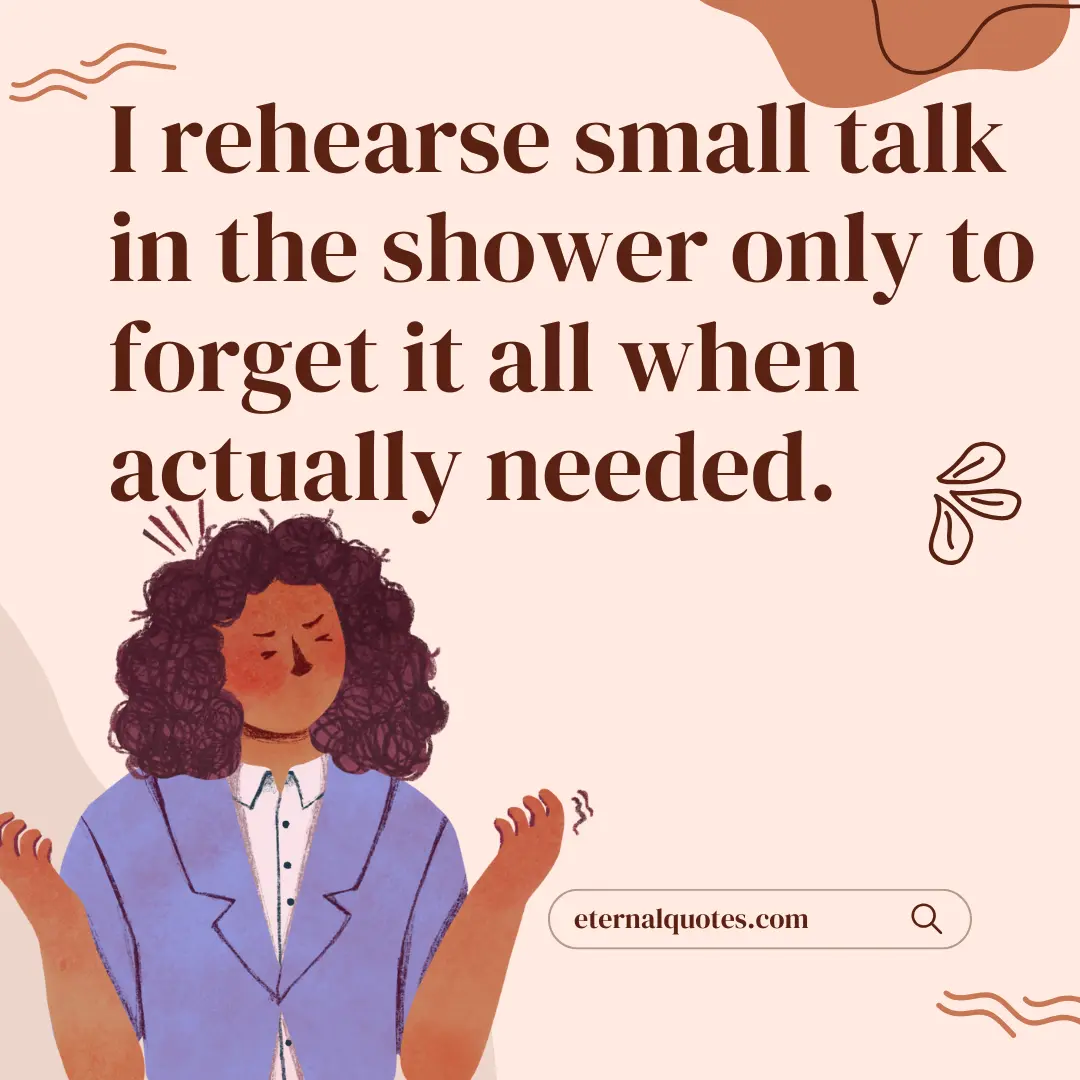
I’m still wondering if that laugh was genuine or polite – from our conversation three years ago.
I’ve crafted and deleted more text messages than I’ve sent.
My social battery drains twice as fast because I’m running two conversations – the real one and the one in my head.
I’ve pre-planned my spontaneity.
I replay social interactions like game tapes, looking for where I went wrong.
I’ve already worried about how this gathering will end before it’s even started.
The phrase “let me think about it” is really code for “let me overthink it.”
I analyze group photos like crime scene evidence to see if I truly belong.
I rehearse phone calls that last 30 seconds for about 30 minutes.
I can’t tell if I’m being included out of pity or genuine interest – so I’ll think about it for the next week.
The Future Forecaster
Looking ahead is a normal part of being human, but some minds do not simply glance forward. They move into the future and begin furnishing it with risks, backups, conversations, regrets, and escape routes. Planning starts as a practical instinct, then slowly becomes a way of living in places that have not happened yet. It can be hard to feel present when tomorrow is already taking up so much space.
There is a strange seriousness that comes with always trying to stay ahead of life. It can make a person appear prepared, responsible, and composed, even while they are quietly worn down by the effort of anticipating everything. The future becomes less of an open landscape and more of a field to patrol. That constant vigilance can look like strength while feeling a lot like strain.
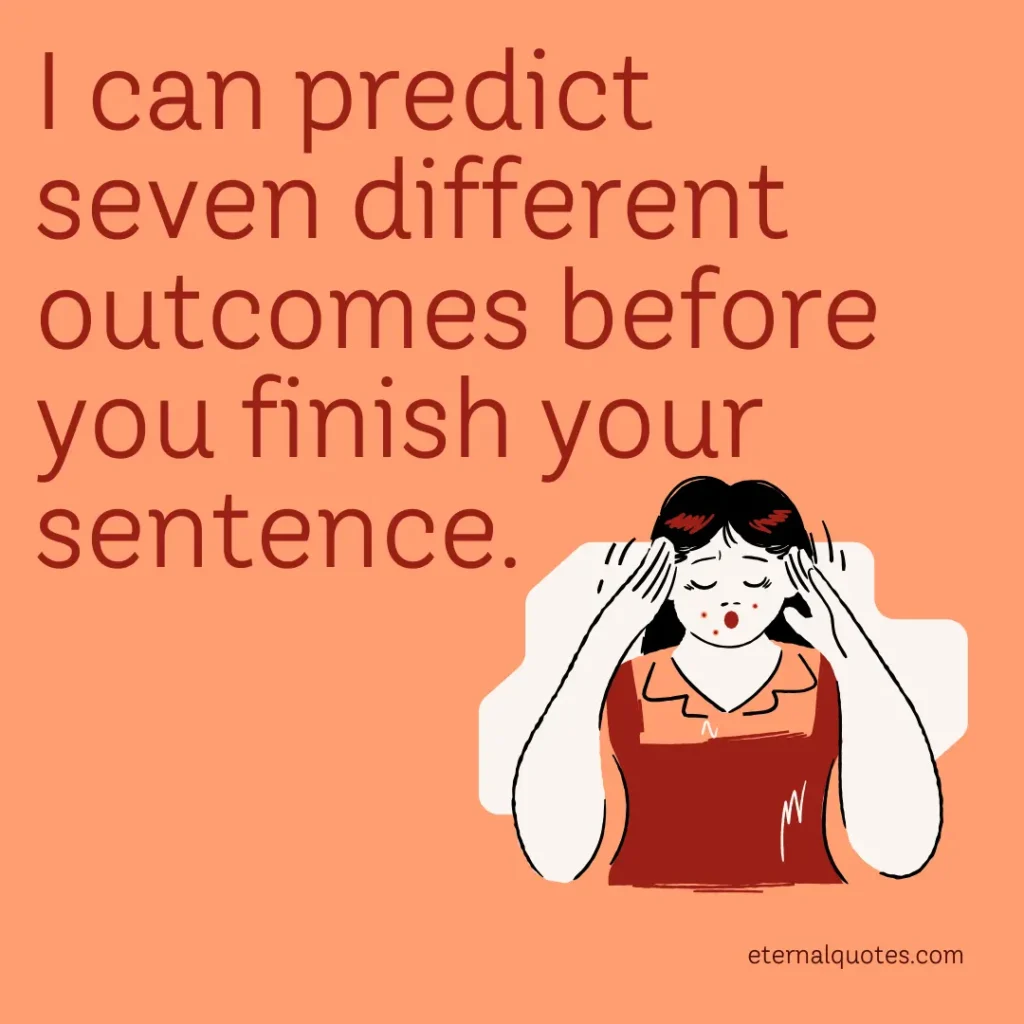
I don’t plan for the future – I’ve already lived it in my mind.
Tomorrow’s problems are today’s thoughts.
I’ve mentally prepared for disasters that statisticians haven’t even calculated yet.
I’ve stress-tested my five-year plan against scenarios NASA hasn’t considered.
The weather forecast says sunny, but I’ve packed for a storm just in case.
I don’t just expect the unexpected – I’ve written the script for it.
My contingency plans have contingency plans.
I’ve already aged ten years thinking about next year.
I’ve prepared for plot twists in a story that hasn’t been written yet.
I’ve mentally walked through more future scenarios than a quantum computer.
The Perfectionist’s Predicament
Perfectionism often sounds disciplined from the outside, but inside it can feel relentless. It keeps raising the standard just as you are about to reach it, then questions whether what you have done is good enough to exist at all. The result is not always excellence. Often it is hesitation, friction, and a deep weariness that comes from never quite allowing yourself to arrive.
Overthinking and perfectionism tend to make each other stronger. One demands certainty, the other keeps searching for flaws, and together they can turn even simple tasks into emotional negotiations. A sentence becomes a draft of a draft of a draft. A decision becomes a test of character instead of a small, ordinary choice.
If overthinking were an Olympic sport, I’d still be analyzing whether I deserve the gold medal.
I don’t make mistakes – I create extensive mental simulations of them before they happen.
I’ve rewritten this sentence in my head 17 times before speaking it once.
My standards are so high they’ve developed altitude sickness.
I don’t just dot the i’s and cross the t’s – I question why they need dotting and crossing in the first place.
I’ve mentally rehearsed this presentation so many times I’m bored of it before delivering it.
Perfection isn’t just a goal – it’s the minimum acceptable standard for my thoughts.
I haven’t failed yet – I’ve just found 10,000 ways my ideas could be better.
I don’t just aim for excellence – I overthink my way past it into paralysis.
My first draft exists only in my mind, where it’s been revised countless times.
The Emotional Excavator
Feelings can become complicated very quickly in a mind that does not let them stay simple. Instead of moving through an emotion, the mind starts examining it, measuring it, tracing its roots, and asking what it says about everything else. Even joy can become something to question. The experience itself is interrupted by the effort to fully understand it.
This kind of inner excavation can create the illusion of clarity while actually increasing distance from what is real and immediate. A person may know every theory about why they feel the way they do and still feel disconnected from the feeling itself. Reflection is valuable, but not when it turns every emotion into an investigation. Sometimes the heart gets buried under all that interpretation.
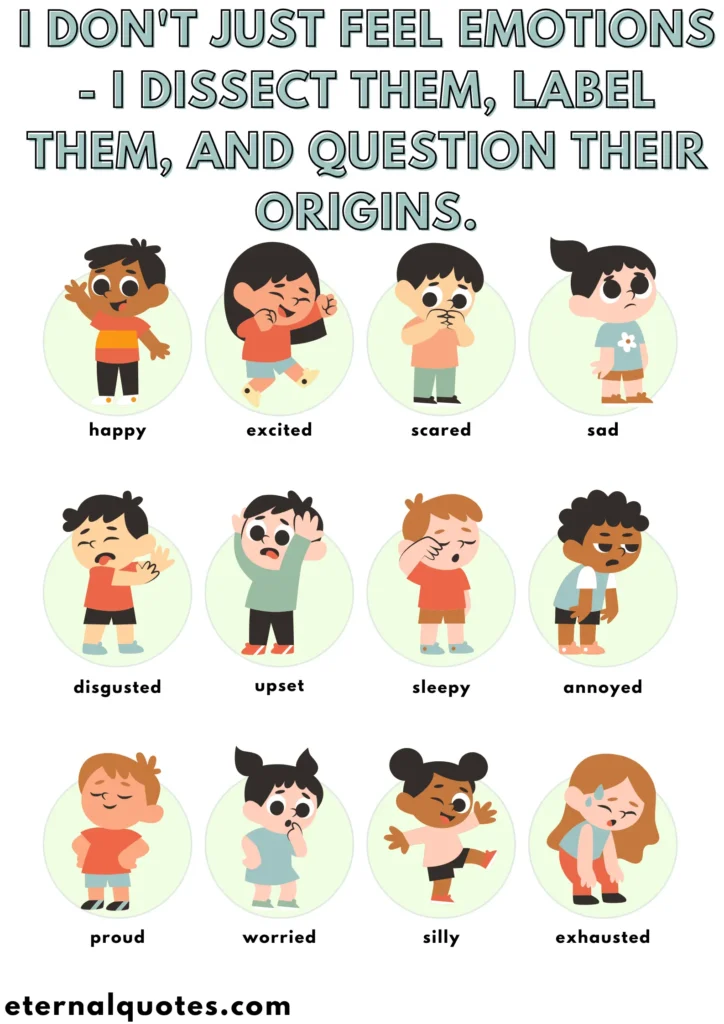
I’ve analyzed my feelings so deeply I’ve forgotten what it’s like to simply experience them.
My emotional intelligence includes overthinking as a core competency.
I don’t just experience joy – I wonder when it will end and why I deserve it.
I’ve questioned the authenticity of my own laughter.
I feel things twice – once when they happen and again when I overthink them.
I can find the hidden sadness in happy moments like a truffle pig finds truffles.
My emotions come with footnotes, appendices, and citations.
I don’t just have feelings – I have comprehensive theories about my feelings.
I’ve psychoanalyzed myself out of genuine reactions.
I can trace today’s mild anxiety back to a seemingly insignificant moment from childhood.
The Decision Paralysis
Choice can feel strangely heavy when the mind insists on treating every option like a life-altering event. Even small decisions begin to branch into imagined consequences, future regrets, and alternate versions of how the day might unfold. What should take a moment starts demanding analysis, comparison, and emotional labor. Freedom stops feeling light when every option carries a shadow.
This paralysis is not laziness or indifference. It usually comes from seeing too much at once and struggling to silence the endless argument between possibilities. The mind keeps searching for the perfect answer, forgetting that most choices do not reveal themselves that way. Sometimes the hardest part is not deciding between good and bad, but between many ordinary options that all seem to matter too much.
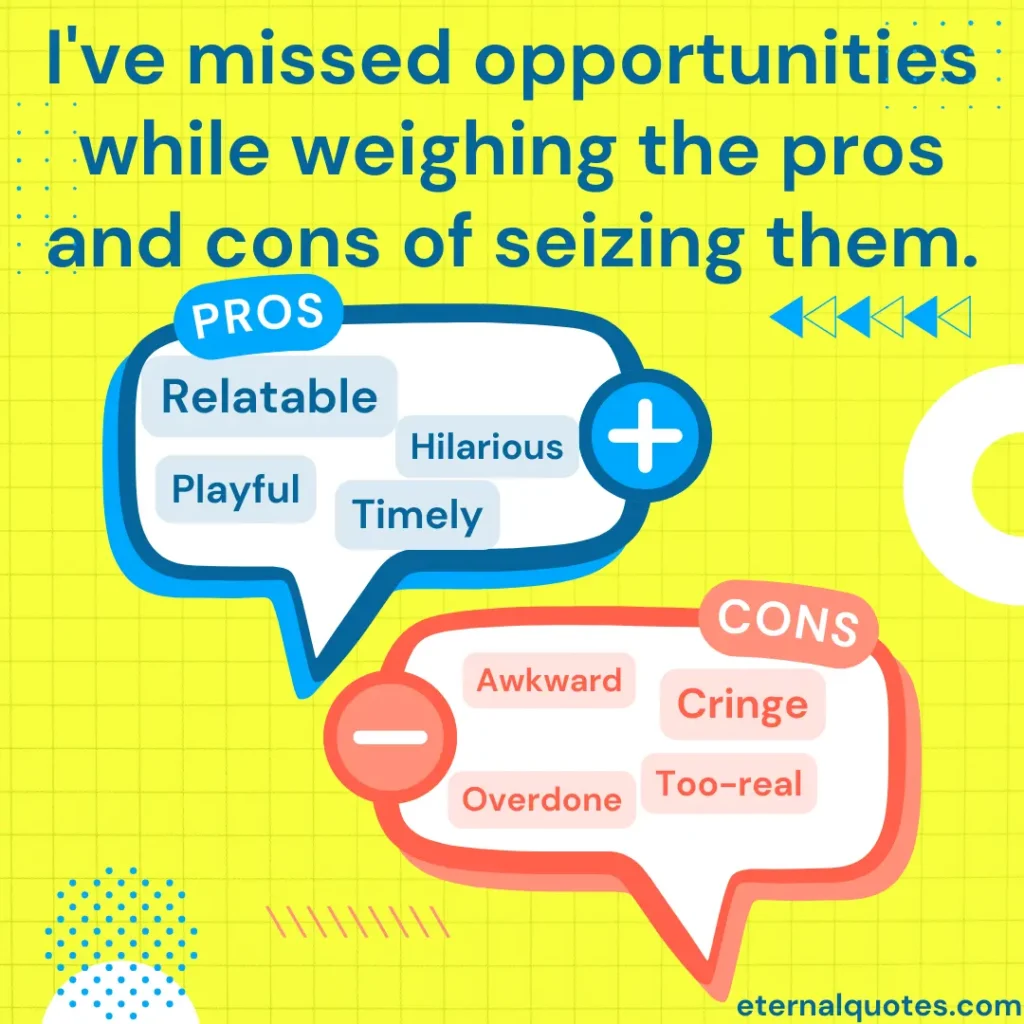
I don’t make decisions – I exhaust all possible alternatives until only one remains standing.
I’ve spent more time deciding what to watch than actually watching anything.
The simplest choices are the hardest because I can see infinite ripple effects.
My grocery shopping takes twice as long because each product comes with a mental debate.
I’ve turned ordering coffee into a philosophical dilemma.
I don’t hesitate – I comprehensively evaluate to the point of paralysis.
Choice is both a freedom and a prison in my overthinking mind.
I could write a dissertation on the implications of my lunch options.
I’ve created decision trees so complex they need their own zip code.
My indecision is actually just hyper-decision making.
The Silver Linings
Even difficult habits often contain qualities that are easier to recognize from a distance. A mind that thinks too much can also be a mind that notices what others overlook, prepares well, and senses emotional undercurrents with unusual clarity. The same sensitivity that causes strain can also create depth. Not every part of overthinking is useless simply because some parts are painful.
That does not mean the struggle should be romanticized. It only means that a restless mind is rarely one-dimensional. Beneath the worry there is often imagination, empathy, caution, and a serious wish to do right by life and by other people. Sometimes the challenge is learning how to keep the insight without letting it harden into constant mental pressure.
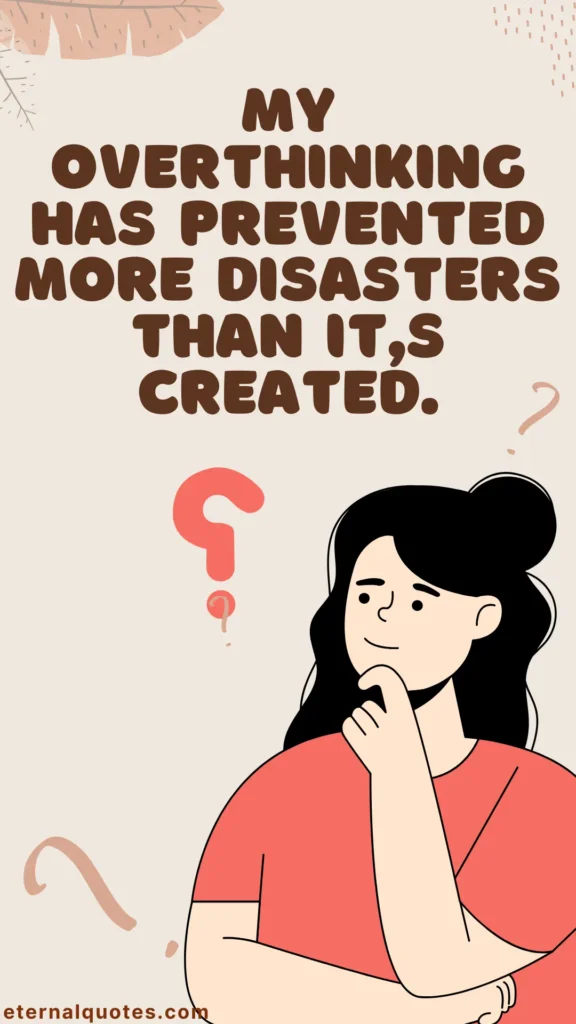
I may overthink, but I’m rarely blindsided.
My preparation is mistaken for paranoia until it becomes valuable foresight.
Overthinking has made me the emergency contact everyone relies on.
I’ve thought through problems so thoroughly that solutions come naturally.
My overthinking makes me extraordinarily empathetic – I’ve already considered every perspective.
I notice details others miss because my mind never rests on the surface.
The depth of my thinking matches the depth of my caring.
My overthinking has built mental muscles others lack.
I don’t just see the world – I see its infinite possibilities.
My overthinking mind creates worlds that my creative outputs benefit from.
When the Mind Refuses to Settle
A restless mind can make ordinary life feel much heavier than it looks. Small moments stretch longer, decisions collect extra weight, and silence rarely stays empty for very long. It is not always dramatic from the outside, but inside it can feel like a constant hum that never fully turns off. That kind of inner noise changes the texture of a day.
One of the hardest parts is that overthinking often disguises itself as responsibility. It tells you that more analysis will finally bring safety, clarity, or control, even when the opposite is happening. So you keep returning to the same thoughts, hoping they will eventually resolve into certainty. Most of the time, they only become more familiar.
Still, a mind like this is not simply a burden. It is often tied to sensitivity, imagination, memory, and the instinct to look beneath the obvious. People who think deeply tend to feel deeply too, even if they do not always show it in visible ways. The challenge is not becoming less thoughtful, but learning how to live without being ruled by every thought that arrives.
There is also a quiet grief in realizing how much time can be lost to inner rehearsals and private debates. Hours disappear into possibilities that never happen, conversations that cannot be changed, and fears that were never asked to prove themselves. That awareness can sting, but it can also be clarifying. It reminds you that mental effort is not always the same thing as wisdom.
At some point, peace begins to matter more than perfect understanding. Not every feeling needs a theory, not every silence needs interpretation, and not every future needs to be pre-lived in advance. A thought can exist without being followed to the end of the maze. That is a difficult lesson, but it is often a necessary one.
What remains is the simple truth that living with an overactive mind requires patience. It asks for gentleness in places where self-criticism usually rushes in first. It asks you to notice when reflection has turned into punishment, and when caution has turned into captivity. A mind may stay busy, but it does not have to be at war with itself forever.