Just so you know – some links on this page are affiliate links. If you click and buy something, I may earn a small commission (think coffee money, not a luxury vacation) at no extra cost to you. I only share things I genuinely like and believe are worth it. Thanks for supporting this little corner of the internet – it really helps keep everything running.
Work settles itself into the shape of everyday life more than most people expect. It structures our mornings, fills our conversations, and quietly influences our mood long after the day ends. Even when a job is manageable, it still comes with repetition, friction, and all kinds of small emotional weather. A lot of what makes work memorable is not the grand milestones, but the steady accumulation of ordinary moments.
Most workplaces run on routines that are both useful and slightly absurd. People learn the timing of each other’s habits, the unwritten rules of shared spaces, and the subtle performance of seeming composed when they are anything but. There is often a strange mix of professionalism and chaos sitting side by side. That contrast is part of what makes work life so recognizable no matter the industry.
Humor has a way of slipping into places where pressure likes to build. It softens the edges of stress without pretending the stress is not real. A difficult day can still contain something ridiculous, badly timed, or unintentionally funny. Sometimes that small moment of humor is the only thing that keeps the whole day from feeling heavier than it needs to.
People rarely talk enough about the mental texture of work. The fatigue is not always dramatic, and neither is the frustration. Sometimes it looks like staring at an inbox too long, reheating the same coffee twice, or trying to gather patience for one more conversation that did not need to happen. Those experiences can feel minor on their own, but together they create the emotional atmosphere of a workday.
At the same time, there is something oddly humanizing about all of it. Work exposes habits, tempers, coping mechanisms, and the little rituals people build to get through demanding stretches. It reveals how much people rely on timing, tone, and shared understanding just to move through the day without friction. Even the awkward and annoying parts say something honest about how people adapt.
That is probably why workplace humor lasts. It is not only about making light of responsibility, but about recognizing the reality people are already living through. A joke lands because it touches something familiar, something people have felt in their shoulders, their schedule, or the silence after an unnecessary meeting. In that way, work becomes more than a task list – it becomes a whole social world with its own strange logic.
Monday Struggles
Monday has a reputation for a reason. It asks people to move too quickly from private time back into structure, noise, and obligation. The shift can feel abrupt even after a restful weekend, and especially after one that disappeared too fast. There is often a dull resistance in the air before the day has properly started.
What makes Monday especially difficult is not always the workload itself, but the emotional reentry. It is the return of alarms, inboxes, unfinished threads, and the expectation that energy should arrive on command. A lot of people are still catching up with themselves while the week is already moving. That tension gives Monday its own particular kind of heaviness.
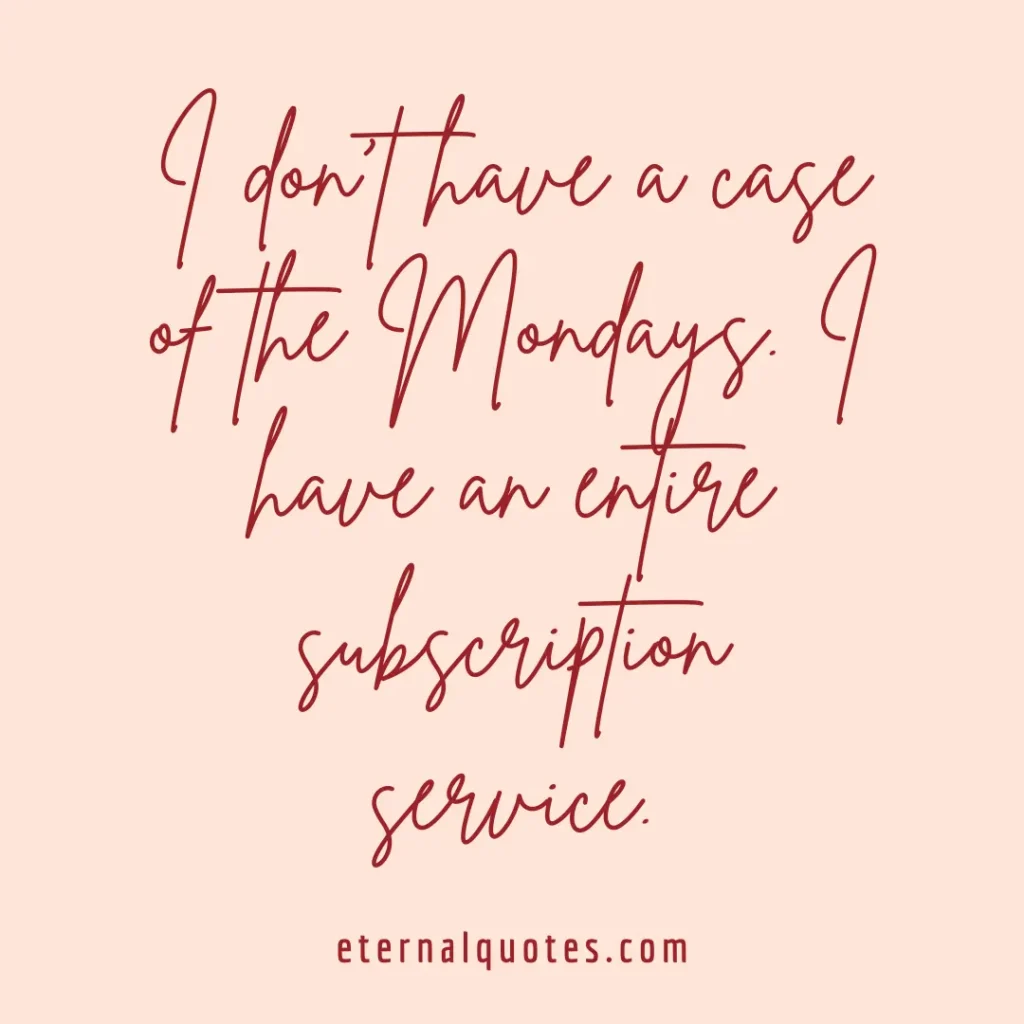
Monday should be optional, like putting pants on for Zoom calls.
I love when people ask how my weekend was at 9:05 AM on Monday, as if I’ve emotionally processed anything yet.
My coffee tastes a lot like I still hate everyone and everything this Monday morning.
Monday is like a math problem. Add the irritation, subtract the sleep, multiply the problems, divide the happiness.
I’m not saying I hate Mondays, but if my coffee mug says “I can’t even,” it’s definitely a Monday.
Monday and I are in a long-term relationship. I hate Mondays, and Mondays hate me back.
Monday morning comes with a special question: “Is it too late to become a professional lottery winner?”
Nothing says Monday like contemplating if your job is worth giving up naptime for.
The only thing worse than Monday is realizing it’s Tuesday, not Wednesday.
Starting the week with “Let’s circle back” is corporate for “It’s Monday and I can’t deal with this yet.”
Office Politics
Every workplace has its own invisible map of influence. Some of it appears in job titles, but a lot of it lives in tone, proximity, timing, and who gets listened to without having to repeat themselves. People learn quickly that offices are rarely powered by logic alone. Personal dynamics tend to shape more than anyone admits out loud.
That is part of what makes office politics so exhausting. It asks people to pay attention not only to the work, but to the mood around the work. Small gestures start to carry weight, and ordinary decisions can feel loaded with implication. Even routine interactions can take on a layer of strategy when the atmosphere gets tense enough.
More Quotes You May Enjoy
My boss asked me to embrace the company culture, so I’m now also hiding in the bathroom scrolling through social media.
Office politics is like chess, except the board is on fire, the pieces hate you, and the rules change hourly.
I’ve worked here so long I remember when the office fridge policy was “common courtesy” instead of a three-page legal document.
If you want to know who has the real power in an office, look for the person who controls the thermostat.
I’m not saying my boss plays favorites, but some of us get “constructive feedback” while others get “development opportunities.”
Corporate hierarchy is just a fancy term for “who can get away with coming in late.”
That awkward moment when you realize your work nemesis and your boss are suddenly best friends on Instagram.
I finally figured out our company values: maximum work, minimum resources, and zero credit.
The unwritten rule of our office kitchen: The person who finishes the coffee never makes a new pot, and the person who makes a new pot never gets to drink it.
I’ve learned that “team building” is corporate code for “we’re going to make you uncomfortable in new and creative ways.”
Meeting Madness
Meetings have a way of expanding to fill whatever time is given to them. What begins as a simple check-in can slowly gather side topics, repeated points, and a layer of polite performance that leaves everyone more tired than informed. The real strain often comes from how often attention is demanded without anything meaningful being resolved. By the end, it is not always clear what moved forward at all.
Part of the frustration is how much inner life gets hidden during these moments. People nod, summarize, and stay visibly engaged while privately drifting somewhere else entirely. A meeting can require a strange mix of stillness and endurance, especially when the conversation circles itself for too long. That contrast between appearance and reality is what makes it such a familiar workplace ritual.
I’ve reached that point in my career where I schedule meetings to avoid other meetings.
Please excuse me while I translate “Let’s take this offline” to “I don’t want to argue with you in front of everyone.”
I survive meetings by mentally calculating how much the company is spending on everyone’s time to discuss absolutely nothing.
The only marathon I run is back-to-back meetings where I pretend to be interested.
That moment when someone asks if you have any questions at the end of a meeting, and you’ve been mentally grocery shopping for the past 45 minutes.
If meetings were food, most would be empty calories.
I’m not saying my day is packed with useless meetings, but my most productive work happens during five-minute bathroom breaks.
A calendar invite with no agenda is just a surprise party for your productivity.
“Brainstorming session” is corporate for “I have no ideas, please help.”
The real skill in virtual meetings is knowing exactly when to unmute without accidentally sharing your true thoughts about the meeting.
Coffee Dependency
Coffee becomes more than a drink in working life. It turns into a pause button, a small reward, a ritual before concentration, or a thin line between patience and irritation. People reach for it not only because they are tired, but because it gives shape to the day. It offers a moment that feels predictable when everything else feels rushed.
There is also something communal about it. The coffee machine, the mug on a desk, the repeated question of whether anyone wants another cup – all of it becomes part of workplace rhythm. Even people who joke about needing it are usually pointing to something real underneath. Fatigue, pressure, and routine often gather around the same warm habit.
I don’t have a caffeine addiction. I have a protective barrier between everyone else and what I really want to say to them.
My blood type is coffee negative, meaning I turn negative without coffee.
Scientists recently discovered that the most efficient fuel for office productivity is coffee and impending deadlines.
Behind every successful person is a substantial amount of coffee and a mild panic attack.
Coffee: because “rage-filled psychopath” isn’t an acceptable job title.
I told my boss I’m a morning person. What I meant was “I’m a ‘after I’ve had three cups of coffee’ person.”
The best part of waking up is remembering the office has better coffee than I do at home.
My productivity directly correlates with the coffee-to-blood ratio in my system.
I measure time in coffee spoons: one cup = sane, two cups = functional, three cups = unstoppable, four cups = someone please hide the “reply all” button.
Coffee doesn’t ask questions, coffee understands. That’s why it’s my only coworker I trust.
Deadline Drama
Deadlines bring clarity, but they also bring distortion. As the clock gets tighter, priorities sharpen while patience tends to disappear. Small tasks suddenly feel loaded, and ordinary setbacks become far more dramatic than they would have seemed a week earlier. Time pressure changes the emotional tone of work almost instantly.
What makes deadlines so intense is how they compress thought and feeling at the same time. People start measuring everything against what still remains undone, even when they are already doing their best. The body feels it too – in rushed breaths, restless focus, and that low-level sense of urgency that follows you home. Pressure may produce motion, but it rarely produces peace.
Nothing inspires creative solutions quite like a deadline that was moved up “just a little bit.”
My deadline response time has three settings: plenty of time, plenty of panic, and plenty of excuses.
I’m most productive during the last 30 minutes before a deadline, which is why I postpone starting for as long as possible.
Deadline: a mythical point in time when managers expect miracles to occur.
I work best under pressure, which is why I ignore projects until I can feel the deadline breathing down my neck.
The only deadline I consistently meet is clocking out.
Deadlines are like dominos – one falls and suddenly your entire month is a disaster.
I told my boss I missed the deadline because of “technical difficulties,” which is technically true if we count my difficulty with caring enough to do it.
I’ve noticed that impossible deadlines often come from people who won’t be involved in the actual work.
The deadline was 5 PM, but in my time zone – procrastination standard time – we still have hours to go.
Work-Life Balance
Work-life balance is often spoken about as if it were a clean equation, but most people experience it as a constant adjustment. Boundaries blur easily when work can follow you through phones, tabs, and unfinished thoughts. Even after the day ends, the mind does not always clock out with the body. That is part of why balance can feel more aspirational than stable.
Still, the desire for balance points to something deeply reasonable. People need room to return to themselves without every spare hour being shaped by productivity. Rest is not only about sleep, but about having time that is not already claimed by someone else’s urgency. When that space gets too small, life starts to feel narrower than it should.
My out-of-office message should just say: “I’m pretending to be unreachable while checking email every 10 minutes anyway.”
I practice work-life balance by bringing my stress home and my laziness to work.
My work-life balance is basically just me staying up late to reclaim some personal time, then being too tired to do anything but work the next day.
I finally achieved work-life balance: I’m equally behind in tasks at work AND at home.
Work hard, play hard, collapse from exhaustion even harder.
The modern work-life balance: using your lunch break to schedule all your doctor’s appointments for the next year.
I told my boss I needed better work-life balance, and they suggested I bring pictures of my family to my desk.
My personal time is the gap between when I close my work laptop and open it again to check “just one more email.”
I’m on a seafood diet at work. I see food in the break room, and I eat it.
Work-life balance means I split my anxiety equally between career failures and personal ones.
Tech Troubles
Technology promises efficiency, but it often introduces a new category of frustration instead. When everything works, it disappears into the background and gets taken for granted. When it fails, even simple tasks can become strangely dramatic. A frozen screen or broken login has a way of making people feel instantly helpless and irritated.
Part of the stress comes from how dependent modern work has become on systems most people cannot fully control. Passwords, updates, platforms, permissions, sync issues – so much of the day rests on things that can collapse without warning. It is hard not to take that personally after the third interruption. Technical problems may be ordinary, but they never feel small in the moment.
I don’t always test the software, but when I do, I do it in production.
IT support asked if I tried turning it off and on again. I wanted to ask if they tried explaining tech issues without sighing first.
The “unexpected error” message would be more helpful if it explained what error the computer WAS expecting.
That moment when your computer crashes and you try to remember the last time you saved your work, your soul leaving your body.
Technology is supposed to make work easier, which explains why I spend half my day updating passwords.
The three most terrifying words in business: “Software update required.”
My computer isn’t slow. It’s just thorough.
The cloud is just someone else’s computer that also hates you and your deadlines.
Error 404: Motivation not found.
I’m not saying IT is avoiding me, but my ticket from 2019 just got marked as “in progress.”
Email Overload
Email was meant to simplify communication, but it often multiplies it instead. Messages pile up faster than attention can follow them, and each new subject line arrives with its own implied demand. Some emails require action, some require interpretation, and some exist only to widen the circle of stress. It is easy for the inbox to become less of a tool and more of a constant backdrop of pressure.
There is also something uniquely draining about how email fragments the day. Focus gets interrupted by pings, follow-ups, forwarded threads, and the need to sound measured while moving quickly. Tone becomes its own form of labor, especially when people are tired or already overloaded. The inbox asks for emotional management as much as administrative effort.
Inbox zero is a fantasy story we tell children and new employees.
My out-of-office reply should just redirect people to my therapist.
I’m great at multitasking – I can waste time, be unproductive, and miss deadlines all while looking at my emails.
My email has two categories: “Urgent!” and “Can safely ignore until someone mentions it in person.”
Nothing says “I don’t really want to deal with you” quite like “As per my previous email…”
Apparently “FYI” stands for “Find Yourself Involved” despite not being needed in this conversation.
CC stands for “Career Consequences” for everyone who now has to pretend they’re following this thread.
The most productive thing I did today was declare email bankruptcy.
That feeling when someone replies-all to an email chain that already has 37 messages saying “please remove me from this list.”
I judge how difficult my day will be by how many emails contain the phrase “moving forward.”
Office Small Talk
Small talk at work sits in an odd space between courtesy and endurance. It helps smooth out daily contact, but it can also feel repetitive in a way that leaves people quietly drained. The same familiar questions come around again and again, often without room for honest answers. What remains is a kind of social choreography that everyone knows how to perform.
Still, there is something revealing about these little exchanges. They show how people try to maintain ease, familiarity, and connection in spaces where deeper conversation is not always possible. A passing comment in a hallway or kitchen can carry more awkwardness than substance, but it also reflects a basic human effort to keep things warm enough. Even shallow conversation has its own purpose in shared environments.
The weather exists solely to give coworkers something to talk about in elevators.
Work friends are people you’d never speak to again if one of you changed jobs, yet somehow know their children’s names and food allergies.
The microwave is the office’s true water cooler – the place where you’re forced to make small talk while watching someone’s leftovers spin.
I’ve perfected the art of nodding while walking so I don’t have to stop for hallway conversations.
How long do you have to work with someone before you can admit you’ve forgotten their name and now it’s too late to ask?
Office small talk always feels like those first awkward minutes of a blind date, except it’s been going on for seven years.
I’ve run out of appropriate responses to “How are you?” that aren’t just screaming into the void.
That awkward moment when you and a coworker walk the same direction after saying goodbye.
My boss keeps asking how my weekend was, as if I did anything besides recover from working here.
I’ve memorized three personal facts about each coworker so I can rotate through them for the next decade.
Friday Celebrations
Friday changes the atmosphere of work in a way that is hard to fake. People move differently, speak differently, and hold their tasks a little more lightly. Even when the workload remains unfinished, the day carries the relief of temporary release. The week loosens its grip, and that alone can make everything feel more bearable.
Part of Friday’s appeal is what it represents rather than what it contains. It offers the promise of unstructured hours, of waking without urgency, of briefly belonging to yourself again. That sense of approaching freedom can make even a difficult day feel easier to survive. Relief has its own kind of energy, and Friday is full of it.
The most productive work minutes of the week are the five minutes before leaving on Friday.
That Friday feeling when your productivity drops faster than your standards for what counts as “done.”
I’ve learned that “casual Friday” refers to my attitude toward work, not just my clothing.
Friday is like a superhero that always arrives just in time to save me from my job.
Nothing tests your integrity quite like your boss asking if you can do “one quick thing” at 4:55 PM on a Friday.
My weekend plans? Sorry, I don’t discuss fiction during business hours.
My Friday productivity can be measured in how many times I’ve looked at the clock.
Friday afternoon meetings should be illegal under the Geneva Convention.
The sound of everyone packing up to leave on Friday afternoon is nature’s most beautiful symphony.
I’ve calculated that between 3 PM and 5 PM on Fridays, the company pays me entirely to mentally plan my weekend.
The Strange Fellowship of Work
Work can be frustrating in ways that are repetitive, petty, and surprisingly personal. A bad system, a tense conversation, or an unnecessary email can stay with someone longer than it should. Yet people keep finding ways to move through it, often with more grace than they are given credit for. That quiet endurance says something real about the ordinary strength built into working life.
A lot of what makes work difficult is also what makes it strangely communal. The annoyances are rarely unique, even when they feel isolating in the moment. Other people know the same tiredness, the same forced politeness, the same private countdown to the end of the day. That shared recognition can make a workplace feel less cold, even when the circumstances are far from ideal.
Humor matters because it creates breathing room. It does not solve poor management, long hours, or systems that make simple things harder than they need to be. What it can do is interrupt the weight of all that for a moment and make it feel more livable. Sometimes a dry observation or a well-timed joke is the most honest response a person has.
There is also something worth noticing in the routines people build around survival. The walk to refill a mug, the look exchanged during a pointless meeting, the small rituals around ending the week – these things can seem insignificant from the outside. Inside a workday, they become ways of holding onto some sense of self. People are often more creative in coping than they realize.
Not every hard day at work carries meaning, and not every inconvenience needs to teach a lesson. Sometimes the printer jams, the meeting drags, the inbox swells, and the mood stays low until evening. Still, even in that kind of plain exhaustion, people keep showing up and finding a way through. There is a quiet dignity in that, even when nobody names it.
Maybe that is why work remains such a deep source of both irritation and recognition. It is where people perform, adapt, hold back, overextend, and occasionally laugh at the whole strange setup together. Beneath the deadlines and routines, it is still a deeply human environment filled with limits, habits, moods, and need. And sometimes seeing that clearly is enough to make the day feel a little lighter.