
Just so you know – some links on this page are affiliate links. If you click and buy something, I may earn a small commission (think coffee money, not a luxury vacation) at no extra cost to you. I only share things I genuinely like and believe are worth it. Thanks for supporting this little corner of the internet – it really helps keep everything running.
Being around children has a way of changing the pace of a room. They notice things adults walk past, ask questions adults stopped asking, and react without the layers of caution that usually come with age. That kind of presence can feel refreshing, but it can also feel confronting. It reminds us how much of life becomes filtered over time.
Children live close to what they feel. Their delight is immediate, their frustration is honest, and their curiosity tends to move faster than any tidy explanation we try to give. They are still learning the shape of the world, but in many ways they move through it more directly than grown people do. That is part of what makes them so difficult to ignore.
To care for a child, teach one, or simply spend time with one is to be reminded that development is never neat. Growth comes with noise, contradiction, repetition, and surprise. Some days it looks playful and light, and other days it feels exhausting in ways that are hard to describe. Both sides belong to the same picture.
Adults often speak about childhood as if it were simple, but it rarely is. It is full of first encounters, strong feelings, shifting boundaries, and an endless effort to make sense of what is happening. Even the happiest childhood contains confusion and vulnerability. That is part of why gentleness matters so much during those early years.
At the same time, children do not only need guidance from adults. They also influence the people around them in quiet and lasting ways. They pull forgotten parts of us back to the surface – patience, playfulness, protectiveness, and sometimes grief for what has been lost. They can make a person look at their own life more closely than they meant to.
The word kid carries more than age. It brings with it a whole world of memory, responsibility, innocence, humor, strain, and hope. It can mean chaos in one moment and tenderness in the next. Few things reveal the heart of a person, a family, or a society more clearly than the way they make space for a child.
Raising Kids
Raising children asks more of a person than most things do. It is not only about keeping them safe or helping them grow, but about showing up again and again even when you are tired, uncertain, or stretched thin. The work is constant, but so is the invitation to become softer, steadier, and more honest with yourself. Few roles expose both your love and your limits so clearly.
Parenting is often spoken about in big milestones, yet much of it happens in ordinary moments. It lives in repeated reminders, small routines, hard conversations, and the way a child learns what home feels like from the people around them. What matters is not perfection but consistency, repair, and the feeling that someone is truly there. Over time, that kind of presence becomes its own kind of shelter.
The best way to keep kids out of trouble is to keep trouble out of kids.
You know your kids are growing up when they stop asking where they came from and refuse to tell you where they’re going.
Having one kid makes you a parent; having two makes you a referee.
If you want your kids to listen, try talking softly to someone else.
Behind every great kid is a parent who’s pretty sure they’re screwing it all up.
Raising kids is like a walk in the park – Jurassic Park.
Kids go where there is excitement; they stay where there is love.
Before I had kids, I had six theories about raising children. Now I have six kids and no theories.
The art of raising kids is finding the balance between protecting them from the world and preparing them for it.
Kids don’t need a perfect parent, just a present one.
Kid Wisdom
Children often arrive at the heart of something faster than adults do. They are less practiced in pretending, less attached to convention, and more willing to keep asking when an answer does not make sense. That can be inconvenient, especially when their honesty unsettles the rules everyone else has agreed to follow. Still, there is a kind of clarity in that refusal to go along blindly.
Wisdom in childhood does not usually sound polished or impressive. It appears in plain words, awkward timing, and questions that expose what grown people have learned to avoid. A child may not have experience, but they often notice what is fair, what feels true, and what is being left unsaid. That kind of insight has its own authority, even when it arrives in a small voice.
Sometimes the smallest things take up the most room in your heart – that’s what every kid teaches us.
Sometimes you need to see things through the unfiltered lens of a kid to appreciate their true beauty.
The wisdom of a kid often surpasses the knowledge of scholars.
When a kid asks why, they’re not just seeking answers – they’re teaching us to question our assumptions.
The most insightful feedback you’ll ever receive will come from a kid who hasn’t learned to filter their thoughts.
Kid wisdom comes wrapped in innocent questions that make adults uncomfortable.
You’re never too old to learn from kid logic – it cuts through complications we create.
Listen carefully when a kid speaks their truth – they haven’t yet learned which truths are “acceptable” to voice.
The best philosophers are often disguised as kids asking “Why?” for the fifteenth time.
A kid’s perspective on fairness is the purest form of ethical reasoning.
Inner Child
Most adults carry earlier versions of themselves more visibly than they realize. Beneath the routines and responsibilities, there is often a part that still remembers what felt exciting, what felt frightening, and what it meant to move through the world with less control. That part does not disappear simply because a person gets older. It just becomes easier to silence.
Staying connected to that inner life is not the same as refusing to grow up. It is more about keeping some openness alive – the ability to play, to imagine, to feel deeply, and to be moved without immediately hardening against it. When that part is neglected for too long, life can start to feel efficient but flat. Reconnection often begins with allowing yourself to care about what once came naturally.

We don’t stop playing because we grow old; we grow old because we stop playing with our inner kid.
Your inner kid never dies – it just needs permission to come out and play.
Success is still having your inner kid intact after surviving adulthood.
When life gets complicated, let your inner kid make the decisions for a while.
Sometimes the wisest thing to do is to listen to your inner kid.
Happiness is rediscovering your inner kid after years of pretending to be a grown-up.
The cure for burnout is to wholeheartedly reconnect with your inner kid.
Your inner kid knows what brings you joy – maybe it’s time to start listening.
The creative genius in each of us is just our inner kid with professional training.
Mental health is maintaining a friendship with your inner kid while navigating an adult world.
Teaching Kids
Teaching a child is never limited to information. Long before facts are remembered, children are learning tone, attention, patience, and whether the person in front of them believes they are worth the effort. Education happens in relationship as much as in instruction. The way something is taught often stays with a person longer than the lesson itself.
Children do not come to learning as blank pages, even when adults speak as if they do. They arrive with temperament, questions, sensitivities, fears, and their own way of making sense of things. Good teaching makes room for that complexity instead of trying to flatten it. It understands that growth is not always visible in the moment, even when something important is taking root.
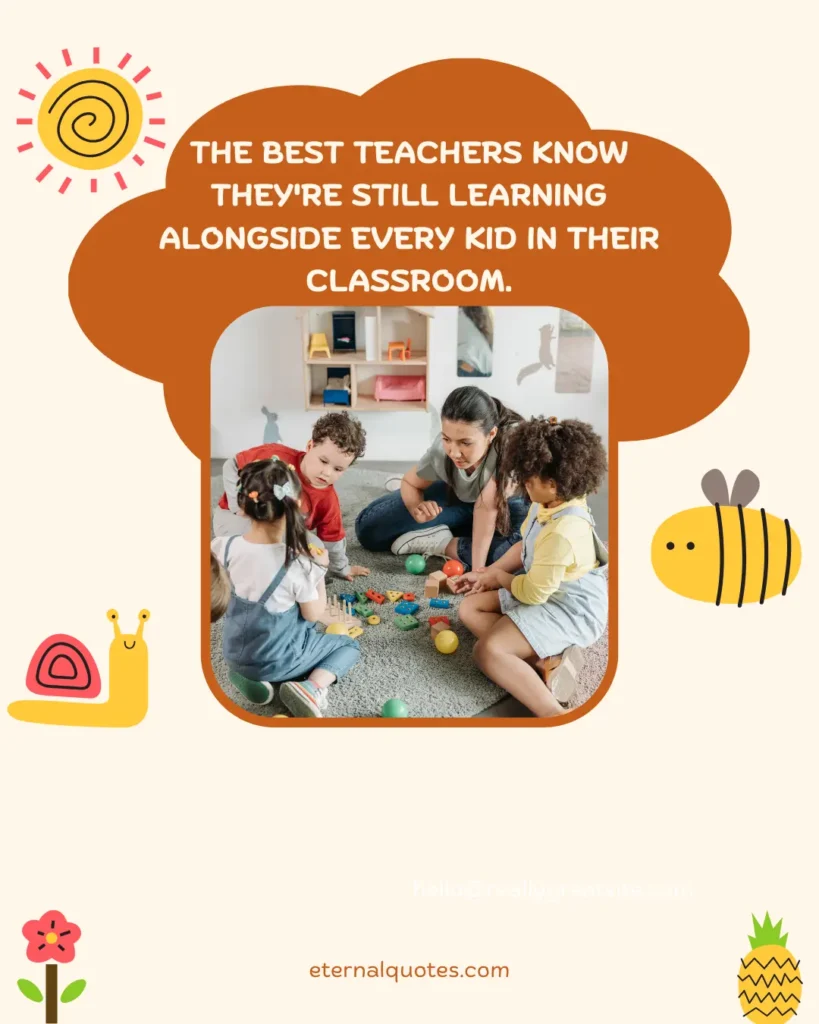
Teaching kids to count is fine, but teaching them what counts is everything.
You can teach a kid a lesson for a day, but if you teach curiosity, they will learn for a lifetime.
Teaching kids requires patience, humor, and the occasional ability to ignore things you just saw happen.
The challenge in teaching kids isn’t sharing knowledge but awakening their desire to know.
Teaching kids is the profession that creates all other professions.
It takes a special person to hear what a kid isn’t saying.
Teaching kids is planting seeds you may never see bloom.
Every kid needs a champion – a teacher who will never give up on them.
Teaching kids to be kind is more important than teaching them to be right.
The best curriculum for teaching kids is one built around their questions, not our answers.
Kids and Time
Time feels different around children. Adults tend to divide life into schedules, deadlines, and long-range plans, while children are often more rooted in what is happening right now. That difference can be frustrating, but it can also be revealing. It shows how much of adulthood is spent reaching ahead while childhood stays close to the moment at hand.
At the same time, nothing makes time feel sharper than watching a child grow. Small habits disappear, voices change, faces stretch toward adolescence, and stages that felt endless suddenly seem brief. The ordinary days are easy to underestimate while you are living them. Later, they are often the ones that return most vividly.
Nothing makes you realize how quickly time passes like watching a kid grow up.
Being a kid is all about living in a timeless state where the future seems impossibly distant.
You spend the first twelve years of your kid’s life trying to teach them to walk and talk, and the next twelve telling them to sit down and shut up.
There’s no time machine like memory to take you back to being a kid.
The days with young kids are long, but the years are short.
Any kid will run any errand for you if you ask at bedtime.
Childhood is the one time in our lives when time moves too slowly for the kid and too quickly for the parent.
The time spent playing with a kid is never wasted time.
Telling a kid “we’ll see” buys you time but costs you trust.
The best time to be a kid is when your only worry is being called in for dinner.
Kids and Joy
Children often meet joy with their whole bodies. They laugh without holding back, become absorbed in small discoveries, and let delight interrupt whatever came before it. That kind of openness can seem simple from the outside, but it rests on something many adults struggle to recover. It comes from not yet having learned to treat wonder as a waste of time.
Being near that energy can be both comforting and bittersweet. It reminds people that joy is not always found in achievement or control, but sometimes in attention, play, and the freedom to be fully present. Children do not always stay in those moments for long, yet they enter them completely. There is something healing about witnessing that kind of wholeheartedness.
Happiness is the art of being satisfied with what you have, a skill every kid masters before adults teach them otherwise.
Joy is contagious when you’re around a kid discovering something for the first time.
There’s no greater joy than seeing the world through a kid’s eyes.
When a kid laughs, all is right with the world, if only for a moment.
Joy is not in things; it is in the unbridled enthusiasm of a kid experiencing life.
The secret of happiness is to preserve the kid in your heart.
No one can feel joy quite as purely as a kid on Christmas morning.
Having a kid doubles your joy and divides your sleep.
The greatest joy comes from doing what people say you cannot do – a lesson every kid learns while climbing a tree they were told was too high.
If you want to rediscover joy, spend a day following the lead of a kid.
Difficult Kids
Some children are described as difficult long before anyone has really tried to understand them. Their behavior may be loud, defiant, withdrawn, impulsive, or hard to manage, and adults often respond first to the disruption rather than the need underneath it. Yet children rarely act in a vacuum. What looks challenging on the surface is often tied to fear, frustration, overwhelm, or a life that has asked too much of them too soon.
Meeting that kind of child well requires more than control. It asks for steadiness, boundaries, curiosity, and the willingness to see a person where others see only a problem. This does not make the work easy, and it does not erase the strain. But it shifts the focus from punishment alone to relationship, which is often where real change begins.
Behind every difficult kid is an untold story they don’t have words for yet.
The kid who challenges you the most is the one who needs you the most.
What we call a difficult kid today may be tomorrow’s innovator who refused to follow norms.
When a kid acts out, they’re not giving you a hard time – they’re having a hard time.
The most difficult kid in the room is carrying the heaviest burden.
A difficult kid doesn’t need to be fixed – they need to be understood.
The kid who seems impossible to reach may be the one most worth reaching.
Labels like “difficult kid” often mask exceptional qualities waiting to be channeled.
Many so-called difficult kids are just square pegs being forced into round holes.
Sometimes the most difficult kid to love is the one who needs love the most.
Kids and Society
The way a society treats children says more about its values than many of its public statements do. Children rely on the decisions of adults without having much power over them, which makes them especially vulnerable to neglect, prejudice, and short-sighted thinking. It is easy for communities to speak about the future in abstract terms. It is harder, and more honest, to look at the actual conditions children are living in now.
Every child grows inside a larger atmosphere made by families, schools, neighborhoods, systems, and cultural habits. What adults normalize around them becomes part of how they interpret safety, difference, fairness, and belonging. That is why responsibility does not stop at the household door. A child is shaped not only by who loves them, but also by the wider world that receives them.
A society grows great when old men plant trees in whose shade they know they shall never sit – the same is true when we invest in every kid.
Kids are excellent judges of character; perhaps society should pay more attention to which adults kids naturally trust.
We’re building society for the kid of today who will lead tomorrow.
Kids don’t see differences until society teaches them to look.
Society measures its progress by how it treats its most disadvantaged kid.
What we whisper about others around our kitchen tables becomes the worldview of the next kid to lead our society.
A society that fails its most vulnerable kid has no future to speak of.
Kids adapt to society’s expectations; perhaps we should examine what we’re asking them to become.
Society worries about what a kid will become tomorrow, yet forgets that they are someone today.
The kid who doesn’t fit into society often grows up to improve it.
Famous People on Kids
When well-known voices speak about children, what stands out is often not status but recognition. Across different fields and generations, people keep returning to similar truths about childhood – its sensitivity, its force, its vulnerability, and its effect on everyone around it. That repetition matters because it suggests something deeper than a passing sentiment. It shows how often children become the measure by which adults understand what really matters.
Famous names may give a thought more visibility, but the subject itself remains familiar and close to ordinary life. Children bring out strong reflections because nearly everyone has known childhood from the inside, and many spend years shaped by the children they raise, teach, or remember being. Public figures are not separate from that human pattern. They are simply another set of people trying to put lasting experiences into words.
Kids are like wet cement – whatever falls on them makes an impression. – Haim Ginott
The soul is healed by being with kids. – Fyodor Dostoevsky
If you’ve never been hated by your kid, you’ve never been a parent. – Bette Davis
Kids are natural zen masters; their world is brand new in each and every moment. – John Bradshaw
Adult logic often pales beside the wonder of a kid asking “why?” – Neil deGrasse Tyson
To every kid – I dream of a world where you can laugh, dance, sing, learn, live in peace and be happy. – Malala Yousafzai
A kid who reads will be an adult who thinks. – Unknown
We worry about what a kid will become tomorrow, yet we forget that they are someone today. – Stacia Tauscher
Hugs can do great amounts of good, especially for kids. – Princess Diana
There’s no such thing as a kid who hates reading. There are kids who love reading, and kids who are reading the wrong books. – James Patterson
Kids and Imagination
Imagination is one of the most natural ways children move through the world. They shift easily between what is real and what is possible, not because they are confused, but because possibility feels close at hand. A chair becomes a fortress, a box becomes a spaceship, and an ordinary afternoon becomes a story worth entering. That instinct gives childhood much of its texture and freedom.
As people get older, imagination is often pushed behind usefulness, productivity, and proof. Yet it remains tied to creativity, resilience, problem-solving, and the ability to see beyond what already exists. Children remind us that imagination is not separate from understanding the world. In many ways, it is one of the first tools we have for making sense of it.
Imagination is the one gift every kid is born with that education often stifles.
The creative adult is the kid who survived.
Logic will get you from A to B. Imagination will take a kid everywhere.
Adults struggle for creativity while every kid effortlessly invents worlds beyond our comprehension.
What a kid can do with a cardboard box puts most screenwriters to shame.
The distance between reality and imagination is shorter when you’re a kid.
A kid’s imagination needs no charging and has unlimited data.
When a kid plays, they’re not just enjoying themselves – they’re rehearsing their understanding of the world.
Imagination is the passport a kid uses to travel anywhere without leaving home.
What Childhood Leaves With Us
Childhood does not stay behind as neatly as people like to imagine. It remains in memory, in reflex, in tenderness, in fear, and in the countless small ways adults respond to the world without always knowing why. A person may grow out of toys, schools, and family homes, but they do not fully grow out of what those early years taught them about love, attention, safety, and belonging. Much of adult life is shaped in conversation with those early impressions.
That is part of why children matter so deeply beyond sentiment. They are not only passing through a stage to be managed until they become more independent or more reasonable. They are building the emotional and moral foundations they will carry into every later relationship. What surrounds them now often echoes for far longer than the adults around them expect.
For adults, thinking about childhood can bring mixed feelings. It may stir affection, regret, gratitude, protectiveness, or a sense of distance from parts of oneself that once felt alive. Sometimes it is comforting, and sometimes it reveals how much was needed and not received. Either way, it tends to bring a person closer to what is most human in them.
Children also remind us that growth is never only individual. Every child is shaped by the quality of attention around them, by the moods in a home, by the patience or impatience of institutions, and by the values a culture repeats until they feel natural. Their lives are personal, but never isolated. To care about children is also to care about the world that is being built around them every day.
What remains striking is how often children return adults to essentials. They draw attention to rhythm, honesty, play, fairness, and the need to be seen clearly. They expose where we are performative, distracted, or emotionally absent. Even when they are difficult, they have a way of pulling life back toward what cannot be faked for long.
Maybe that is why the idea of a kid stays so vivid throughout life. It represents not only youth, but beginning, dependence, possibility, and the fragile ways a person first learns who they are. To think seriously about children is to think seriously about what kind of people we become and what kind of world we make room for. That reflection does not end when childhood does.