
Just so you know – some links on this page are affiliate links. If you click and buy something, I may earn a small commission (think coffee money, not a luxury vacation) at no extra cost to you. I only share things I genuinely like and believe are worth it. Thanks for supporting this little corner of the internet – it really helps keep everything running.
Friendships tend to accumulate their own quiet mythology over time. The nicknames that stuck for no logical reason, the shorthand that needs no explanation, the moments that became permanent fixtures in how you understand yourself. Most of it was never planned. It just settled in, the way good things do.
What makes a friendship genuinely close is hard to put into words, but you always know when it’s there. It’s less about grand gestures and more about the accumulated weight of ordinary moments shared with someone who actually pays attention. That kind of familiarity is rare, and most people who have it don’t talk about it enough.
Close friends have a way of holding a version of you that you sometimes forget exists. They remember who you were before the more polished, careful version of yourself took over. That can be uncomfortable, but it’s also one of the most grounding things another person can offer you.
Humor is woven into most deep friendships in a way that’s hard to separate from the love itself. The jokes land harder because they’re built on years of context. The laughter is easier because nothing needs to be explained or softened first. It becomes its own language.
There’s a particular kind of comfort that comes from being with someone who has no interest in impressing you anymore, and you have none in impressing them. You’ve already seen each other through enough that the performance fell away a long time ago. What’s left tends to be much more honest, and much more enjoyable.
Friendship, at its best, makes ordinary life feel more worth paying attention to. Not because everything becomes exciting, but because having someone alongside you changes how even small things register. The mundane becomes a shared experience, and shared experiences have a way of mattering more than solitary ones ever quite do.
Friends and Their Weird Habits
Every close friendship eventually develops its own catalog of oddities. The habits that would seem strange to anyone else become familiar, even endearing, because you’ve watched them long enough to understand the person behind them. What looks like quirk from the outside is often just someone being completely themselves.
Over time, you stop noticing the strange things and start noticing their absence when the person isn’t around. The weird habits become part of what you’d miss. That’s a quiet but telling measure of how deeply someone has worked their way into your life.
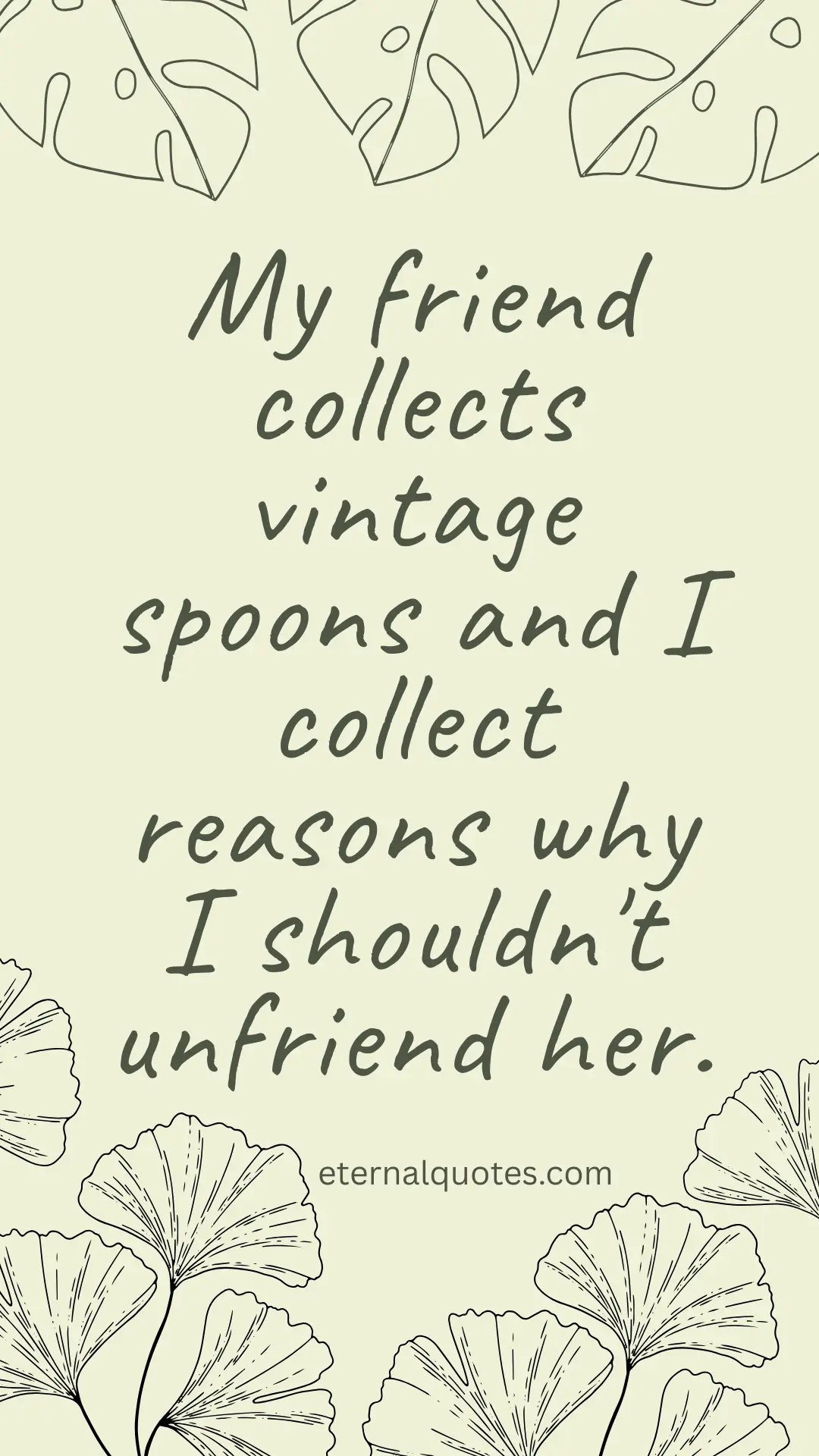
True friends don’t judge you for eating cereal for dinner – they bring the milk.
I love how my best friend thinks talking louder will make her bad singing sound better.
Good friends let you have the last slice of pizza. Best friends order another pizza.
My friend organizes her books by color and I organize my life by chaos – we’re perfect together.
Real friends don’t care that you haven’t washed your hair in three days – they probably haven’t either.
I have a friend who uses GPS to get to places she’s been a hundred times, and honestly, I respect the commitment.
Best friends are people who make your problems their problems so you don’t have to suffer alone.
My friend takes photos of her food before every meal like she’s documenting evidence for a court case.
True friendship is when you can sit in comfortable silence or have the most random 3 AM conversations about whether aliens like pizza.
I love my friend who still sleeps with a stuffed animal and pretends it’s for decoration when people come over.
Looking for Good K-Beauty?
MISSHA has a huge range of Korean skincare and makeup, including some seriously popular bestsellers.
Food Adventures with Friends
Food has a way of becoming central to friendships without anyone really planning it. A shared meal slows things down in a way that not much else does. Conversations go longer, guards come down, and somewhere between the ordering and the bill, something honest usually gets said.
The best food memories with friends aren’t usually the fancy ones. They’re the late-night diners, the splitting of things neither of you could finish alone, the places you returned to so many times they started to feel like yours. Those meals become part of the texture of the friendship itself.
More Quotes You May Enjoy

We’re the type of friends who can finish each other’s french fries and each other’s sentences.
My best friend and I have an unspoken agreement that calories don’t count when we eat together.
True friends don’t let you eat alone – they grab a fork and join the feast.
I love how my friend acts surprised every time I order dessert like she doesn’t know me at all.
Good friends bring snacks to movie night. Great friends bring the snacks you forgot you were craving.
My friend judges my cooking but still shows up for dinner every time I invite her.
We’re not just friends, we’re each other’s official taste testers and food photographers.
Real friendship is when you both order way too much food and nobody feels guilty about it.
My friend has never met a buffet she didn’t want to conquer, and I respect that energy.
Best friends are the ones who know your coffee order by heart and judge you when you try to change it.
Technology and Modern Friendship
Friendship has always adapted to whatever tools people use to stay in touch, and this era is no different. The medium changes but the impulse doesn’t — you find something and your first thought is which specific person needs to see it. The platforms shift; the wanting to share doesn’t.
There’s something worth noticing about how much of a friendship now lives in small digital exchanges. A meme sent at the wrong hour, a voice note recorded mid-thought, a screenshot saved for absolutely no reason. These fragments accumulate into something surprisingly real, even when none of them individually seem like much.
We’ve been best friends for years but I still don’t know how to pronounce her WiFi password.
True friendship is when you share your Netflix password without being asked.
My best friend sends me memes at 2 AM and gets offended when I don’t respond immediately.
We’re the friends who take 47 photos to get one decent group selfie and still look terrible.
Real friends don’t just like your posts – they comment with inside jokes that confuse everyone else.
My friend uses voice-to-text for everything and her messages read like abstract poetry.
Best friends are people who will FaceTime you while you’re both doing absolutely nothing interesting.
We’re the type of friends who have separate group chats to talk about our other friends.
My friend screenshots everything and has basically created a digital museum of our friendship.
True friendship is being tagged in memes that are so accurate they’re slightly concerning.
Shopping and Money Disasters
Money and friendship occupy an interesting space together. Close friends have a way of making you feel like spending is a form of living rather than a lapse in judgment. The logic gets looser when someone you like is standing next to you explaining why you absolutely need the thing you absolutely do not need.
The shared financial disasters of friendship tend to become the stories told most often afterward. The unnecessary purchase, the sale that wasn’t actually a sale, the afternoon that somehow cost three times what either of you planned. In hindsight, most of it was worth it — not for the thing bought, but for the company.
We go shopping for one thing and somehow come home with everything except that thing.
True friendship is lending money and pretending to forget about it until they bring it up.
My best friend enables all my bad financial decisions and I love her for it.
Real friends don’t judge you for buying the same shirt in three different colors.
We’re the type of friends who go window shopping and somehow break our budgets.
My friend can talk herself into buying anything if she mentions it’s on sale.
Best friends are people who will hold your bags while you try on the entire store.
Friendship is when you both agree that retail therapy is a legitimate form of healthcare.
My friend and I have a joint Pinterest board that’s basically a catalog of things we can’t afford.
True friends split the cost of shared regrettable purchases and blame each other equally.
Travel and Adventure Chaos
Traveling with a close friend strips away the version of yourself that likes to appear competent. You get lost together, you make the wrong call together, you eat something questionable together and spend the next hour wondering if you should be worried. It’s revealing in the best way.
The trips that go sideways tend to be the ones remembered most clearly. Not because the disasters were fun in the moment, but because navigating them with someone you trust creates a particular kind of closeness. You learn a lot about a person when the plan has completely fallen apart and you both have to figure out what to do next.
We’re the travelers who get lost in our own hometown but somehow navigate foreign countries.
True friendship is sharing hotel rooms and pretending not to notice each other’s weird sleep habits.
My best friend takes vacation photos like she’s documenting a nature expedition to Walmart.
Real friends don’t judge you for wearing the same outfit three days in a row while traveling.
We’re the type of friends who plan elaborate trips and end up spending most of our time taking naps.
My friend insists on trying local cuisine even when local cuisine is questionable gas station food.
Best friends are people who will split an Uber even when you’re going in opposite directions.
Friendship is agreeing to be each other’s emergency contacts on questionable adventure activities.
My friend and I have the worst sense of direction but the best sense of finding food trucks.
True friends take turns being the responsible one who remembers where we parked the car.
Growing Up Together
Friends who have known you across different chapters of your life carry something no newer friendship quite can. They’ve seen the versions of you that didn’t work out, the phases you’d rather not explain, the person you were when you had no idea yet who you’d become. That history gives a friendship a kind of depth that takes years to build and can’t really be shortcut.
Growing up alongside someone means your memories are braided together in ways you can’t fully untangle. Their recollections fill in gaps in yours. They hold the context for things you’ve half-forgotten. That shared continuity becomes more valuable the older you get, because it keeps some part of your story from being lost entirely.
We’ve been through so many phases together that we’re basically walking embarrassment archives.
True friendship is having someone who knew you before you learned how to pretend to be cool.
My best friend remembers every crush I’ve ever had and brings them up at inappropriate times.
Real friends are people who have photographic evidence of your regrettable fashion choices.
We’re the type of friends who still get excited about the same things we loved as kids.
My friend and I have inside jokes that are so old we forgot what they originally meant.
Best friends are people who can make you feel 12 years old again just by saying one word.
Friendship is having someone who knew you when you thought you were going to marry your third-grade crush.
My friend still calls me by the weird nickname I got in high school and refuses to stop.
True friends remember your childhood dreams and either support them or gently mock them.
Friends Who Know Too Much
Being truly known by someone is a different experience than being liked by them. Most people are likable from a certain distance. Being known means someone has seen the less curated version — the tired one, the defensive one, the one that surfaces when things aren’t going well — and decided to stay anyway.
The friends who know too much about you are also the ones who can be completely honest with you. They’ve forfeited the social niceness that keeps most relationships at arm’s length. That can feel exposed sometimes, but it’s also what makes those friendships the ones you actually rely on when something matters.
We’re the type of friends who have enough dirt on each other to start our own gossip magazine.
True friendship is having someone who’s seen you at your absolute worst and still chooses to hang out with you.
My best friend knows which of my smiles are real and which ones are just socially acceptable grimaces.
Real friends don’t need to ask what’s wrong – they can tell by your texting patterns.
We’re the friends who can communicate entire conversations with just facial expressions.
My friend knows my coffee shop order, my parking spot preferences, and my deepest fears about butterflies.
Best friends are people who remember random details about your life that you forgot you told them.
Friendship is having someone who knows when you’re lying but loves you anyway.
My friend can predict my mood based on which shoes I’m wearing, and she’s never wrong.
True friends know which of your stories they’re allowed to tell in public and which ones are vault material.
Daily Life Shenanigans
Most of friendship happens in the spaces between anything remarkable. The errand run together, the phone call on the way home from work, the afternoon where nothing particular occurred but somehow felt worth spending. These ordinary pockets of time don’t make for dramatic stories, but they’re often what the friendship is actually built on.
A good friend can make the least interesting day feel like it had a point. Not by adding drama or excitement, but simply by being present in it with you. That low-key company — the kind where no one feels the need to perform — is something most people quietly value more than they admit.
We’re the type of friends who make grocery shopping feel like a reconnaissance mission.
True friendship is someone who will pick up your prescription when you’re too embarrassed to face the pharmacist.
My best friend and I have turned complaining about minor inconveniences into an art form.
Real friends don’t judge you for having cereal for dinner or ice cream for breakfast.
We’re the friends who can make waiting in line at the DMV feel like a comedy show.
My friend calls me to discuss whether her outfit matches even though I have zero fashion sense.
Best friends are people who will come over just to help you decide what to watch on Netflix.
Friendship is having someone who understands that sometimes you need to cancel plans to reorganize your sock drawer.
My friend and I rate our days based on how many times we had to talk to strangers.
True friends celebrate your minor victories like surviving Monday or finding a good parking spot.
The Friendship That’s Like Family
Some friendships gradually cross a line where the word “friend” starts to feel insufficient. The person knows your family, your history, the layout of your kitchen. They show up in the stories your relatives tell about you. At some point the distinction between chosen and given family starts to blur in a way that feels completely natural.
These friendships tend to develop their own rituals without anyone deciding to create them. A standing habit, a recurring joke with the people you love, an ease of presence that doesn’t require an invitation anymore. That kind of belonging — earned rather than assigned — often ends up meaning more than people expect it to.
We’re the type of friends who don’t knock anymore – we just walk in and raid the fridge.
True friendship is when your mom asks about your friend more than she asks about you.
My best friend knows where everything is in my house and often finds things I’ve lost.
Real friends are people who can tell your family embarrassing stories and somehow get away with it.
We’re the friends who have keys to each other’s houses and use them primarily for snack emergencies.
My friend shows up to family dinners uninvited and my relatives save her a plate.
Best friends are people who remember your family drama better than you do.
Friendship is having someone who treats your pets like their own grandchildren.
My friend and my siblings gang up on me, and I’m not even mad about it anymore.
True friends become part of your family tree through sheer force of personality and constant presence.
The Unbreakable Bond
The friendships that last through actual time and distance have a different quality to them. They’ve been tested by circumstances that pulled people apart — different cities, different seasons of life, long stretches where contact was minimal. What survives that isn’t just habit. It’s something more deliberate.
Durability in friendship isn’t the same as ease. Some of the most enduring ones have gone through periods of friction, misunderstanding, or simply drifting. What keeps them isn’t the absence of any of that — it’s the willingness to return, to pick back up, to keep choosing the person even when nothing external requires you to.
We’re the type of friends who can pick up conversations from six months ago like no time has passed.
True friendship is knowing that no matter how much time goes by, you’ll always have each other’s backs.
My best friend has seen me ugly cry more times than my own mother, and that’s saying something.
Real friends are people who love you despite knowing exactly how weird you really are.
We’re the friends who could probably survive a zombie apocalypse together through pure stubbornness.
My friend and I have enough shared memories to write a very confusing autobiography.
Best friends are people who make you feel like you’re home even when you’re nowhere near it.
Friendship is having someone who believes in you even when you’ve given up on yourself.
My friend knows all my flaws and somehow still thinks I’m worth keeping around.
True friends are the family you choose, and I chose well even if I chose chaotically.
What Good Friendship Actually Gives You
When you look back at the friendships that have genuinely mattered, the common thread is rarely the big moments. It’s more often the accumulated proof that someone paid attention — that they showed up quietly and consistently, without needing the occasion to be significant. That kind of presence is harder to come by than most people realize until they’ve had it.
Good friendship offers something that’s difficult to name directly but easy to feel. It’s a kind of permission — to be less polished, less certain, less together than you’d let on to most people. You don’t have to maintain the version of yourself that functions well under observation. That relief, repeated over years, changes how you carry yourself.
Friendship also has a way of making your own life legible to you. A good friend reflects things back that you can’t quite see from the inside. They notice patterns you’ve grown too close to recognize, hold memories you’ve let go of, and sometimes understand what you’re going through before you’ve found the words for it yourself.
The humor that develops in long friendships is its own form of affection. When you can laugh about something difficult together, it shrinks it slightly. Not because the problem disappears, but because shared laughter is a reminder that you’re not facing it in isolation. That matters more than people tend to credit it.
It’s worth being honest about how much effort real friendship requires, even the easiest-feeling ones. Staying present in someone’s life across different circumstances, different moods, different chapters — that takes a quiet but genuine commitment. The friendships that feel effortless usually got that way because both people kept showing up when it wasn’t.
The people who know you well and still genuinely like you are doing something meaningful, whether or not either of you thinks of it that way. Hold onto them. Make it easy for them to stay. The kind of friendship that goes deep and lasts is not something you stumble into twice, and it’s worth being a little deliberate about keeping it.