
Just so you know – some links on this page are affiliate links. If you click and buy something, I may earn a small commission (think coffee money, not a luxury vacation) at no extra cost to you. I only share things I genuinely like and believe are worth it. Thanks for supporting this little corner of the internet – it really helps keep everything running.
Scripture has a way of arriving at exactly the moment you need it. Not always dramatically — sometimes it is just a line you have read a hundred times that suddenly lands differently, in the middle of an ordinary Tuesday, and something in you quietly shifts. The Bible is not a collection of motivational slogans, though it has been treated that way often enough. It is something older and stranger than that: a record of people in genuine difficulty, reaching toward something they could not fully see.
Faith, as these verses understand it, is not the absence of doubt or the presence of certainty. It is closer to a practice — something you return to, something that holds its shape even when your own does not. The passages gathered here have accompanied people through grief and fear and the particular exhaustion that comes from trying to live well in a world that does not always cooperate. That is part of what makes them worth returning to.
There is a range in this collection — verses about stillness and verses about courage, about love and about perseverance, about trusting a plan you cannot yet make out. They do not all say the same thing. But running through them is a consistent quality: an insistence that human beings are held, that they are not navigating their lives entirely alone, that something larger than their own effort is at work. That insistence is worth sitting with, regardless of where you are in your own understanding of it.
Reading these passages slowly — not to extract a lesson, but just to let them settle — tends to do something different than reading them quickly. Many of them were written in conditions of real hardship, by people who had no guarantee of how things would go. That context does not diminish their comfort; if anything, it deepens it. What follows is an invitation to spend some time with words that have been carrying people for a very long time.
On Stillness, Peace, and the Release of Anxiety
The instruction to be still runs against most of what daily life asks of us. We are rewarded for doing, for producing, for solving — and anxiety, in many ways, is simply the engine of that mode running too hot, unable to switch off. Scripture’s repeated invitation toward stillness is not passivity. It is something more like trust made physical: the act of stopping, of ceasing to grip so hard, of allowing something other than your own effort to be enough.
Anxiety and prayer are, in the biblical understanding, not opposites so much as companions — one leading into the other. Bringing your worries forward honestly, naming them, releasing them into something larger than yourself: this is not a technique for making problems disappear, but a practice that changes your relationship to them. The peace described in these verses is not the peace of having everything resolved. It is something that coexists with uncertainty, and in some ways depends on it.

“Be still, and know that I am God.”
Psalm 46:10
“Therefore, if anyone is in Christ, the new creation has come: The old has gone, the new is here!”
2 Corinthians 5:17
“Do not be anxious about anything, but in every situation, by prayer and petition, with thanksgiving, present your requests to God.”
Philippians 4:6
“May the God of hope fill you with all joy and peace as you trust in him, so that you may overflow with hope by the power of the Holy Spirit.”
Romans 15:13
“The name of the LORD is a fortified tower; the righteous run to it and are safe.”
Proverbs 18:10
Looking for Good K-Beauty?
MISSHA has a huge range of Korean skincare and makeup, including some seriously popular bestsellers.
On Refuge, Strength, and Not Giving Up
The image of God as refuge runs throughout the Psalms with a consistency that suggests it was not merely poetic. People in genuine danger, people who had lost much, people who were tired in ways that sleep could not fix — they kept returning to this image. A refuge is not a solution; it is a place to stop running, to catch your breath, to remember that the ground beneath you has not disappeared.
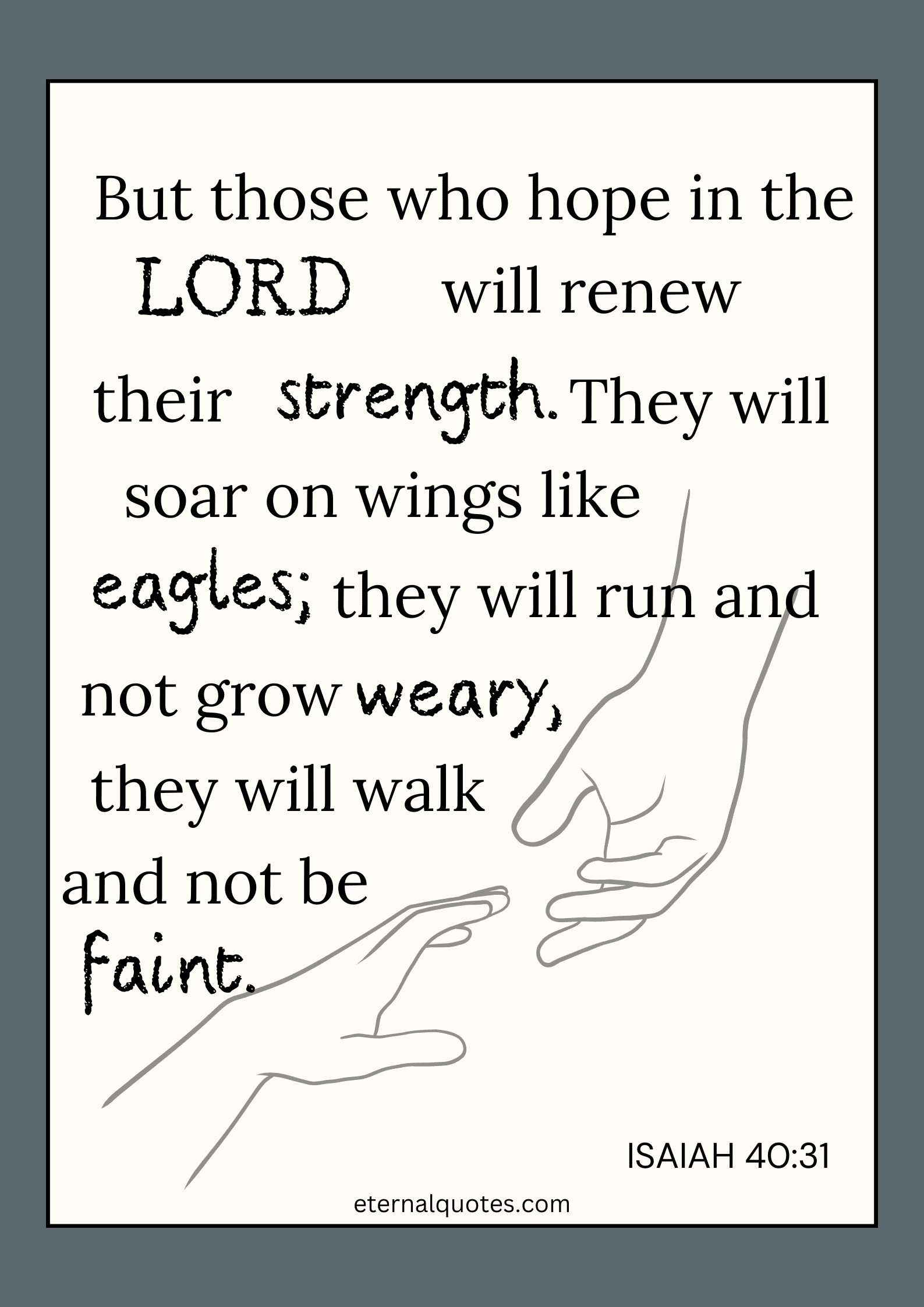
The promise not to grow weary in doing good is one of the more honest verses in this collection — because it acknowledges that weariness is real. Goodness is not effortless. Perseverance has a cost. The verse does not pretend otherwise; it simply holds out the longer view, the harvest that comes not from a single extraordinary act but from the accumulated weight of ordinary faithfulness over time.
More Quotes You May Enjoy


“Cast all your anxiety on him because he cares for you.”
1 Peter 5:7
“God is our refuge and strength, an ever-present help in trouble.”
Psalm 46:1
“No, in all these things we are more than conquerors through him who loved us.”
Romans 8:37
“The LORD gives strength to his people; the LORD blesses his people with peace.”
Psalm 29:11
“Let us not become weary in doing good, for at the proper time we will reap a harvest if we do not give up.”
Galatians 6:9
On God’s Presence, Guidance, and the Fruit of the Spirit
The assurance that you are not alone is one of the most repeated promises in Scripture, and the repetition itself is telling. It suggests that fear and the sense of abandonment are not new problems — that they have been part of human experience for as long as people have been trying to live faithfully. The answer offered is not a removal of difficulty but a presence within it: I am with you, the text says, in the middle of this, not on the other side.
The fruit of the Spirit described in Galatians is worth reading slowly, because it is not a list of achievements or virtues to be performed. It is the natural outgrowth of a life oriented toward something beyond itself — love, joy, peace, patience, kindness, goodness, faithfulness, gentleness, self-control. These qualities do not arrive through effort alone. They tend to emerge quietly, over time, as a person’s interior life settles into something more spacious.
“Fear not, for I am with you; be not dismayed, for I am your God; I will strengthen you, I will help you, I will uphold you with my righteous right hand.”
Isaiah 41:10
“Commit to the LORD whatever you do, and he will establish your plans.”
Proverbs 16:3
“Let the morning bring me word of your unfailing love, for I have put my trust in you. Show me the way I should go, for to you I entrust my life.”
Psalm 143:8
“But the fruit of the Spirit is love, joy, peace, forbearance, kindness, goodness, faithfulness, gentleness and self-control.”
Galatians 5:22-23
“The LORD your God is with you, the Mighty Warrior who saves. He will take great delight in you; in his love he will no longer rebuke you, but will rejoice over you with singing.”
Zephaniah 3:17
On Courage, Direction, and Finding Joy in Trials
Courage in the biblical sense is rarely the absence of fear — it is more often action taken despite it. The command to be strong and courageous appears throughout Scripture in contexts where the person receiving it had very good reasons to be afraid. The promise attached to it is not that everything will be easy, but that the person will not be alone in whatever comes next. That distinction matters.
The instruction to consider trials as pure joy is perhaps the most counterintuitive in the New Testament, and it deserves to be read carefully. It is not an instruction to pretend difficulty is not difficult, or to perform cheerfulness in the face of hardship. It is something narrower and more specific: an invitation to recognize that the testing of faith, as it works itself out, produces something that cannot be produced any other way. The joy is not in the trial itself but in what the trial is doing.

“Have I not commanded you? Be strong and courageous. Do not be afraid; do not be discouraged, for the LORD your God will be with you wherever you go.”
Joshua 1:9
“But seek first his kingdom and his righteousness, and all these things will be given to you as well.”
Matthew 6:33
“So do not fear, for I am with you; do not be dismayed, for I am your God.”
Isaiah 41:10
“I will instruct you and teach you in the way you should go; I will counsel you with my loving eye on you.”
Psalm 32:8
“Consider it pure joy, my brothers and sisters, whenever you face trials of many kinds.”
James 1:2
On Comfort for the Brokenhearted and Living One Day at a Time
Grief and heartbreak are not conditions that Scripture tries to argue people out of. The Psalms in particular are full of lament — raw, honest, unfiltered — and the God they address is not a God who demands composure before offering comfort. The closeness promised to the brokenhearted is not contingent on their having processed their pain correctly. It arrives in the middle of the breaking.
Worry about the future is one of the most persistently human experiences, and the instruction not to worry about tomorrow is both simple and genuinely difficult. It is not a dismissal of real concerns — it is a reorientation of attention toward what is actually available to you right now, today, in this moment. Most suffering is either about the past or the future; the present, fully inhabited, tends to be more manageable than the projections that surround it.
“The Lord is close to the brokenhearted and saves those who are crushed in spirit.”
Psalm 34:18
“Therefore do not worry about tomorrow, for tomorrow will worry about itself. Each day has enough trouble of its own.”
Matthew 6:34
“A friend loves at all times, and a brother is born for a time of adversity.”
Proverbs 17:17
“And whatever you do, whether in word or deed, do it all in the name of the Lord Jesus, giving thanks to God the Father through him.”
Colossians 3:17
“Taste and see that the LORD is good; blessed is the one who takes refuge in him.”
Psalm 34:8
On Love, Gratitude, and Being Wonderfully Made
The description of love in 1 Corinthians 13 is so well-known that it can be difficult to actually hear anymore. But read slowly, it is surprisingly demanding — not as a list of things love feels like, but as a list of things love does and does not do. Patience and kindness are active. The absence of envy and boasting is a daily choice. This is not a portrait of easy affection but of something that requires returning to, again and again, through difficult conditions.
Gratitude, in the biblical frame, is not a mood but a practice. It is something enacted regardless of circumstances — not because everything is good, but because something enduring underlies everything. The verse from Psalm 139, which locates human worth not in achievement or appearance but in the simple fact of having been made, is one of the more quietly radical claims in all of Scripture. It asks very little of you, and offers everything in return.

“Love is patient, love is kind. It does not envy, it does not boast, it is not proud.”
1 Corinthians 13:4
“Rejoice always, pray continually, give thanks in all circumstances; for this is God’s will for you in Christ Jesus.”
1 Thessalonians 5:16-18
“The grass withers and the flowers fall, but the word of our God endures forever.”
Isaiah 40:8
“Give thanks to the LORD, for he is good; his love endures forever.”
Psalm 107:1
“I praise you because I am fearfully and wonderfully made; your works are wonderful, I know that full well.”
Psalm 139:14
On Grace, Peace, and the Promise of God’s Constancy
The idea that grace is sufficient — that divine power is somehow made more fully visible through human weakness — is one of the more unexpected turns in Paul’s letters. It inverts the ordinary assumption that strength is what matters, that having it together is the condition of being used or loved. The verse does not celebrate weakness for its own sake, but it does suggest that the places where we are most undone are not necessarily the places where God is absent.
The peace offered in John 14:27 is described as distinct from the kind the world gives — and that distinction is worth sitting with. The peace the world tends to offer is circumstantial: things going well, threats receding, needs being met. The peace described here is something that holds its shape even when circumstances do not cooperate. It is not the peace of resolution but the peace of a presence that does not depend on outcomes.

“But he said to me, ‘My grace is sufficient for you, for my power is made perfect in weakness.'”
2 Corinthians 12:9
“The LORD himself goes before you and will be with you; he will never leave you nor forsake you. Do not be afraid; do not be discouraged.”
Deuteronomy 31:8
“Peace I leave with you; my peace I give you. I do not give to you as the world gives. Do not let your hearts be troubled and do not be afraid.”
John 14:27
“The LORD watches over you—the LORD is your shade at your right hand.”
Psalm 121:5
“I have told you these things, so that in me you may have peace. In this world you will have trouble. But take heart! I have overcome the world.”
John 16:33
On Seeking, Light in Darkness, and the Desires of the Heart
The invitation to ask, seek, and knock in Matthew 7 is one of the most open-ended promises in the Gospels — and also one of the most easily misread. It is not a formula for getting what you want. It is more like an encouragement toward a certain posture: one of active engagement, of not giving up, of continuing to approach even when the door has not yet opened. The asking itself is part of the relationship.
Light and darkness are among the oldest images in religious language, and they have not worn out yet because they describe something real. Darkness is not just the absence of light — it is a condition that shapes perception, that makes navigation difficult, that can feel total even when it is not. The claim that light shines in the darkness and the darkness has not overcome it is not a denial of how dark the dark can get. It is a different kind of claim: that the light was there first, and will be there last.

“Ask and it will be given to you; seek and you will find; knock and the door will be opened to you.”
Matthew 7:7
“The light shines in the darkness, and the darkness has not overcome it.”
John 1:5
“Let love and faithfulness never leave you; bind them around your neck, write them on the tablet of your heart.”
Proverbs 3:3
“Blessed are those who mourn, for they will be comforted.”
Matthew 5:4
“Delight yourself in the LORD, and he will give you the desires of your heart.”
Psalm 37:4
On Help, Hope, Forgiveness, and Perseverance
The Psalmist’s question — where does my help come from? — is one that most people know from the inside, even if they have never read the verse. It is the question asked in the middle of the night, in the middle of a crisis, when the resources you thought you had have run out. The answer given is not a strategy or a set of steps. It is simply a name, and a direction to look: upward, outward, beyond the limits of what you can arrange on your own.
Forgiveness, as Ephesians 4:32 frames it, is not primarily something you do for the other person. It is modeled on something done for you — a gift received that then becomes possible to give. That framing changes the motivation entirely. Perseverance, similarly, is not presented in James 1:12 as something admirable in itself, but as something that is going somewhere: toward a life that has been tested and held, and found worthy of what it was promised.

“I lift up my eyes to the mountains—where does my help come from? My help comes from the LORD, the Maker of heaven and earth.”
Psalm 121:1-2
“Let us hold unswervingly to the hope we profess, for he who promised is faithful.”
Hebrews 10:23
“Be kind and compassionate to one another, forgiving each other, just as in Christ God forgave you.”
Ephesians 4:32
“The LORD will fight for you; you need only to be still.”
Exodus 14:14
“Blessed is the one who perseveres under trial because, having stood the test, that person will receive the crown of life that the Lord has promised to those who love him.”
James 1:12
On Wisdom, Rejoicing, and the Love That Sent a Son
Heavenly wisdom, as James describes it, is not primarily intellectual. It is relational and ethical — pure, peace-loving, considerate, full of mercy. This is wisdom understood not as a body of knowledge but as a quality of presence: the way a person enters a room, approaches a disagreement, holds space for someone in difficulty. It is both more ordinary and more demanding than the kind of wisdom we usually admire.
John 3:16 is perhaps the most cited verse in all of Scripture, and it carries the risk of any very familiar thing — that it stops being heard. But the claim it makes is not a small one. It locates the origin of everything that follows not in law or obligation but in love: a love large enough to enter what it loves, to take on its vulnerability, to stay. Whatever your relationship to its theology, that is a significant thing to say about the nature of the universe.
“But the wisdom that comes from heaven is first of all pure; then peace-loving, considerate, submissive, full of mercy and good fruit, impartial and sincere.”
James 3:17
“This is the day that the LORD has made; let us rejoice and be glad in it.”
Psalm 118:24
“In the same way, let your light shine before others, that they may see your good deeds and glorify your Father in heaven.”
Matthew 5:16
“For God so loved the world that he gave his one and only Son, that whoever believes in him shall not perish but have eternal life.”
John 3:16
“Finally, brothers and sisters, whatever is true, whatever is noble, whatever is right, whatever is pure, whatever is lovely, whatever is admirable—if anything is excellent or praiseworthy—think about such things.”
Philippians 4:8
What It Means to Keep Returning to These Words
There is something worth noticing about the fact that people have been returning to these verses for centuries — not as a historical curiosity, but as a living resource. Generations who faced conditions very different from our own found in them something that held. That continuity is not nothing. It suggests that whatever these words are pointing at is not merely cultural or contextual but touches something persistent in human experience: the need to be held, to be guided, to not be entirely alone in the dark.
Scripture does not promise that life will be easy, and it is worth appreciating that honesty. The verses about courage acknowledge there is something to be afraid of. The verses about not growing weary acknowledge that weariness is real. The promise of comfort for those who mourn does not argue that mourning is unnecessary. This is not a collection of feel-good aphorisms; it is something more honest than that — a body of language that has been tested in difficult conditions and has not dissolved.
Faith, as these passages collectively understand it, is not a static thing. It is something practiced — in the daily choice to pray rather than spiral, to trust rather than grasp, to let one day be enough without loading it with the weight of all the ones that follow. None of this is easy to sustain. But it is a practice, which means it can be returned to even after it has been dropped, which means there is always a way back in.
The instruction in Philippians 4:8 — to direct the mind toward what is true, noble, right, pure, lovely, admirable — is perhaps the most practical in this collection. It is not asking for a particular emotion or a particular belief. It is asking for an orientation of attention: toward what is real and good, rather than toward what is feared or resented. That choice, made repeatedly over time, does something to a person. It quietly reshapes what they notice, and what they become.
There is a kind of rest described in these pages that is not the rest of having nothing left to do. It is the rest that comes from having handed something over — from having, at least for a moment, stopped trying to carry everything alone. That rest is available not once a life is sorted out, but in the middle of its being unsorted. It does not wait for resolution. It arrives, when it arrives, as a kind of grace: unearned, unexplained, and real.
Whatever brings you back to these words — habit, or crisis, or simple curiosity — they will meet you where you are. They have been doing that for a very long time. You do not need to have everything figured out to find something useful here. You do not need to be at your best. The verses about the brokenhearted, about the weary, about those who mourn and those who are afraid — they were written for exactly the moments when you feel least equipped to receive them. That is when they tend to do the most.